

ETFdb Logo
  • ETF Database
  • Content Hubs
    • Themes
      • Active ETF
      • Alternatives
      • Artificial Intelligence
      • China Insights
      • Core Strategies
      • Crypto
      • Disruptive Technology
      • Energy Infrastructure
      • ETF Building Blocks
      • ETF Investing
      • ETF Strategist
      • Financial Literacy
      • Fixed Income
      • Free Cash Flow
      • Future ETFs
      • Innovative ETFs
      • Institutional Income Strategies
      • Leveraged & Inverse
      • Market Insights
      • Market Outlooks
      • Modern Alpha
      • Nuclear Energy
      • Portfolio Strategies
      • Sector Investing
      • Tax Efficient Income
      • Thematic Investing
    • Asset Class
      • Equity
        • U.S. Equity
        • Int'l Developed
        • Emerging Market Equities
      • Alternatives
        • Gold/Silver/Critical Materials
        • Cryptocurrency
        • Currency
        • Volatility
      • Fixed Income
        • Investment Grade Corporates
        • US Treasuries & TIPS
        • High Yield Corporates
        • Int'l Fixed Income
    • ETF Ecosystem
    • ETFs in Canada
    • Market Outlook
    • Crypto ETF Hub
  • Tools
    • ETF Screener
    • ETF Country Exposure Tool
    • ETF Database Categories
    • Indexes
    • Scenario Analysis
    • Watchlists
    • Head-To-Head ETF Comparison Tool
    • Mutual Fund To ETF Converter
    • ETF Stock Exposure Tool
    • ETF Issuer Fund Flows
  • Research
    • ETF Education
    • Equity Investing
    • Dividend ETFs
    • Leveraged ETFs
    • Inverse ETFs
    • Index Education
    • Index Insights
    • Top ETF Sectors
    • Top ETF Issuers
    • Top ETF Industries
  • Webcasts
  • Sectors
    • Sector Investing Content Hub
    • XLK
    • XLI
    • XLU
    • XLY
    • XLP
    • XLRE
    • Sector Power Rankings
    • XLE
    • XLC
    • XLF
    • XLV
    • XLB
  • Multimedia
    • ETF 360 Video Series
    • ETF of the Week Podcast
    • Gaining Perspective Podcast
    • ETF Prime Podcast
    • Video
  • Company
    • About VettaFi
  • PRO
    • Pro Content
    • Pro Tools
    • Advanced
    • FAQ
    • Free sign up
    • Login
  1. ETF Education Content Hub
  2. Building a Better Bond ETF with Invesco’s ‘PHB’
ETF Education Content Hub
Share

Building a Better Bond ETF with Invesco's 'PHB'

Tom LydonFeb 10, 2021
2021-02-10

Yields on high-yield corporate debt are declining and underscoring the importance of emphasizing fundamentals. There’s an exchange traded fund for that: the Invesco Fundamental High Yield® Corporate Bond ETF (PHB B).

The Invesco Fundamental High Yield® Corporate Bond ETF (Fund) is based on the RAFI® Bonds US High Yield 1-10 Index (Index). The Fund will generally invest at least 80% of its total assets in the securities that comprise the Index. The Index is comprised of US dollar-denominated high yield corporate bonds that are SEC-registered securities or Rule 144A securities with registration rights and whose issuers are public companies listed on a major US stock exchange.

Only investible non-convertible, non-exchangeable, non-zero, fixed coupon high-yield corporate bonds qualify for inclusion in the Index. Based on the Fundamental Index® methodology developed by Research Affiliates, LLC, the Index is compiled and calculated by ALM Research Solutions, LLC. The Fund and the Index are rebalanced monthly and reconstituted annually in March.

“The average yield on U.S. junk bonds dropped below 4% for the first time ever as investors seeking a haven from ultra-low interest rates keep piling into an asset class historically known for its high yields,” reports Carolina Gonzalez for Bloomberg. “The measure for the Bloomberg Barclays U.S. Corporate High-Yield index dipped to 3.96% on Monday evening, making it six straight sessions of declines.”
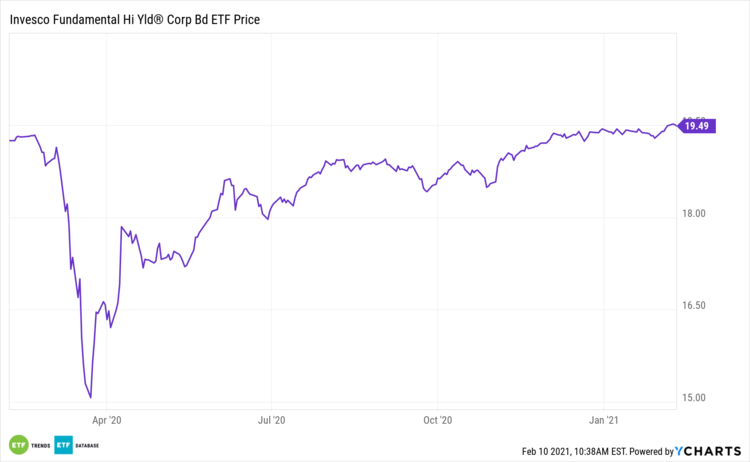
PHB 1 Year Performance

Why Go with PHB?

With its unique scoring methodology, PHB offers investors a potentially better mousetrap for junk bonds, especially for those investors seeking long-term, yield-bearing allocations.

“Yield-hungry investors have been gobbling up junk bonds as an alternative to the meager income offered in less-risky bond markets. Demand for the debt has outweighed supply by so much that some money managers are even calling companies to press them to borrow instead of waiting for deals to come their way. A majority of new issues, even those rated in the riskiest CCC tier of junk, have been hugely oversubscribed,” according to Bloomberg.

PHB’s emphasizes quality high-yield corporate bonds. PHB, which tracks the RAFI Bonds US High Yield 1-10 Index, tilts towards slightly higher quality corporate debt securities than its major competitors. The ETF features no exposure to CCC-rated bonds. Three-quarters of PHB’s holdings are rated BBB or BB.

“Some see continued outperformance from the junkiest part of the market. CCCs, which have accounted for a significant chunk of recent supply, may be one of the best parts of credit this year, according to David Norris, head of U.S. credit at TwentyFour Asset Management,” concludes Bloomberg.

For more news, information, and strategy, visit the ETF Education Channel.


Content continues below advertisement

Loading Articles...

Advertisement

Is Your Portfolio Positioned With Enough Global Exposure?

ETF Education Channel

How to Allocate Commodities in Portfolios

Tom LydonApr 26, 2022
2022-04-26

A long-running debate in asset allocation circles is how much of a portfolio an investor should...

Core Strategies Channel

Why ETFs Experience Limit Up/Down Protections

Karrie GordonMay 13, 2022
2022-05-13

In a digital age where information moves in milliseconds and millions of participants can transact...

}
X
