

ETFdb Logo
  • ETF Database
  • Content Hubs
    • Themes
      • Active ETF
      • Alternatives
      • Artificial Intelligence
      • China Insights
      • Core Strategies
      • Crypto
      • Disruptive Technology
      • Energy Infrastructure
      • ETF Building Blocks
      • ETF Investing
      • ETF Strategist
      • Financial Literacy
      • Fixed Income
      • Free Cash Flow
      • Future ETFs
      • Innovative ETFs
      • Institutional Income Strategies
      • Leveraged & Inverse
      • Market Insights
      • Market Outlooks
      • Modern Alpha
      • Nuclear Energy
      • Portfolio Strategies
      • Sector Investing
      • Tax Efficient Income
      • Thematic Investing
    • Asset Class
      • Equity
        • U.S. Equity
        • Int'l Developed
        • Emerging Market Equities
      • Alternatives
        • Gold/Silver/Critical Materials
        • Cryptocurrency
        • Currency
        • Volatility
      • Fixed Income
        • Investment Grade Corporates
        • US Treasuries & TIPS
        • High Yield Corporates
        • Int'l Fixed Income
    • ETF Ecosystem
    • ETFs in Canada
    • Market Outlook
    • Crypto ETF Hub
  • Tools
    • ETF Screener
    • ETF Country Exposure Tool
    • ETF Database Categories
    • Indexes
    • Scenario Analysis
    • Watchlists
    • Head-To-Head ETF Comparison Tool
    • Mutual Fund To ETF Converter
    • ETF Stock Exposure Tool
    • ETF Issuer Fund Flows
  • Research
    • ETF Education
    • Equity Investing
    • Dividend ETFs
    • Leveraged ETFs
    • Inverse ETFs
    • Index Education
    • Index Insights
    • Top ETF Sectors
    • Top ETF Issuers
    • Top ETF Industries
  • Webcasts
  • Sectors
    • Sector Investing Content Hub
    • XLK
    • XLI
    • XLU
    • XLY
    • XLP
    • XLRE
    • Sector Power Rankings
    • XLE
    • XLC
    • XLF
    • XLV
    • XLB
  • Multimedia
    • ETF 360 Video Series
    • ETF of the Week Podcast
    • Gaining Perspective Podcast
    • ETF Prime Podcast
    • Video
  • Company
    • About VettaFi
    • Get VettaFi’ed
  • PRO
    • Pro Content
    • Pro Tools
    • Advanced
    • FAQ
    • Free sign up
    • Login
  1. ETF Education Content Hub
  2. This ETF Does Not Change Its Spots
ETF Education Content Hub
Share

This ETF Does Not Change Its Spots

Tom LydonMar 01, 2021
2021-03-01

Most passive index funds don’t have high turnover ratios, but when a fund sports a specific objective – say low volatility – some changes in holdings are to be expected.

It may be of note that following its recent rebalance, the Invesco S&P 500 Low Volatility ETF (SPLV A+) didn’t experience much in the way of change.

SPLV seeks to invest at least 90% of its total assets in common stocks that comprise the Index. The Index is compiled, maintained, and calculated by Standard and Poor’s and consists of the 100 stocks from the SP 500 Index with the lowest realized volatility over the past 12 months.

Volatility is a statistical measurement of the magnitude of up and down asset price fluctuations over time. The Fund and the Index are rebalanced and reconstituted quarterly in February, May, August, and November.

“The Low Vol index rebalanced after the market’s close on Feb. 19, 2021; not much changed. With the lowest turnover in the history of the index, six names cycled out, accounting for about 5% of the index,” according to S&P Dow Jones Indices. “The biggest change was in Health Care, which gave up 3% of its weight. The slack was mostly offset by Information Technology. Real Estate lost a bit of ground as Industrials added about 1%. All other sectors held steady.”
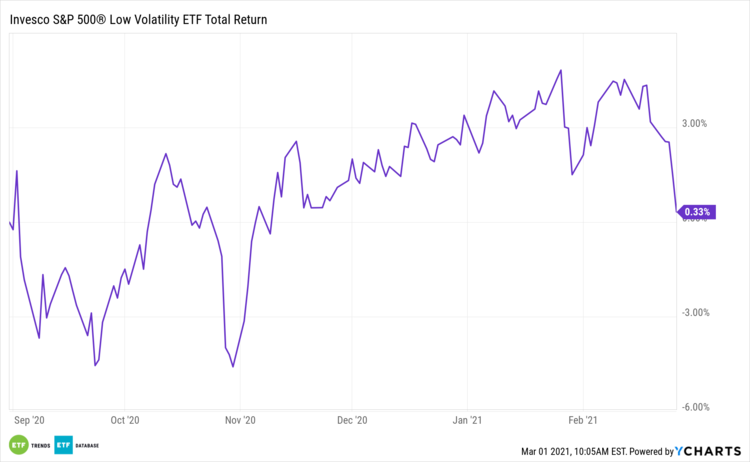
SPLV 6 Month Performance

The Low Volatility Methodology

One of the primary objectives of low volatility ETFs such as SPLV isn’t to capture all of a bull market’s upside, but rather to capture less downside when markets swoon. What that means is that a fund such as SPLV, if behaving as expected, won’t be immune from equity market retrenchment when stocks decline, but it will fall less during rough periods.

“Dynamics in sectors provide us with some insight into what drove the changes in the latest rebalance. While volatility remains elevated, similar to the November 2020 rebalance, it continues to decline. Importantly, volatility declined by a similar proportion across all sectors, which explains the minimal turnover in the latest rebalance,” notes S&P Dow Jones.

Low volatility factor investments work on the idea that they help cushion against market turns, limiting drawdowns that investors experience while providing upside potential. Consequently, the low- or min-vol strategies may produce better risk-adjusted returns over the long haul, a notion has been backed by extensive academic research.

For more news, information, and strategy, visit the ETF Education Channel.


Content continues below advertisement

Loading Articles...

Advertisement

Is Your Portfolio Positioned With Enough Global Exposure?

ETF Education Channel

How to Allocate Commodities in Portfolios

Tom LydonApr 26, 2022
2022-04-26

A long-running debate in asset allocation circles is how much of a portfolio an investor should...

Core Strategies Channel

Why ETFs Experience Limit Up/Down Protections

Karrie GordonMay 13, 2022
2022-05-13

In a digital age where information moves in milliseconds and millions of participants can transact...

}
X
