


Options-based strategies remain popular with equity investors in a year of ongoing market volatility and uncertainty. Advisors and investors need look no further than the recently launched Fidelity options-based ETFs for their equity investing needs.
In the last several years, increased correlations between stocks and bonds proved challenging for traditional portfolios that relied on fixed income exposures to hedge against equity drawdowns. This prompted some investors to seek alternatives for diversification beyond just stocks and bonds. And this contributed to the rise in popularity of liquid alternative strategies and options-based strategies.
Fidelity offers three different actively managed ETFs that pair options with broad market equity exposures. The three recently launched funds allow investors to maintain equity exposure while seeking to enhance their portfolio’s risk/return profile with either defensive or income-oriented strategies.
Looking at Drawdowns
Investors may potentially underestimate the longer-term costs of significant market drawdowns. A drawdown of roughly 50%, like that during the Global Financial Crisis of 2008, required 100% returns and nearly three years to recuperate losses. That’s according to Mitch Livestone, PhD, CFA, CIO, Arbitrage and Hedging Solutions at Fidelity Investments; Eric Granat, CAIA, PM/Derivative Analyst at Fidelity Investments; and Sladja Carton, Institutional PM, Liquid Alternatives at Fidelity Investments, in a Fidelity white paper.
“Reducing the large drawdown scenarios allows investors to have the psychological fortitude to stay invested in the markets and to continue to compound returns over the long run, when their instincts may be to sell (usually near the bottom),” the authors explained. “We believe that a strategic allocation to defensive options strategies can effectively tackle this issue given that timing the market is virtually impossible and may result in additional trading costs.”
Fidelity’s most recently launched actively managed ETFs utilize options in several ways to pursue their various strategies. Choosing the strategy that most aligns with the customer’s objective may allow investors to position each fund optimally within their portfolios to complement or enhance existing equity allocations.
Underlying each of the new Fidelity options-based ETFs is a common core U.S. equity strategy that seeks to outperform the S&P 500 Index. This equity strategy leverages a multifactor model to help select companies with desirable fundamental characteristics, including attractive valuations and strong quality metrics. The portfolio construction aims to keep the fund’s risk characteristics similar to those of the S&P 500 benchmark. Each ETF combines this core equity portfolio with a distinct options-based overlay, seeking to add defensiveness or enhance yield.
Defensive Equity Positioning
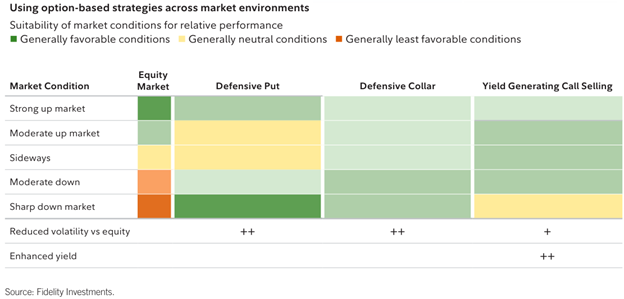
The Fidelity Dynamic Buffered Equity ETF (FBUF ) combines the equity portfolio with call-writing and put-buying strategies to create a dynamic “collar” overlay. This collar overlay entails buying long put options to seek to create downside protection. At the same time, the fund sells index call options to generate premiums to offset the cost of the puts. This allows investors to seek a level of downside protection at the cost of some upside potential. Collar option strategies often perform best in moderately up or down market environments. FBUF carries a net expense ratio of 0.48%.
Seeking Downside Protection With Greater Potential Upside Participation
The Fidelity Hedged Equity ETF (FHEQ ) aims to protect against sudden and meaningful market drawdowns, while still participating in sharp market rallies, by buying put options at various expiries and strikes. Because this strategy strictly buys protection, it may lag the market if there is low volatility or the market moves sideways. FHEQ carries a net expense ratio of 0.48%.
Equity Investing with Options Income
The Fidelity Yield Enhanced Equity ETF (FYEE ) seeks to deliver an attractive distribution yield by harvesting option premia from dynamic covered call writing. To generate this potential yield, the fund writes call options on the S&P 500® index. These calls generate additional premiums above what just equity dividends alone would provide but cap the underlying equities’ upside potential above the call strike price. Call-writing strategies generally offer optimal performance in sideways and range-bound markets. FYEE carries a net expense ratio of 0.28%.
For more news, information, and analysis, visit the ETF Investing Channel.
Fidelity Investments® is an independent company, unaffiliated with VettaFi. There is no form of legal partnership, agency affiliation, or similar relationship between VettaFi and Fidelity Investments. Nor is such a relationship created or implied by the information herein. Fidelity Investments has not been involved with the preparation of the content supplied by VettaFi. It does not guarantee, or assume any responsibility for its content.
1151079.1.0

