


The current U.S. stock market presents a complex landscape for investors with major indices trading at all-time highs and raising legitimate concerns about broad market valuations. A recent Goldman Sachs report suggests that the S&P 500 Index may deliver only modest returns by averaging approximately 3% annually over the next decade. While this projection might seem discouraging, it also unveils a critical insight: not all stocks are created equal, and strategic investors can still identify compelling opportunities beneath the surface of market-wide averages.
The key to navigating this environment lies in a nuanced approach that moves beyond headline index performance. By dissecting market valuations across different styles, sectors, and weighting methodologies, investors can uncover pockets of potential value that remain overlooked by broader market sentiment.
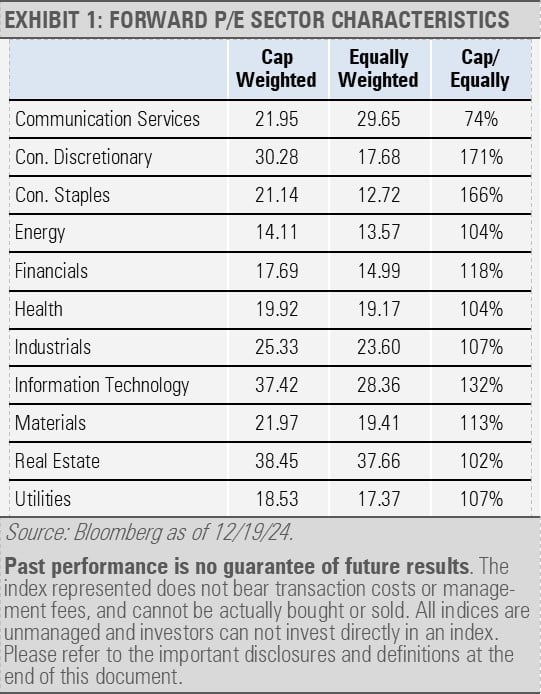
One of the most striking revelations is the significant valuation disparity between market-cap weighted and equally-weighted indices. The S&P 500 Index is currently trading at a nearly 30% premium to its equally-weighted counterpart when comparing forward 12-month price-to-earnings (PE) ratios. This discrepancy is particularly pronounced in sectors like consumer discretionary, consumer staples, and information technology where the largest companies command substantially higher valuations.
This valuation phenomenon is largely driven by the concentration of market capitalization within a handful of top performers. Just ten stocks currently represent approximately 34% of the S&P 500 Index, which effectively skews the overall market’s valuation metrics. While these companies are undoubtedly world-class businesses, the premium investors are paying may not necessarily reflect proportional future growth potential.
Savvy investors can leverage this insight by exploring opportunities in equally-weighted strategies or by focusing on high-quality companies that have been overshadowed by mega-cap titans. The equally-weighted S&P 500 Index is trading at valuation levels comparable to international indices, which suggests significant potential for value discovery within the U.S. market.
Sector-specific analysis reveals additional nuances. Consumer discretionary, consumer staples, and information technology show forward PE ratios at least 30% higher in their cap-weighted versions compared to equally-weighted counterparts. This doesn’t necessarily mean these sectors are unattractive, but it does indicate that investors may want to look beyond the largest components to find compelling investment opportunities.
Importantly, all companies included in major indices like the S&P 500 Index must pass rigorous quality earnings screens. This means that the “cheaper” stocks are not necessarily lower-quality businesses, but rather companies that have been less impacted by the current market momentum driving mega-cap valuations.
Investment strategies to consider include:
- Equally-weighted index funds that provide more balanced exposure to market constituents;
- Sector-specific ETFs with equal weighting;
- Targeted stock selection focusing on high-quality companies trading at more reasonable valuations; and
- Value-oriented approaches that prioritize fundamental financial strength over market capitalization.
While the broader market may face challenges in delivering exceptional returns, the current environment offers discerning investors multiple avenues for potential growth. The key is to look beyond headline indices, understand valuation nuances, and maintain a disciplined, research-driven approach to portfolio construction. The current market does not represent a lost opportunity, but rather a landscape rich with investment possibilities for active investors willing to look beyond surface-level metrics and conduct thorough, nuanced analysis.
For more news, information, and analysis, visit the ETF Strategist Channel.
DISCLOSURES
Any forecasts, figures, opinions or investment techniques and strategies explained are Stringer Asset Management, LLC’s as of the date of publication. They are considered to be accurate at the time of writing, but no warranty of accuracy is given and no liability in respect to error or omission is accepted. They are subject to change without reference or notification. The views contained herein are not be taken as an advice or a recommendation to buy or sell any investment and the material should not be relied upon as containing sufficient information to support an investment decision. It should be noted that the value of investments and the income from them may fluctuate in accordance with market conditions and taxation agreements and investors may not get back the full amount invested.
Past performance and yield may not be a reliable guide to future performance. Current performance may be higher or lower than the performance quoted.
The securities identified and described may not represent all of the securities purchased, sold or recommended for client accounts. The reader should not assume that an investment in the securities identified was or will be profitable.
Data is provided by various sources and prepared by Stringer Asset Management, LLC and has not been verified or audited by an independent accountant.
Index Definitions:
The S&P 500 Index is a capitalization-weighted index of 500 stocks. The Index is designed to measure performance of a broad domestic economy through changes in the aggregate market value of 500 stocks representing all major industries. The S&P 500 Communication Services Index is capitalization-weighted and is designed to measure the telecommunication services sector of the S&P 500 Index. The S&P 500 Consumer Discretionary Index is capitalization-weighted and is designed to measure the consumer discretionary sector of the S&P 500 Index. The S&P 500 Consumer Staples Index is capitalization-weighted and is designed to measure the consumer staples sector of the S&P 500 Index. The S&P 500 Energy Index is capitalization-weighted and is designed to measure the energy sector of the S&P 500 Index. The S&P 500 Financials Index is capitalization-weighted and is designed to measure the financial sector of the S&P 500 Index. The S&P 500 Health Care Index is capitalization-weighted and is designed to measure the health care sector of the S&P 500 Index. The S&P 500 Industrials Index is capitalization-weighted and is designed to measure the industrial sector of the S&P 500 Index. The S&P 500 Information Technology Index is capitalization-weighted and is designed to measure the information technology sector of the S&P 500 Index. The S&P 500 Materials Index is capitalization-weighted and is designed to measure the materials sector of the S&P 500 Index. The S&P 500 Real Estate Index is capitalization-weighted and is designed to measure the real estate sector of the S&P 500 Index. The S&P 500 Utilities Index is capitalization-weighted and is designed to measure the utilities sector of the S&P 500 Index. Equally-Weighted variations of the same indices are also used in the comparisons.

