


SUMMARY
- Declining money market yields make sitting in cash increasingly costly.
- Treasuries offer attractive real yields and lower volatility than equities.
- Strong equity gains create an opportunity to rebalance into bonds.
The Alternative to Cash and Higher Portfolio Risk
Now that the book has been closed on the first half of 2026 – a period propelled by the AI-driven technology trade – investors are searching for what to do next. For those investors that have ridden the stock market up to near all-time highs, they may be thinking about reducing their equity exposure and adding fixed income to their portfolio. Others that have sat paralyzed on the sidelines, looking for the right time to enter the market, may simply want their money to work for them. We will walk through how both types of investors should view bonds moving forward.
Investors Sitting in Cash are Facing Declining Money Market Rates
For the investor that has been sitting in cash, the last few years have been manageable due to money market funds paying competitive rates. Prior to 2022, money market rates were pinned near zero, so there was an incentive for investors to allocate to equities. Post-2022, after interest rates moved higher, some conservative investors sold stocks and retreated to the sidelines as they were able to receive yields just above 5% in money market funds. However, since peaking in 2023, money market fund yields have steadily declined… and currently are just below 3.50%. Investors that choose to stay in cash will face further reinvestment risk if money market yields continue to decline.
According to the St. Louis Federal Reserve Bank, at the end of Q1 there was over $8.2 trillion held in money market funds, as shown in Chart 1. The steady decline in money market yields should be a call to action for investors sitting in cash and cash equivalents, in our opinion.
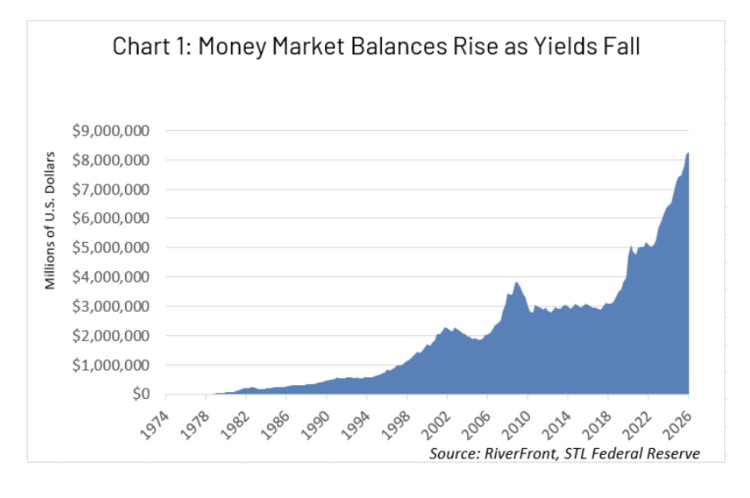
From our perspective, despite the Fed currently taking a ‘hawkish’ tone to fight inflation, we do not believe that they will hike interest rates in 2026. The upward movement of yields since the beginning of the Iran War has tightened financial conditions for all bond maturities from two to thirty years (the yield curve). For conservative investors that are in cash and cash equivalents, the focus should be on the front-end of the yield curve, as it is more sensitive to changes in monetary policy that impact money market fund rates.
Currently, the 2-year Treasury is yielding 4.21%, which is 0.83% higher than where it was at the end of February… while money market yields have only fallen further. By investing in short-term bonds, investors that have been risk-adverse can gradually re-enter the market without meaningfully changing their risk profile.
Equity Rally Did Heavy Lifting; Now Fixed Income Can Help Ease the Load
Reflecting on our 2026 Outlook entitled Riding the Wave: The Anatomy of Booms & Bubbles, our base case forecast for the year was for the S&P 500 to return between 8 and 12%, and the 10-year Treasury to yield 4.20%. Through the first half of the year, the S&P 500 returned just over 10% and the 10-year Treasury was yielding 4.47%. Therefore, while the equity market is on pace to exceed our base case forecast, treasuries have underachieved…leaving potentially some room for capital appreciation in the 2nd half of the year should risk appetite decrease. In our view, the 10-year Treasury is giving investors a better opportunity to enhance the total return in a balanced portfolio due to higher yields and a lower volatility profile than its equity alternatives.
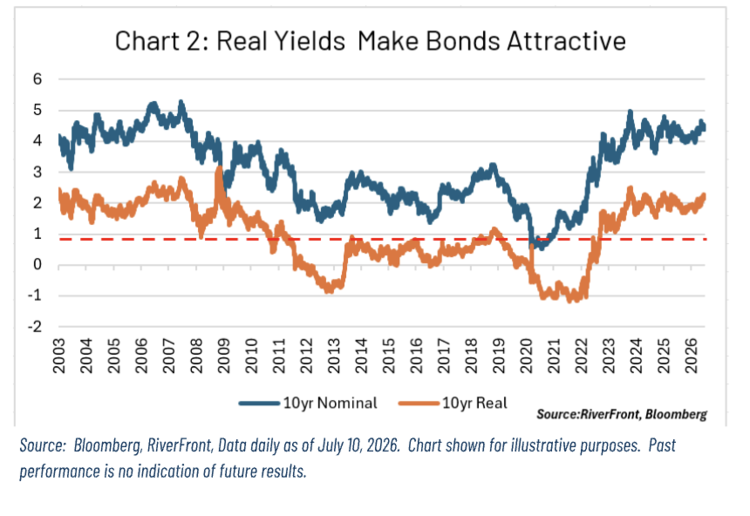
As we wrote in our fixed income-focused Weekly View in May, we believe that fair value on the 10-year Treasury is around 4.3%, making investing at higher yields attractive. Additionally, real’ yields (yields adjusted for inflation) remain above 2%, after averaging nearly 1% over the last 23 years (Chart 2, right). Given that equities did a lot of heavy lifting in the first half of the year, it would make sense that balanced investors that have ‘ridden the wave’ in stocks would consider reducing their equity exposure to dial down the level of risk in their portfolios. Furthermore, these investors can move up in priority in the capital structure as they shift from stocks to bonds, as interest payments will be prioritized over dividends or stock buybacks if the economic circumstances deteriorate.
Conclusion: Why We're Looking to Add Bonds Here
Bonds offer value on two fronts: they can help de-risk balanced portfolios after a strong first-half equity rally, and they provide a compelling alternative for investors still parked in cash. Whether viewed through the lens of ETFs or individual bonds, we believe the asset class is attractive — particularly the short end of the yield curve, where 1-to-5-year Treasuries yield between 4% and 4.30%. Investors willing to take on credit risk can pick up an additional 0.50% by moving into corporate bonds. We would avoid longer maturities at this time, given inflationary pressures from higher oil prices driven by the Middle East conflict. That said, if the 10-year Treasury rises above 4.75%, we would view that as a buying opportunity. As we are currently underweight fixed income, we are actively looking for opportunities in our shorter-horizon portfolios to add bond exposure and enhance income generation.
For more news, information, and analysis, visit the ETF Strategist Content Hub.
Risk Discussion: All investments in securities, including the strategies discussed above, include a risk of loss of principal (invested amount) and any profits that have not been realized. Markets fluctuate substantially over time, and have experienced increased volatility in recent years due to global and domestic economic events. Performance of any investment is not guaranteed. In a rising interest rate environment, the value of fixed-income securities generally declines. Diversification does not guarantee a profit or protect against a loss. Investments in international and emerging markets securities include exposure to risks such as currency fluctuations, foreign taxes and regulations, and the potential for illiquid markets and political instability. Please see the end of this publication for more disclosures.
Important Disclosure Information
The comments above refer generally to financial markets and not RiverFront portfolios or any related performance. Opinions expressed are current as of the date shown and are subject to change. Past performance is not indicative of future results and diversification does not ensure a profit or protect against loss. All investments carry some level of risk, including loss of principal. An investment cannot be made directly in an index.
Information or data shown or used in this material is for illustrative purposes only and was received from sources believed to be reliable, but accuracy is not guaranteed.
This report does not provide recipients with information or advice that is sufficient on which to base an investment decision. This report does not take into account the specific investment objectives, financial situation or need of any particular client and may not be suitable for all types of investors. Recipients should consider the contents of this report as a single factor in making an investment decision. Additional fundamental and other analyses would be required to make an investment decision about any individual security identified in this report.
Chartered Financial Analyst is a professional designation given by the CFA Institute (formerly AIMR) that measures the competence and integrity of financial analysts. Candidates are required to pass three levels of exams covering areas such as accounting, economics, ethics, money management and security analysis. Four years of investment/financial career experience are required before one can become a CFA charterholder. Enrollees in the program must hold a bachelor’s degree.
All charts shown for illustrative purposes only. Technical analysis is based on the study of historical price movements and past trend patterns. There are no assurances that movements or trends can or will be duplicated in the future.
Stocks represent partial ownership of a corporation. If the corporation does well, its value increases, and investors share in the appreciation. However, if it goes bankrupt, or performs poorly, investors can lose their entire initial investment (i.e., the stock price can go to zero). Bonds represent a loan made by an investor to a corporation or government. As such, the investor gets a guaranteed interest rate for a specific period of time and expects to get their original investment back at the end of that time period, along with the interest earned. Investment risk is repayment of the principal (amount invested). In the event of a bankruptcy or other corporate disruption, bonds are senior to stocks. Investors should be aware of these differences prior to investing.
In general, the bond market is volatile, and fixed income securities carry interest rate risk. (As interest rates rise, bond prices usually fall, and vice versa). This effect is usually more pronounced for longer-term securities). Fixed income securities also carry inflation risk, liquidity risk, call risk and credit and default risks for both issuers and counterparties. Lower-quality fixed income securities involve greater risk of default or price changes due to potential changes in the credit quality of the issuer. Foreign investments involve greater risks than U.S. investments, and can decline significantly in response to adverse issuer, political, regulatory, market, and economic risks. Any fixed-income security sold or redeemed prior to maturity may be subject to loss.
Investing in foreign companies poses additional risks since political and economic events unique to a country or region may affect those markets and their issuers. In addition to such general international risks, the portfolio may also be exposed to currency fluctuation risks and emerging markets risks as described further below.
Changes in the value of foreign currencies compared to the U.S. dollar may affect (positively or negatively) the value of the portfolio’s investments. Such currency movements may occur separately from, and/or in response to, events that do not otherwise affect the value of the security in the issuer’s home country. Also, the value of the portfolio may be influenced by currency exchange control regulations. The currencies of emerging market countries may experience significant declines against the U.S. dollar, and devaluation may occur subsequent to investments in these currencies by the portfolio.
Foreign investments, especially investments in emerging markets, can be riskier and more volatile than investments in the U.S. and are considered speculative and subject to heightened risks in addition to the general risks of investing in non-U.S. securities. Also, inflation and rapid fluctuations in inflation rates have had, and may continue to have, negative effects on the economies and securities markets of certain emerging market countries.

