


Investors and market pundits have been arguing that today’s market is similar to the late 1990s. Investors see a handful of dominant technology stocks surging higher, artificial intelligence driving euphoric sentiment, and comparisons to the 1996-1999 dot-com melt-up becoming increasingly common.
On the surface, the analogy makes sense. A few select stocks are leading the market, valuations are expanding, retail enthusiasm is back, and investors once again believe technology can solve nearly every economic problem.
But investors are comparing today to the wrong decade. The better historical analog is not the late 1990s. It is the 1970s.
That distinction matters enormously because the 1970s were defined by structurally higher inflation (just like today), rising interest rates (just like today), commodity leadership (just like today although nobody wants to admit it), and repeated waves of inflation (just like today) that forced investors to rethink portfolio construction entirely.
In Astoria’s view, today’s environment increasingly resembles that backdrop.
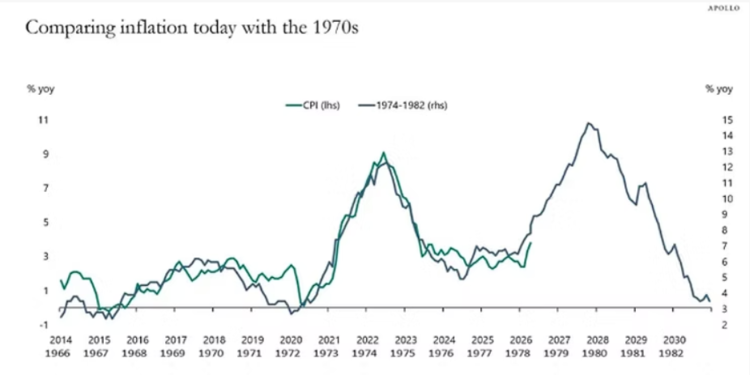
Inflation expectations have climbed to their highest level in four years, while CPI and PPI have begun accelerating again. The recent rise in producer prices and sticky services inflation suggest inflation may not smoothly glide back toward the Fed’s 2% target. Instead, inflation appears to be following a pattern eerily similar to the inflation cycles of the 1970s.
The chart below from Apollo comparing current inflation trends with the 1970s analog is particularly striking. The pattern is no longer just a theoretical concern. After the initial inflation spike subsided, many investors believed the problem had been solved in the 1970s, only to watch inflation surge again in a second and more painful wave. The current cycle increasingly looks similar.
The 10-year Treasury yield recently surpassed 4.5%, historically a difficult level for equities. There is also a deeply negative correlation between equity performance and rising rates today, particularly as markets push expected Fed cuts further into the future.
Today’s environment is one where inflation-sensitive assets are quietly outperforming beneath the surface. While investors remain obsessed with AI and the Magnificent Seven, real assets have become some of the best-performing areas of the market in the past 6 years. Commodities, natural resources, and inflation sensitive equities are significantly outperforming broader markets year-to-date.
Importantly, this does not mean technology stocks must collapse. In fact, secular growth and AI beneficiaries can continue performing well. But investors are making a critical mistake by building portfolios as though inflation and rates no longer matter.
Investors should not position exclusively for a 1999-style speculative boom. They should prepare for a world where inflation remains structurally higher, rates stay elevated longer than expected, and leadership broadens beyond a narrow group of technology companies.
The winners of the next decade may not simply be the fastest-growing software companies. They may also include energy, commodities, industrials, infrastructure, and real assets that benefit from persistent inflation and supply-side constraints. History rarely repeats perfectly. But it often rhymes. And right now, the market sounds a lot more like 1970s than the late 1990s.
This week, Astoria’s John Davi was interviewed by the CNBC where he talked about sticky inflation and portfolio construction. Watch the interview here:
Originally posted on Astoria Advisors
For more news, information, and analysis, visit the ETF Strategist Content Hub.
Important Information
There are no warranties implied. Past performance is not indicative of future results. Information presented herein is for educational purposes only and does not intend to make an offer or solicitation for the sale or purchase of any specific securities, investments, or investment strategies. Investments involve risk and, unless otherwise stated, are not guaranteed.
This information contained herein has been prepared by Astoria Portfolio Advisors LLC on the basis of publicly available information, internally developed data, and other third-party sources believed to be reliable. Astoria Portfolio Advisors LLC has not sought to independently verify information obtained from public and third-party sources and makes no representations or warranties as to the accuracy, completeness, or reliability of such information. Astoria Portfolio Advisors LLC is a registered investment adviser located in New York. Astoria Portfolio Advisors LLC may only transact business in those states in which it is registered or qualifies for an exemption or exclusion from registration requirements.
FOR FINANCIAL PROFESSIONAL USE ONLY. NOT FOR PUBLIC DISTRIBUTION.
Past performance is not indicative of future results.

