


Last week, U.S. Federal Reserve (Fed) Chair Kevin Warsh held his first press conference following the Federal Open Market Committee (FOMC) meeting. While the Committee’s decision to leave interest rates unchanged was widely expected, investors were focused on what the new Chair’s remarks would reveal about the future direction of monetary policy and the institution itself. Warsh emphasized the Fed’s commitment to its 2% inflation target and signaled a reduced reliance on forward guidance. Beyond policy, he outlined an ambitious agenda to modernize the Fed by announcing a series of task forces aimed at reviewing everything from communications practices to data collection and analysis. Together, these initiatives suggest that Warsh’s tenure could be defined as much by institutional reform as by monetary policy, with a focus on reshaping how the Fed operates, communicates, and adapts to an evolving economy.
The June FOMC meeting produced few surprises for investors. The Committee left the federal funds target range unchanged at 3.50% to 3.75%, while their updated Summary of Economic Projections showed a modest upward shift in the median policy path that suggests participants now expect a small rate increase by year-end. Persistent inflation pressures, exacerbated by rising energy prices following the conflict with Iran, continue to complicate the case for policy easing. From a fixed income perspective, the market appears to have largely anticipated this outcome. Bond returns have been relatively muted year-to-date, which reflects expectations that the Fed would remain on hold and potentially maintain a tightening bias. Inflation expectations tell a similar story. TIPS breakeven spreads had already been elevated before geopolitical tensions pushed oil prices upward, suggesting investors remain concerned that inflation could prove more persistent than previously expected.
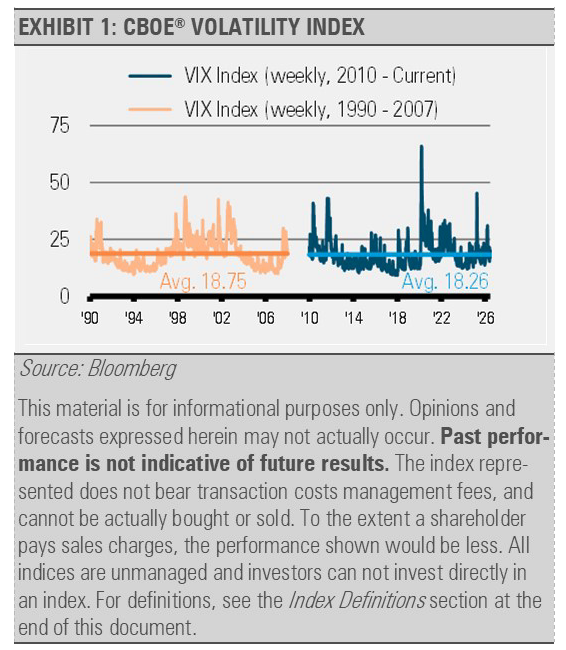
Meaningful changes may be coming to the Fed and in some respects these reforms could prove beneficial. One area receiving particular attention is the potential reduction in forward guidance, which has become a central component of monetary policy since the 2008 financial crisis. While greater policy uncertainty could contribute to increased short-term market volatility, the long-term effects are less clear. Interestingly, a comparison of equity market volatility, as measured by the VIX, shows that average volatility levels over the fifteen years preceding the Global Financial Crisis were not materially different from those observed during the past fifteen years despite the Fed’s expanded use of forward guidance. The more important question may not be whether volatility increases, but rather how market shocks are transmitted and absorbed. With less explicit guidance from policymakers, investors may need to place greater emphasis on economic fundamentals and incoming data.
One of the more notable comments from last week’s press conference was Warsh’s emphasis on remaining mindful of broader economic and geopolitical developments when evaluating monetary policy. While being clear that the Fed’s dual mandate and preferred data points remain the primary drivers of policy decisions, he also acknowledged that policymakers cannot assess those data points in isolation. Financial markets, geopolitical events, fiscal policy, and global economic conditions all influence the environment in which monetary policy operates. This willingness to consider the broader macroeconomic backdrop, while maintaining a disciplined focus in our opinion may lead to better monetary policy decisions.
Monetary policy remains one of the primary drivers of fixed income markets, and a new Fed Chair coupled with evolving policy frameworks introduces an additional layer of uncertainty for investors. At the same time, persistent inflation pressures continue to challenge traditional assumptions about the path of interest rates. In this environment, we believe active fixed income management is particularly valuable. The ability to adjust duration, sector exposure, and portfolio positioning as economic conditions and policy expectations evolve may be critical to navigating the opportunities and risks that lie ahead.
Any forecasts, figures, opinions or investment techniques and strategies explained are solely the authors as of the date of publication. They are considered to be accurate at the time of writing, but no warranty of accuracy is given and no liability in respect to error or omission is accepted. They are subject to change without reference or notification. The views contained herein are not be taken as an advice or a recommendation to buy or sell any investment and the material should not be relied upon as containing sufficient information to support an investment decision. It should be noted that the value of investments and the income from them may fluctuate in accordance with market conditions and taxation agreements and investors may not get back the full amount invested.
For more news, information, and analysis, visit the ETF Strategist Content Hub.
Past performance and yield may not be a reliable guide to future performance. Current performance may be higher or lower than the performance quoted. The securities identified and described may not represent all of the securities purchased, sold or recommended for client accounts. The reader should not assume that an investment in the securities identified was or will be profitable.
Data is provided by various sources and has not been verified or audited by an independent accountant.
Index Definitions:
Cboe Volatility Index – This Index is a leading measure of market expectations of near-term volatility conveyed by S&P 500 Index option prices. Since its introduction in 1993, the VIX Index has considered by many to be the world’s premier barometer of investor sentiment and market volatility.

