


The U.S. economy created 911,000 fewer jobs from April 2024 through March 2025 than originally reported, according to a major revision announced this week by the Bureau of Labor Statistics. This comes after recent news that the economy added just 22,000 new jobs in August, following revised data showing a net loss of jobs in June for the first time since 2020.
Is the sky falling? We don’t believe it is. It’s crucial to look beyond the headlines for context during moments like this. Do so, and you’ll see the following:
1. Revisions are nothing new: This week’s preliminary Quarterly Census on Employment and Wages (QCEW) report covers about 97% of businesses, making it far more comprehensive than monthly jobs surveys, which capture only a third of the labor market. As a result, annual upward and downward revisions are common. 2. A major revision was anticipated: Measuring monthly job growth after the pandemic has often led to big errors. The last QCEW report (April 2023–March 2024) was revised down by 818,000 jobs, and economists this time expected a similar cut of about 700,000. The actual revision was larger, but not unexpected. 3. Consumers remained strong: Consumer spending averaged 2.75% during the same 12-month period that the preliminary QCEW covers—a strong showing despite the relatively low job growth numbers.
Preliminary Jobs Revision Data
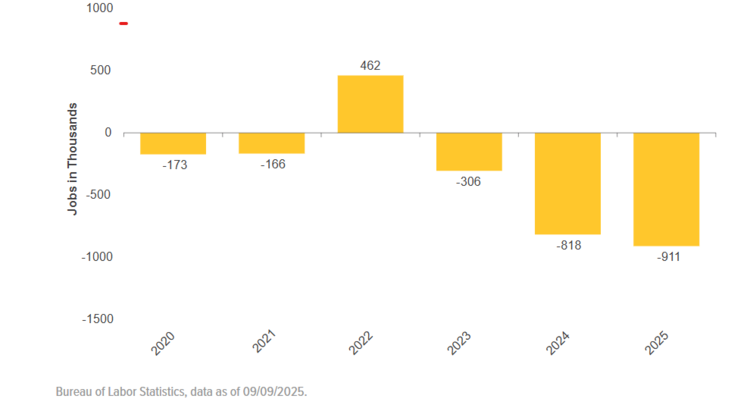
With the job market slowing, these revisions are becoming a more important data point to watch. As a result, the market expects the Federal Reserve Board to cut interest rates later this month and plans to implement additional cuts down the road.
Ultimately, the lesson from all these revised numbers is that it’s unwise to rely on a single data point—such as monthly job growth—to make broad conclusions about the economy and the financial markets. A broader range of economic indicators is crucial for developing a more comprehensive picture that can potentially enable goal-based investors to make better decisions.
By Mike Dickson, Ph.D.
Originally published at Horizon Investments
For more news, information, and analysis, visit the ETF Strategist Content Hub.
References to indices, or other measures of relative market performance over a specified period of time are provided for informational purposes only. Reference to an index does not imply that any account will achieve returns, volatility or other results similar to that index. The composition of an index may not reflect the manner in which a portfolio is constructed in relation to expected or achieved returns, portfolio guidelines, restrictions, sectors, correlations, concentrations, volatility or tracking error targets, all of which are subject to change. It is not possible to invest directly in an index. Information obtained from third party sources is believed reliable but has not been vetted by the firm or its personnel.
This commentary is written by Horizon’s asset management team. Past performance is not indicative of future results. Nothing contained herein should be construed as an offer to sell or the solicitation of an offer to buy any security. This report does not attempt to examine all the facts and circumstances that may be relevant to any company, industry, or security mentioned herein. We are not soliciting any action based on this document. It is for the general information of clients of Horizon Investments, LLC (“Horizon”). This document does not constitute a personal recommendation or take into account the particular investment objectives, financial situations, or needs of individual clients. Before acting on any analysis, advice, or recommendation in this document, clients should consider whether the security in question is suitable for their particular circumstances and, if necessary, seek professional advice. Investors may realize losses on any investments. Asset allocation cannot eliminate the risk of fluctuating prices and uncertain returns. All investing involves the risk of loss.
The investments recommended by Horizon are not guaranteed. There can be economic times when all investments are unfavorable and depreciate in value. Clients may lose money. This commentary is based on public information that we consider reliable, but we do not represent that it is accurate or complete, and it should not be relied on as such. The opinions expressed herein are our opinions as of the date of this document. These opinions may not be reflected in all of our strategies. We do not intend to and will not endeavor to update the information discussed in this document. No part of this document may be (i) copied, photocopied, or duplicated in any form by any means or (ii) redistributed without Horizon’s prior written consent. Forward-looking statements cannot be guaranteed. Other disclosure information is available at www.horizoninvestments.com.
Horizon Investments is a registered trademark of Horizon Investments, LLC
©2025 Horizon Investments, LLC.

