


On Friday, the Supreme Court ruled that the International Emergency Economic Powers Act (IEEPA) does not grant the president authority to impose tariffs, striking down the reciprocal, fentanyl, and immigration‑related regimes enacted under the law. President Trump responded with a new blanket tariff — first 10%, then 15% — reviving trade policy uncertainty with implications for both markets and economic activity.
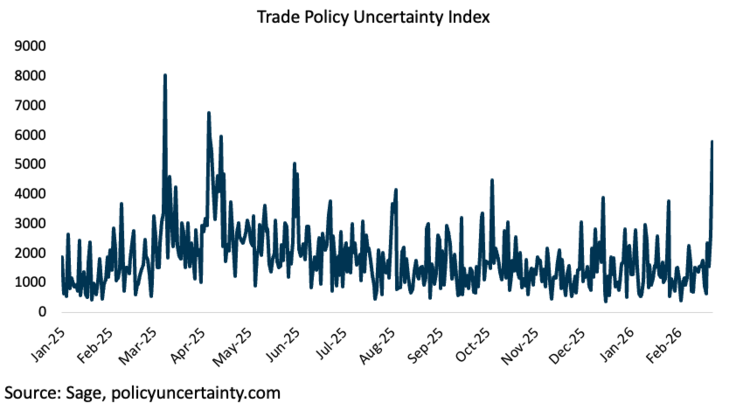
The Trade Policy Uncertainty Index, which measures the intensity of media discussion on trade policy and tariffs, spiked to the highest level since April 2025, when the US initially introduced its tariff policy, reflecting a return to a headline-driven market.
- Lower policy-driven inflation risk premium with larger tails. The Yale Budget Lab estimates the effective trade‑weighted tariff rate fell from 16% before the Supreme Court ruling to 12.7% today, even after incorporating the new 15% blanket tariff under Section 122. This implies modestly less near‑term tariff inflation, but greater two‑way risk around future tariff levels and timing.
- Tariff inflation fades while fiscal shock could tighten financial conditions. Refunds could be large and administratively complex, as the Supreme Court ruling did not provide any color on the mechanics and timing of tariff refunds. Treasury refunds mean lower revenue for the federal government, which could lead to higher borrowing needs, increasing treasuries issuance and tightening financial conditions. The balance of market risk has transitioned from tariff shock on inflation to a fiscal shock on financial conditions. Markets will have to square the balance of risks as higher bond issuance exerts upward pressure on rates, while lower inflation does the opposite.
- Variance of Fed policy outcomes widens significantly. The FOMC’s policy reaction function will be much harder to communicate in this regime given so much uncertainty around the tariff and refund process along with a transition to Warsh as the new Fed chair. Interest rate volatility may rise from historically subdued levels as reduced forward guidance and heightened data sensitivity force markets to wait for “clean” confirmation of stability — something likely hard to find near term.
While the Supreme Court IEEPA ruling reduces tariff-induced inflation pressures in the near term, it widens the distribution of potential paths for interest rates and Fed policy. Clarity remains limited, as markets face a protracted period of trade uncertainty while refunds, trade negotiations, and fiscal implications are worked through. In last week’s Notes, we described the current interest rate regime as being among the most stable and rangebound in history this ruling may be the catalyst that triggers wider trading ranges ahead.
Originally posted on Sage Advisory on February 23.
Disclosures: This is for informational purposes only and is not intended as investment advice or an offer or solicitation with respect to the purchase or sale of any security, strategy or investment product. Although the statements of fact, information, charts, analysis and data in this report have been obtained from, and are based upon, sources Sage believes to be reliable, we do not guarantee their accuracy, and the underlying information, data, figures and publicly available information has not been verified or audited for accuracy or completeness by Sage. Additionally, we do not represent that the information, data, analysis and charts are accurate or complete, and as such should not be relied upon as such. All results included in this report constitute Sage’s opinions as of the date of this report and are subject to change without notice due to various factors, such as market conditions. Investors should make their own decisions on investment strategies based on their specific investment objectives and financial circumstances. All investments contain risk and may lose value. Past performance is not a guarantee of future results.
Sage Advisory Services, Ltd. Co. is a registered investment adviser that provides investment management services for a variety of institutions and high net worth individuals. For additional information on Sage and its investment management services, please view our website at www.sageadvisory.com, or refer to our Form ADV, which is available upon request by calling 512.327.5530.

