


The Fairlead Tactical Sector ETF (TACK) is a model-driven exchange-traded fund that uses a disciplined, repeatable process to adapt across market environments. The foundation of the model is technical analysis, with a focus on indicators that identify long-term trends and major reversals. TACK’s primary objective is to harness sector leadership while reducing risk during equity market drawdowns through asset allocation. Opportunities are identified using signals from a blend of trend-following indicators, after which a quantitative momentum overlay helps refine the final portfolio.
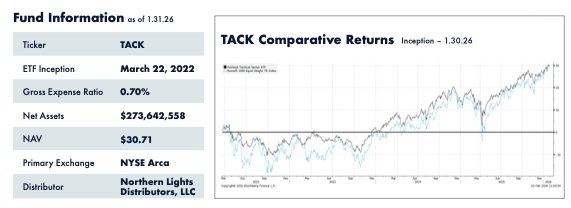
TACK has slightly outpaced its benchmark, the Russell 1000 Equal-Weight Index, returning 28.78% from March 2022 through January 2026. The fund has done so with lower volatility, reflected in a 0.45 beta versus the benchmark over the same period. Equal-weight approaches can offer an advantage over cap-weighted strategies by reducing concentration risk while still capturing leadership within sectors.
TACK gained 2.47% in January, outperforming the SPDR S&P 500 ETF Trust (SPY) by 100 basis points. Key contributors included the Industrial Select Sector SPDR ETF (XLI),which gained 6.65%, and, most notably, the SPDR Gold MiniShares Trust (GLDM),which rose 12.46%. This was the strongest month for GLDM over the fund’s history.
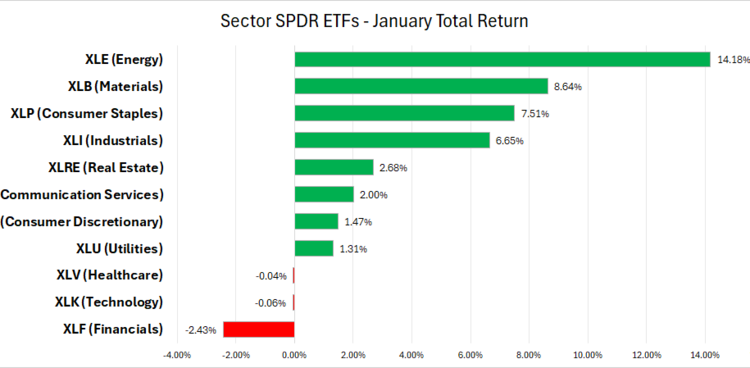
While SPY gained 1.47% in January, dispersion was significant beneath the surface. The spread between the best-performing sector, the Energy Select Sector SPDR ETF (XLE), up 14.18%, and the worst-performing sector, the Financial Select Sector SPDR ETF (XLF), down 2.43%, highlights the extent of the rotation. More broadly, the market rewarded 2025 laggards, signaling a potential shift in leadership as the year begins.
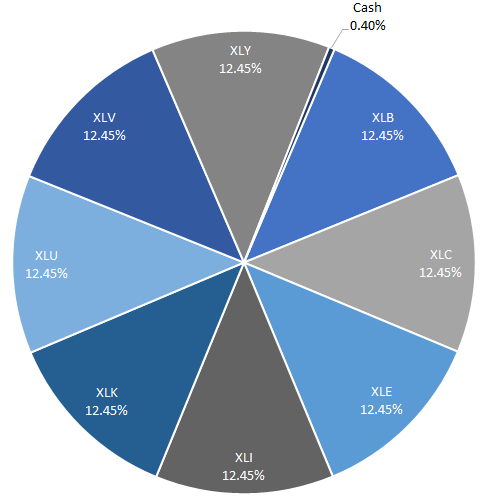
Our technical indicators are treating January’s shift as a meaningful change in market conditions. In response, the TACK model added 12.5% equal-weight positions in XLE and the Materials Select Sector SPDR ETF (XLB) for February, while removing allocations to alternative assets including the SPDR Portfolio Long Term Treasury ETF (SPTL), the SPDR Portfolio Short Term Treasury ETF (SPTS), and GLDM. With these changes, the fund is fully allocated to equities, although we would not be surprised to see “risk-off” positions reintroduced over the next few months. The shift reflects our process: when leadership broadens and risk appetite improves, the model allocates to sectors with strengthening trends.
Performance data shown represents past performance and is no guarantee of, and not necessarily indicative of future results. Current performance may be lower or higher than quoted. Returns include changes in share price and reinvestment of dividends, if any. For fund information current to the most recent month-end, please call 1-877-865-9549.
TACK is designed to benefit from rotational markets by applying a disciplined approach to sector selection. As megacap leadership becomes less dependable, we believe TACK’s diversified, equal-weight framework is advantageous, which can improve long-term momentum across a wider set of sectors seeking to expand the opportunity set and reducing reliance on a narrow segment of the market to drive returns.
Evolving Sector Rotation
After three years of consistent leadership from technology, the Technology Select Sector SPDR ETF (XLK) returned –0.06% in January, signaling a potential change in market leadership entering 2026. With technology representing roughly one-third of the S&P 500’s market cap, the sector’s lack of upside leadership weighed on sentiment. Still, improving breadth across other sectors helped support the major indices.
In January, 7 of the 11 S&P 500 sectors outperformed SPY. That is a notable shift from the narrow leadership of 2023-2025, when just 3-4 sectors drove index gains. We view this rotation as both a challenge and an opportunity. Popular passive strategies such as SPY and the Invesco QQQ Trust (QQQ) may struggle if technology and other megacap-heavy sectors continue to lose leadership, while active approaches like TACK can benefit by emphasizing areas of improving relative strength, including smaller sectors such as energy (XLE) and materials (XLB).
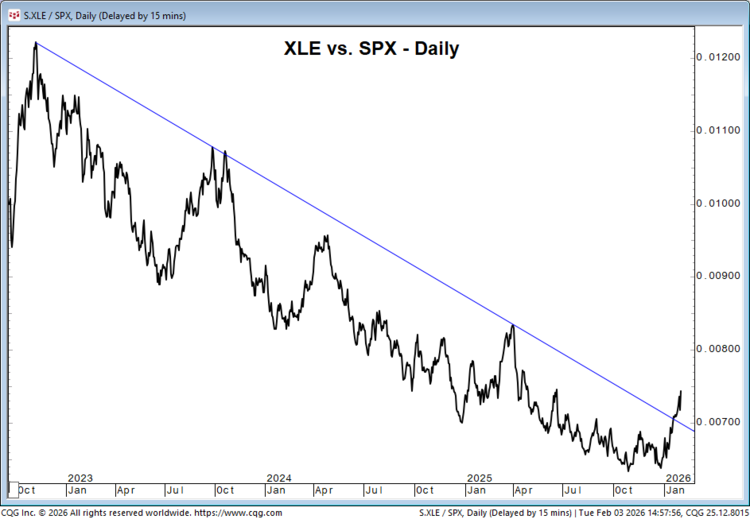
Relative strength trends across sectors reinforce this evolving picture. Momentum in technology has faded, while several 2025 laggards have stabilized. Energy stands out as the clearest beneficiary, with XLE reversing a downtrend versus SPY. This stabilization aligns with renewed rotation into energy-related commodities, which we believe may reflect a broader commodity bull cycle that also supports materials stocks.
For more information on how TACK navigates changing market conditions, visit the fund’s website or reach out to [email protected].
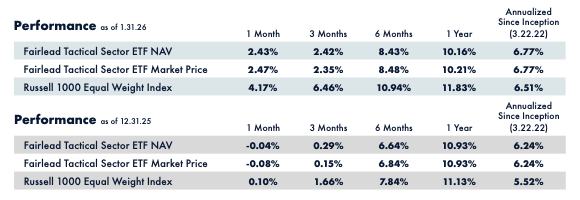
Performance data shown represents past performance and is no guarantee of, and not necessarily indicative of, future results. Current performance may be lower or higher than quoted. Returns include changes in share price and reinvestment of dividends, if any. For fund performance information current to the most recent month-end, please call 1-877-865-9549.
Total return and value will vary, and you may have a gain or loss when shares are sold. Returns include changes in share price and reinvestment of dividends, if any. Market returns are based upon the closing price at 4:00 p.m. Eastern time, when the NAV is normally calculated for ETFs. Your returns may differ if you traded shares at other times. NAV returns represent the closing price of underlying securities.
Investors should carefully consider the investment objectives, risks, charges and expenses of the fund before investing. The prospectus contains this and other information about the fund, and it should be read carefully before investing. Investors may obtain a copy of the prospectus by calling 877-865-9549, emailing [email protected] or it may be download here.
The fund is distributed by Northern Lights Distributors, LLC (Member FINRA). Northern Lights Distributors, LLC, Fairlead Strategies, LLC, and Cary Street Partners Asset Management LLC are separate and unaffiliated. Cary Street Partners is the trade name used by Cary Street Partners LLC, Member FINRA/SIPC; Cary Street Partners Investment Advisory LLC and Cary Street Partners Asset Management LLC, registered investment advisers. Cary Street Partners is the Adviser for the Fairlead Tactical Sector ETF (TACK). For full disclaimers and disclosures, please view Disclaimers and Disclosures.
Fairlead Strategies, LLC is a registered investment adviser and the Subadviser for TACK. For access to the full disclaimers and disclosures for Fairlead Strategies, including their policy regarding editor securities holdings, go to https://www.fairleadstrategies.com/disclaimers-and-disclosures or email [email protected].
Notice of Benchmark Change: Effective as of 07/31/2024, the Russell 1000 Equal Weight Index replaced the Morningstar Moderate Target Risk Index as the Fund’s broad-based securities market index. The Russell 1000 Equal Weight index was selected in connection with certain regulatory requirements to provide a broad measure of market performance. The Fund will retain the Morningstar Moderate Target Risk Index as a secondary benchmark.
Important Risk Information:
Investing involves risk, including loss of principal. There is no guarantee the fund will achieve its investment objective. As an actively-managed ETF, the fund is subject to management risk. The ability of the Adviser to successfully implement the fund’s investment strategies will significantly influence the fund’s performance. The success of the fund will depend in part upon the skill and expertise of certain key personnel of the Adviser, and there can be no assurance that any such personnel will be successful. Neither the Adviser nor the Subadviser has previously served as an adviser or a subadviser to a mutual fund or exchange-traded fund. As a result, there is no long-term track record against which an investor may judge the Adviser and/or Subadviser.
The TACK ETF is structured as a fund-of-funds and is subject to the same risks as the Funds it holds. Investors will incur the expenses of the Fund in addition to fees of the underlying Funds in the portfolio.
The Adviser may allocate more of the Fund’s investments to a particular sector or sectors in the market, including the following sectors: Communications Services, Consumer Discretionary, Consumer Staples, Energy, Financials, Health Care, Industrials, Materials, Real Estate, Technology, and Utilities. If the Fund invests a significant portion of its total assets in a certain sector or certain sectors, its investment portfolio will be more susceptible to the financial, economic, business, and political developments that affect those sectors than a fund that is more diversified.
Important Terms and Definitions: A basis point is a standard measure of percentages in finance that equals 1/100th of a percent (i.e., 0.1%). A risk-adjusted return is a calculation of the profit from an investment that considers the degree of risk that must be accepted to achieve it. The risk is measured in comparison to that of a virtually risk-free investment. Our Risk-Off Classification applies when the TACK strategy invests in Treasury ETFs and Gold Shares to reduce market exposure.

