


The most notable item in the minutes the January FOMC meeting released last week was the committee’s discussion on issues related to the balance sheet, indicating that regarding the potential for significant swings in reserves over the coming months related to debt ceiling…it may be appropriate to consider pausing or slowing balance sheet runoff. While not an explicit monetary policy action, the Federal Reserve’s rumored pause or slowdown in its quantitative tightening (QT) runoff ahead of this summer’s debt ceiling discussions is nonetheless significant, with broad implications for liquidity and markets. In this post we attempt to demystify the mechanics and implications behind why the Fed is considering pausing its QT program.
Beginning in March 2022, the Fed began shrinking its balance sheet, shaving just over $2 trillion of bond holdings from a peak of $9 trillion. The Fed is currently allowing up to $25 billion in Treasuries and $35 billion in mortgage-backed securities to mature monthly without reinvestment.
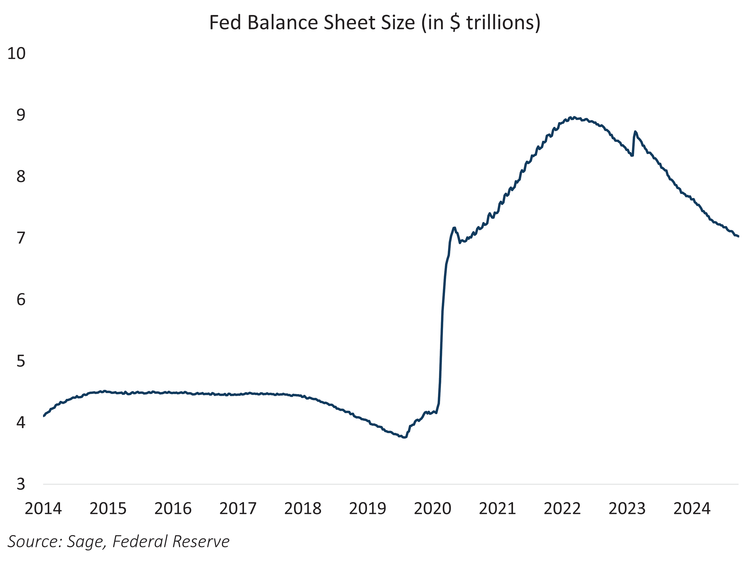
The Fed’s balance sheet directly influences system-wide bank reserves. When the Fed expands its balance sheet through asset purchases, it injects reserves into the banking system, increasing liquidity. Conversely, when the Fed reduces its balance sheet via QT, it passively removes reserves by allowing Treasuries and MBS to mature without reinvestment. This reduction in reserves tightens financial conditions by increasing competition for liquidity among banks, raising short-term funding costs, and potentially leading to increased volatility in money markets. The pace of QT and the level of reserves in the system are critical in determining the availability of credit and the stability of financial markets.
The negotiations around raising the debt ceiling this summer is a complicating factor in the Fed’s calculus. The debt ceiling represents the legal cap on the total amount of money the US government is authorized to borrow to meet its existing obligations. When the ceiling is reached, the Treasury must rely on temporary “extraordinary measures” to keep funding the government. If Congress fails to raise or suspend the limit, the US risks defaulting on its obligations, which could have catastrophic financial repercussions. In turn, Congress has chosen the path of raising the debt ceiling every few years and is expected to do so this time, although not without a contentious negotiation process among lawmakers, given the heightened focus on fiscal sustainability.
While the debt ceiling negotiations are taking place, there will be a period in which the debt ceiling is binding the Treasury from issuing bonds. During this time, the Treasury will be forced to draw down its Treasury General Account (TGA) to fund government obligations, which will temporarily inject liquidity into the financial system and inflate bank reserves. However, once the debt ceiling is lifted, the Treasury will need to issue a significant volume of bonds to replenish the TGA, which will rapidly absorb reserves from the banking system. This abrupt shift in liquidity conditions could create funding market volatility and tighten financial conditions more than anticipated. To mitigate these risks, the Fed is erring on the side of caution by pausing QT, ensuring that liquidity remains ample during this period of transition and preventing an unintended shock to financial markets.
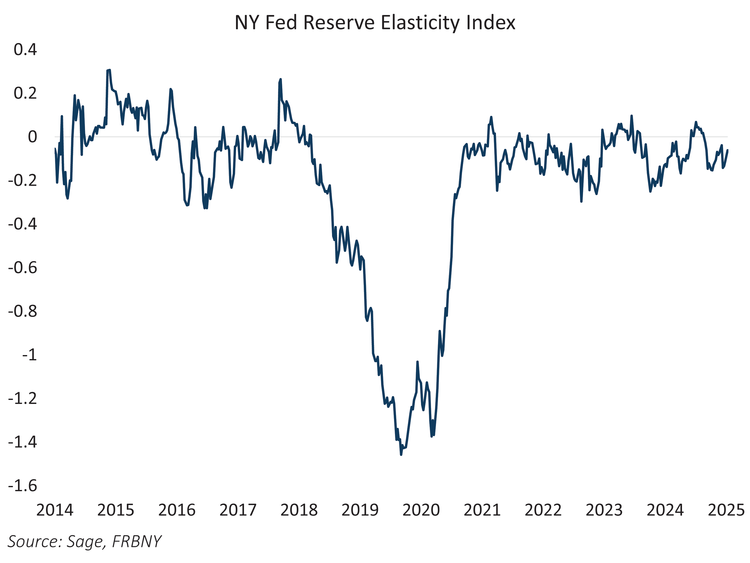
The New York Fed’s demand elasticity tool measures how sensitive the banking system’s demand for reserves is to changes in interest rates, helping to assess whether reserves are abundant or scarce. When reserve demand is elastic (near zero), banks can function smoothly with fewer reserves, and small supply reductions have minimal impact on market rates. However, when demand becomes inelastic (below zero), competition for reserves intensifies, leading to sharp increases in short-term borrowing costs and potential funding stress. Currently, reserves remain ample, preventing any immediate funding stress, but the Fed is taking a preemptive approach to ensure that liquidity does not become constrained as fiscal conditions evolve, as seen by the elasticity measure in 2019.
While the decision to slow or pause QT does not signal a shift in the Fed’s broader monetary policy stance, its actions indicate a preference for maintaining stability and preventing unnecessary disruptions in financial markets. The Fed’s decision to err on the side of injecting rather than draining liquidity amid an uncertain fiscal landscape may be interpreted by markets as a dovish signal, reinforcing expectations that the central bank will act to mitigate financial turbulence rather than exacerbate it. As fiscal concerns are having an increasingly dominant effect on financial conditions, the Fed’s monetary stance will remain reactive to fiscal developments for the foreseeable future.
For more news, information, and analysis, visit the ETF Strategist Channel.
Disclosures: This is for informational purposes only and is not intended as investment advice or an offer or solicitation with respect to the purchase or sale of any security, strategy or investment product. Although the statements of fact, information, charts, analysis and data in this report have been obtained from, and are based upon, sources Sage believes to be reliable, we do not guarantee their accuracy, and the underlying information, data, figures and publicly available information has not been verified or audited for accuracy or completeness by Sage. Additionally, we do not represent that the information, data, analysis and charts are accurate or complete, and as such should not be relied upon as such. All results included in this report constitute Sage’s opinions as of the date of this report and are subject to change without notice due to various factors, such as market conditions. Investors should make their own decisions on investment strategies based on their specific investment objectives and financial circumstances. All investments contain risk and may lose value. Past performance is not a guarantee of future results.
Sage Advisory Services, Ltd. Co. is a registered investment adviser that provides investment management services for a variety of institutions and high net worth individuals. For additional information on Sage and its investment management services, please view our web site at sageadvisory.com, or refer to our Form ADV, which is available upon request by calling 512.327.5530.

