

ETFdb Logo
  • ETF Database
  • Content Hubs
    • Themes
      • Active ETF
      • Alternatives
      • Artificial Intelligence
      • China Insights
      • Core Strategies
      • Crypto
      • Disruptive Technology
      • Energy Infrastructure
      • ETF Building Blocks
      • ETF Investing
      • ETF Strategist
      • Financial Literacy
      • Fixed Income
      • Free Cash Flow
      • Future ETFs
      • Innovative ETFs
      • Institutional Income Strategies
      • Leveraged & Inverse
      • Market Insights
      • Market Outlooks
      • Modern Alpha
      • Nuclear Energy
      • Portfolio Strategies
      • Sector Investing
      • Tax Efficient Income
      • Thematic Investing
    • Asset Class
      • Equity
        • U.S. Equity
        • Int'l Developed
        • Emerging Market Equities
      • Alternatives
        • Gold/Silver/Critical Materials
        • Cryptocurrency
        • Currency
        • Volatility
      • Fixed Income
        • Investment Grade Corporates
        • US Treasuries & TIPS
        • High Yield Corporates
        • Int'l Fixed Income
    • ETF Ecosystem
    • ETFs in Canada
    • Market Outlook
    • Crypto ETF Hub
  • Tools
    • ETF Screener
    • ETF Country Exposure Tool
    • ETF Database Categories
    • Indexes
    • Scenario Analysis
    • Watchlists
    • Head-To-Head ETF Comparison Tool
    • Mutual Fund To ETF Converter
    • ETF Stock Exposure Tool
    • ETF Issuer Fund Flows
  • Research
    • ETF Education
    • Equity Investing
    • Dividend ETFs
    • Leveraged ETFs
    • Inverse ETFs
    • Index Education
    • Index Insights
    • Top ETF Sectors
    • Top ETF Issuers
    • Top ETF Industries
  • Webcasts
  • Sectors
    • Sector Investing Content Hub
    • XLK
    • XLI
    • XLU
    • XLY
    • XLP
    • XLRE
    • Sector Power Rankings
    • XLE
    • XLC
    • XLF
    • XLV
    • XLB
  • Multimedia
    • ETF 360 Video Series
    • ETF of the Week Podcast
    • Gaining Perspective Podcast
    • ETF Prime Podcast
    • Video
  • Company
    • About VettaFi
  • PRO
    • Pro Content
    • Pro Tools
    • Advanced
    • FAQ
    • Free sign up
    • Login
  1. ETF Yield Content Hub
  2. Hedge Your Large-Cap Exposure With PHEQ
ETF Yield Content Hub
Share

Hedge Your Large-Cap Exposure With PHEQ

Karrie GordonJul 24, 2024
2024-07-24

Earnings misses and hopes of a September rate cut saw many investors dropping large-cap tech stocks in favor of their small-cap counterparts. Those investors looking to hedge against potential losses in large-caps should consider the Parametric Hedged Equity ETF (PHEQ B).

Tesla and Alphabet earnings misses sent individual and broad equity indexes sliding on Wednesday. Alphabet beat on both the top and bottom line but missed YouTube advertising revenues. The company’s stock slid 4% while Tesla came in under earnings expectations and dropped 12% according to CNBC.

The misses by these megacap technology companies dragged broad equity indexes down. Whether it’s a sign of AI enthusiasm fizzling remains to be seen as earnings season is still underway.

The current overweight in broad equity indexes to large- and megacap technology companies creates the potential for drawdowns should earnings season prove a disappointment for more AI-centric stocks.

Hedge For Large-Cap Drawdowns With PHEQ

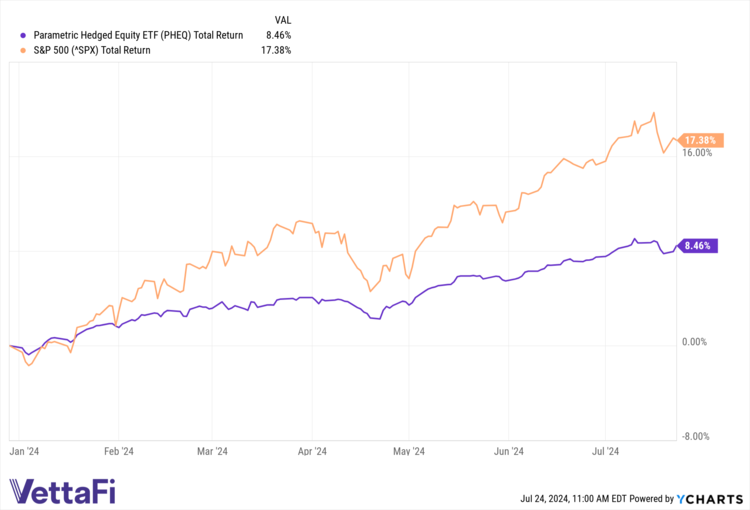
A pivot to small-caps currently underway and political changes shaking up the campaign landscape create added uncertainty for large-cap stocks. Investors looking to remain invested in broad equities but hedge for drawdown risks in large-caps would do well to consider the Parametric Hedged Equity ETF (PHEQ B). The fund seeks to provide capital appreciation while protecting against losses.

While PHEQ limits upside capture, the strategy provided a much smoother ride within broad equities. The ability of the fund to mitigate losses proves a boon in ongoing volatility.

Content continues below advertisement

Hedge Your Large-Cap Exposure With PHEQ

PHEQ invests in U.S. large-cap stocks within the Solactive GBS US 500 Index while utilizing options to hedge against drawdowns. The strategy optimizes the weights of its holdings to create a risk and return profile similar to that of the Index.

It also employs a laddered options overlay strategy that sacrifices some upside potential for downside protection. PHEQ does so by utilizing a put spread collar strategy wherein it buys close to the money protective puts and sells further out of the money puts.

Any loss mitigation is limited to that which the put spread covers. The fund ladders the one-year options across quarters to allow for optimal downside protection and upside capture. The fund also writes calls, thereby earning a premium to offset the put spreads.

The fund engages in tax loss harvesting within its equity holdings to offset realized gains. It distributes a quarterly dividend and carries an expense ratio of 0.29%.

For more news, information, and analysis, visit The ETF Yield Channel.

Loading Articles...

Advertisement

Is Your Portfolio Positioned With Enough Global Exposure?

ETF Education Channel

How to Allocate Commodities in Portfolios

Tom LydonApr 26, 2022
2022-04-26

A long-running debate in asset allocation circles is how much of a portfolio an investor should...

Core Strategies Channel

Why ETFs Experience Limit Up/Down Protections

Karrie GordonMay 13, 2022
2022-05-13

In a digital age where information moves in milliseconds and millions of participants can transact...

}
X
