

ETFdb Logo
  • ETF Database
  • Content Hubs
    • Themes
      • Active ETF
      • Alternatives
      • Artificial Intelligence
      • China Insights
      • Core Strategies
      • Crypto
      • Disruptive Technology
      • Energy Infrastructure
      • ETF Building Blocks
      • ETF Investing
      • ETF Strategist
      • Financial Literacy
      • Fixed Income
      • Free Cash Flow
      • Future ETFs
      • Innovative ETFs
      • Institutional Income Strategies
      • Leveraged & Inverse
      • Market Insights
      • Market Outlooks
      • Modern Alpha
      • Nuclear Energy
      • Portfolio Strategies
      • Sector Investing
      • Tax Efficient Income
      • Thematic Investing
    • Asset Class
      • Equity
        • U.S. Equity
        • Int'l Developed
        • Emerging Market Equities
      • Alternatives
        • Gold/Silver/Critical Materials
        • Cryptocurrency
        • Currency
        • Volatility
      • Fixed Income
        • Investment Grade Corporates
        • US Treasuries & TIPS
        • High Yield Corporates
        • Int'l Fixed Income
    • ETF Ecosystem
    • ETFs in Canada
    • Crypto ETF Hub
  • Tools
    • ETF Screener
    • ETF Country Exposure Tool
    • ETF Database Categories
    • Indexes
    • Scenario Analysis
    • Watchlists
    • Head-To-Head ETF Comparison Tool
    • Mutual Fund To ETF Converter
    • ETF Stock Exposure Tool
    • ETF Issuer Fund Flows
  • Research
    • ETF Education
    • Equity Investing
    • Dividend ETFs
    • Leveraged ETFs
    • Inverse ETFs
    • Index Education
    • Index Insights
    • Top ETF Sectors
    • Top ETF Issuers
    • Top ETF Industries
  • Webcasts
  • Sectors
    • Sector Investing Content Hub
    • XLK
    • XLI
    • XLU
    • XLY
    • XLP
    • XLRE
    • Sector Power Rankings
    • XLE
    • XLC
    • XLF
    • XLV
    • XLB
  • Multimedia
    • ETF 360 Video Series
    • ETF of the Week Podcast
    • Gaining Perspective Podcast
    • ETF Prime Podcast
    • Video
  • Company
    • About VettaFi
  • PRO
    • Pro Content
    • Pro Tools
    • Advanced
    • FAQ
    • Free sign up
    • Login
  1. ETF Yield Content Hub
  2. Look To Equity Income ETF PAPI in Market Turbulence
ETF Yield Content Hub
Share

Look To Equity Income ETF PAPI in Market Turbulence

Karrie GordonApr 25, 2024
2024-04-25

Slower growth and signs of persistent inflation caused equities to slide on Thursday while bonds sold off. Investors seeking reliable income with quality equity exposure should consider the actively managed Parametric Equity Premium Income ETF (PAPI B).

Interest rate concerns in the wake of a high personal consumption expenditures price (PCE) index reading prompted a selloff in bonds. PCE rose 3.4% annualized in the first quarter while core PCE (excludes food and energy) rose 3.7%. Core PCE is a preferred measure of inflation for the Fed.

Major equity indexes slid to close the day down on concerns of high inflation and economic slowing. GDP came in well below expectations for the first quarter. When adjusted for inflation and seasonality, GDP measured 1.6% on Dow Jones estimates of 2.4%.

“This was a worst of both worlds report – slower than expected growth, higher than expected inflation,” David Donabedian, CIO of CIBC Private Wealth US told CNBC.

It remains to be seen which direction rates and the economy go. The only certainty for now appears to be uncertainty.

See also: Invest in Equities While Mitigating Volatility With PHEQ

Quality Equity Exposure, Added Options Income

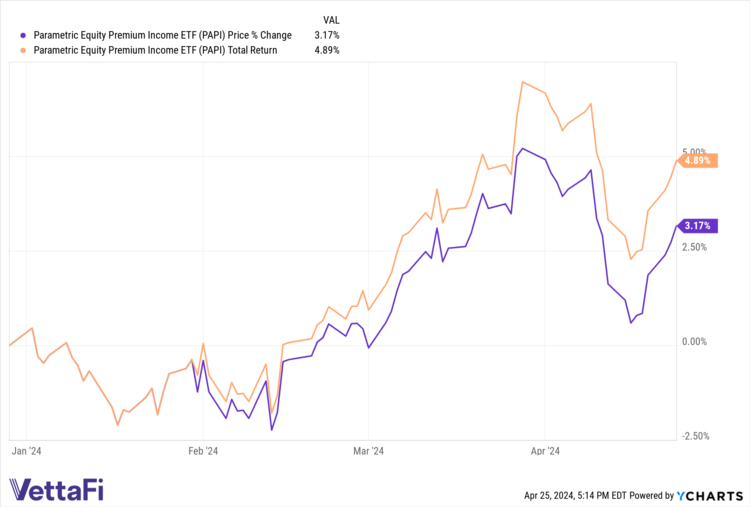
The inability to reliably predict the direction of inflation, rates, and the economy contributed to prolonged and elevated market volatility in the last two years. The Parametric Equity Premium Income ETF (PAPI B) offers investors the dual benefit of active management alongside reliable equity income in challenging market environments.

Content continues below advertisement

Look To Equity Income ETF PAPI in Market Turbulence

PAPI seeks consistent monthly income as well as capital appreciation. The strategy does so by investing in an actively managed portfolio of dividend-paying equities chosen from the Russell 3000. It does so by using top-down, systematic analysis to select quality companies.

Companies included demonstrate 12 months of high current income and reduced risk within their sectors. The quality equity portfolio is also diversified across sectors, with sectors equally weighted.

The fund also employs an options strategy that writes short-dated, laddered, out-of-the-money calls on the S&P 500. The laddered calls generate premiums as well as allow for more upside appreciation potential compared to a single call option position.

PAPI generated a distribution yield of 7.99% as of 03/31/2024. Distribution annualizes the most recent distribution and divides it by the fund’s most recent NAV. It’s a forward-looking indicator of what investors could potentially earn in the next year if distributions remained the same.

PAPI carries an expense ratio of 0.29%, making it an affordable entry into the equity income space.

For more news, information, and analysis, visit The ETF Yield Channel.

Loading Articles...

Advertisement

Is Your Portfolio Positioned With Enough Global Exposure?

ETF Education Channel

How to Allocate Commodities in Portfolios

Tom LydonApr 26, 2022
2022-04-26

A long-running debate in asset allocation circles is how much of a portfolio an investor should...

Core Strategies Channel

Why ETFs Experience Limit Up/Down Protections

Karrie GordonMay 13, 2022
2022-05-13

In a digital age where information moves in milliseconds and millions of participants can transact...

}
X
