


Multileg options strategies can allow experienced option traders to capitalize on market expectations in various ways. When expecting elevated volatility and having an appetite for a higher risk/reward potential, a strangle options strategy could prove beneficial.
Strangle strategies are similar to straddles in that both multileg options strategies seek to harness volatility for gains. A straddle is generally used when expecting strong price movements but is uncertain about which direction those moves will go. A strangle is typically used when a trader expects strong movement and believes prices may move in a specific direction or wishes to take on a higher risk/reward position. However, they still seek a level of protection should prices move in the opposite direction.
A long strangle entails buying a call and put option on the same underlying asset with the same expiration. However, the two options are bought at different strike prices. A call option gives the buyer the right, but not the obligation, to purchase a stock at an agreed strike price by the contract’s expiration. A put option gives the buyer the right, but not the obligation, to sell a stock at the strike price by expiration.
The call and put strike prices are both bought out-of-the-money. This means the call option is bought with a strike price above the current underlying price, while the put strike price is bought below. It’s a strategy with a defined risk window and nearly unlimited return potential on the call option side, but it requires greater price movement than a straddle.
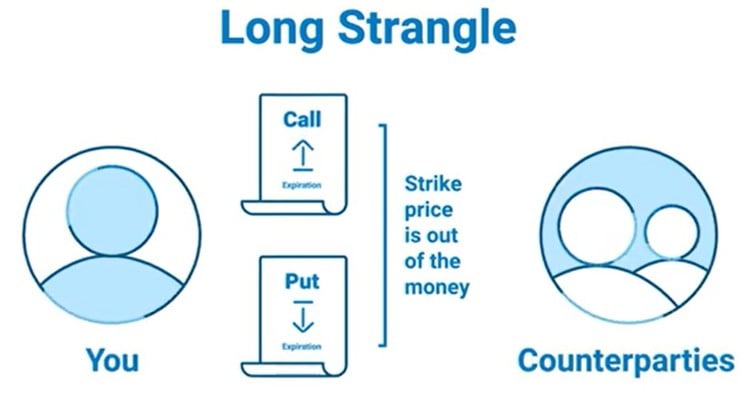
“It’s called a strangle because you’re setting up two opposing positions on either side of the current price to benefit from a big move in either direction,” explained BMO in a video. “Often, long strangles are established in advance of highly anticipated market-moving news.”
For example, an investor knows that earnings announcements for stock XYZ are in four weeks and anticipates large price moves as a result. The stock currently trades at $100, and the trader buys a call option at $105 for a $3 premium and a put option at $95 for a $3 premium. Both options expire in five weeks.
The total of the two premiums amounts to $6, making up the maximum risk for the strangle. In such a scenario, the underlying price would need to move an additional $6 beyond the strike price to break even or return a profit. If the strike price isn’t reached for either option, it expires worthless for a net loss of $6.
If, instead, the underlying price crosses the strike price but doesn’t move the additional $6, the investor would receive some compensation for the premiums paid but still end at a loss. Let’s say stock XYZ reaches $109 by the option’s expiration. The put expires unexercised, but the call is exercised with $4 in profit. However, since $6 in premiums were paid in total, the long strangle resulted in a net loss of $2.
“The disadvantage to this strategy is that you usually need a substantial rise or fall in a stock price to turn a profit, especially for stocks that are already volatile,” BMO said.
For more news, information, and analysis, visit the ETFs in Canada Channel.

