


Options strategies can offer a range of opportunities for investors across market environments. While some investors may associate options with elevated volatility, multi-leg strategies like short straddles intend to take advantage of decreasing or muted volatility to produce income.
A short straddle options strategy seeks to generate income in periods of reduced volatility. “It’s called a straddle because it doesn’t matter which way the stock moves, as long as it doesn’t move drastically,” BMO explained in a video.
A trader sells a call and puts on the same underlying asset to create a short straddle. These option contracts have the same strike price and the same expiration. A call gives the buyer the right but not the obligation to purchase the underlying security at the strike price by the expiration. Meanwhile, a put gives the buyer the right to sell the underlying security at the strike price. Option writers earn premiums on the options they sell, generating income.
The strike prices of a short straddle are generally at- or near-the-money, meaning they’re close to the cost of the underlying security. Traders typically employ short straddles during periods of reduced volatility, or when they believe the options market may be inaccurately forecasting volatility, BMO explained.
Short straddles offer defined rewards while carrying substantial risk potential. The strategy profits if the options expire unused or the underlying price remains rangebound between the two strike prices.
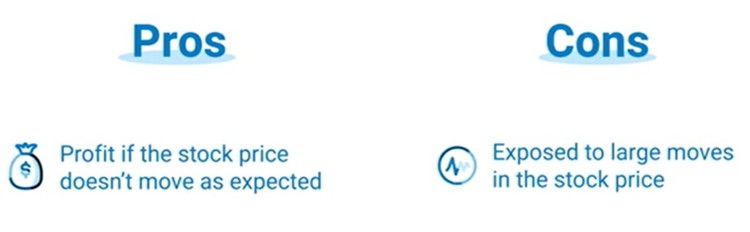
The option writer must supply the stock if the underlying price rises above the call strike price. If they didn’t already own it, they would have to purchase the underlying stock at the elevated price. While the premiums earned offer a buffer, the short straddle trader remains at a net loss. If the underlying price falls below the put strike price, the writer would have to buy the depreciated asset, with the premiums once again only offering a buffer for the net loss.
For example, a trader wishes to create a short straddle around stock ABC, believing that markets are incorrectly forecasting volatility. Stock ABC’s price is currently $80, and the trader writes a call option at $80, selling it for a premium of $4, while also writing a put option at $80 and selling it for $4 as well. Both options expire in four weeks.
In this scenario, the premiums earned totaled $8, meaning that as long as the stock prices fail to rise above $84 or fall below $76, the short straddle trader earns a net profit. However, if the stock’s price increases to $90, the put expires unused while the call is exercised. The $8 premiums offer a buffer against the $10 call value, leading to a $2 net loss. Similarly, should the price decline to $66, the call expires unused while the put’s value is $14. It creates a net loss of $6.
“A short straddle may be useful if you believe a stock will remain neutral and you want to generate some income,” BMO concluded.
For more news, information, and analysis, visit the ETFs in Canada Channel.

