

ETFdb Logo
  • ETF Database
  • Content Hubs
    • Themes
      • Active ETF
      • Alternatives
      • Artificial Intelligence
      • China Insights
      • Core Strategies
      • Crypto
      • Disruptive Technology
      • Energy Infrastructure
      • ETF Building Blocks
      • ETF Investing
      • ETF Strategist
      • Financial Literacy
      • Fixed Income
      • Free Cash Flow
      • Future ETFs
      • Innovative ETFs
      • Institutional Income Strategies
      • Leveraged & Inverse
      • Market Insights
      • Market Outlooks
      • Modern Alpha
      • Nuclear Energy
      • Portfolio Strategies
      • Sector Investing
      • Tax Efficient Income
      • Thematic Investing
    • Asset Class
      • Equity
        • U.S. Equity
        • Int'l Developed
        • Emerging Market Equities
      • Alternatives
        • Gold/Silver/Critical Materials
        • Cryptocurrency
        • Currency
        • Volatility
      • Fixed Income
        • Investment Grade Corporates
        • US Treasuries & TIPS
        • High Yield Corporates
        • Int'l Fixed Income
    • ETF Ecosystem
    • ETFs in Canada
    • Market Outlook
    • Crypto ETF Hub
  • Tools
    • ETF Screener
    • ETF Country Exposure Tool
    • ETF Database Categories
    • Indexes
    • Scenario Analysis
    • Watchlists
    • Head-To-Head ETF Comparison Tool
    • Mutual Fund To ETF Converter
    • ETF Stock Exposure Tool
    • ETF Issuer Fund Flows
  • Research
    • ETF Education
    • Equity Investing
    • Dividend ETFs
    • Leveraged ETFs
    • Inverse ETFs
    • Index Education
    • Index Insights
    • Top ETF Sectors
    • Top ETF Issuers
    • Top ETF Industries
  • Webcasts
  • Sectors
    • Sector Investing Content Hub
    • XLK
    • XLI
    • XLU
    • XLY
    • XLP
    • XLRE
    • Sector Power Rankings
    • XLE
    • XLC
    • XLF
    • XLV
    • XLB
  • Multimedia
    • ETF 360 Video Series
    • ETF of the Week Podcast
    • Gaining Perspective Podcast
    • ETF Prime Podcast
    • Video
  • Company
    • About VettaFi
  • PRO
    • Pro Content
    • Pro Tools
    • Advanced
    • FAQ
    • Free sign up
    • Login
  1. ETFs in Canada Content Hub
  2. Investing for Volatility With Options: The Long Straddle
ETFs in Canada Content Hub
Share

Investing for Volatility With Options: The Long Straddle

Aaron NeuwirthMar 14, 2025
2025-03-14

Options can offer the opportunity to enhance portfolios in various ways for knowledgeable investors. For those experienced options investors with expectations of volatility but not stock price directionality, the long straddle may be worth consideration.

A long straddle options strategy allows a trader to position for expected market volatility. It’s also a kind of strategy that can be beneficial when traders are uncertain about which direction an underlying asset’s price will move. Long straddles are a multileg strategy typically used by experienced options investors.

A trader buys a call and puts on the same underlying asset to create a long straddle. These options contracts have the same strike price as well as the same expiration. A call gives the buyer the right but not the obligation to purchase the underlying security at the strike price by the expiration. Meanwhile, a put gives the buyer the right to sell the underlying security at the strike price. Buyers pay a premium for options that must be considered when calculating net profits.

In a long straddle, “typically the strike price is at- or near-the-money, meaning that it is very close to the current price of the underlying security,” explained BMO in a video. In buying a position on either side of the stock’s price, the strategy benefits should markets move sharply in either direction. “Often, long straddles are established in advance of market-moving news.”

Long straddles can provide a number of benefits to investors. The strategy profits should prices move sharply and also offers uncapped return potential. Meanwhile, the risk for the owner of a long straddle is contained in the total cost of the premiums.
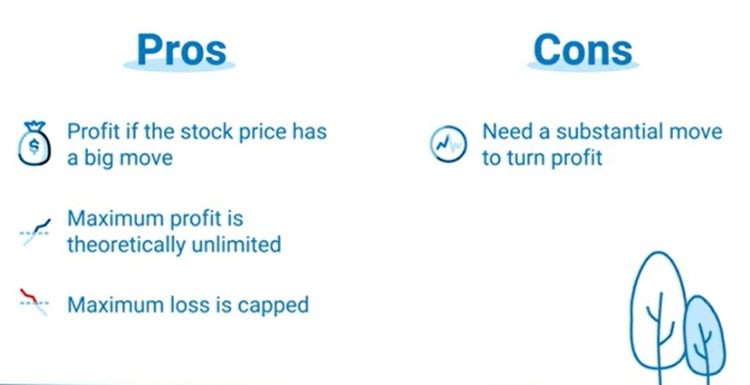
straddle chart pros cons
Image source: BMO

For example, it’s the beginning of the month, and an investor knows that earnings for company XYZ will be announced at the end of the month. XYZ stock currently trades at $75. The investor purchases a call with a strike price of $75 as well as a put for $75, with both set to expire the first day of the following month. The investor pays a premium of $3 for the call and $3 for the put.

The combined total of the premiums paid is $6, meaning that to break even, the stock price must rise or fall greater than $6 from its initial point of $75. Should prices fail to move significantly, the investor ends up with a loss, with the options expiring unused. However, the investor profits if prices move above $81 or below $69.

“A long straddle may be useful if you believe a stock is about to rise or fall significantly, you aren’t sure what direction it will take, and you’re looking for a lower risk approach than a long strangle,” BMO concluded.

For more news, information, and analysis, visit the ETFs in Canada Channel.


Content continues below advertisement

Loading Articles...

Advertisement

Is Your Portfolio Positioned With Enough Global Exposure?

ETF Education Channel

How to Allocate Commodities in Portfolios

Tom LydonApr 26, 2022
2022-04-26

A long-running debate in asset allocation circles is how much of a portfolio an investor should...

Core Strategies Channel

Why ETFs Experience Limit Up/Down Protections

Karrie GordonMay 13, 2022
2022-05-13

In a digital age where information moves in milliseconds and millions of participants can transact...

}
X
