

ETFdb Logo
  • ETF Database
  • Content Hubs
    • Themes
      • Active ETF
      • Alternatives
      • Artificial Intelligence
      • China Insights
      • Core Strategies
      • Crypto
      • Disruptive Technology
      • Energy Infrastructure
      • ETF Building Blocks
      • ETF Investing
      • ETF Strategist
      • Financial Literacy
      • Fixed Income
      • Free Cash Flow
      • Future ETFs
      • Innovative ETFs
      • Institutional Income Strategies
      • Leveraged & Inverse
      • Market Insights
      • Market Outlooks
      • Modern Alpha
      • Nuclear Energy
      • Portfolio Strategies
      • Sector Investing
      • Tax Efficient Income
      • Thematic Investing
    • Asset Class
      • Equity
        • U.S. Equity
        • Int'l Developed
        • Emerging Market Equities
      • Alternatives
        • Gold/Silver/Critical Materials
        • Cryptocurrency
        • Currency
        • Volatility
      • Fixed Income
        • Investment Grade Corporates
        • US Treasuries & TIPS
        • High Yield Corporates
        • Int'l Fixed Income
    • ETF Ecosystem
    • ETFs in Canada
    • Market Outlook
    • Crypto ETF Hub
  • Tools
    • ETF Screener
    • ETF Country Exposure Tool
    • ETF Database Categories
    • Indexes
    • Scenario Analysis
    • Watchlists
    • Head-To-Head ETF Comparison Tool
    • Mutual Fund To ETF Converter
    • ETF Stock Exposure Tool
    • ETF Issuer Fund Flows
  • Research
    • ETF Education
    • Equity Investing
    • Dividend ETFs
    • Leveraged ETFs
    • Inverse ETFs
    • Index Education
    • Index Insights
    • Top ETF Sectors
    • Top ETF Issuers
    • Top ETF Industries
  • Webcasts
  • Sectors
    • Sector Investing Content Hub
    • XLK
    • XLI
    • XLU
    • XLY
    • XLP
    • XLRE
    • Sector Power Rankings
    • XLE
    • XLC
    • XLF
    • XLV
    • XLB
  • Multimedia
    • ETF 360 Video Series
    • ETF of the Week Podcast
    • Gaining Perspective Podcast
    • ETF Prime Podcast
    • Video
  • Company
    • About VettaFi
  • PRO
    • Pro Content
    • Pro Tools
    • Advanced
    • FAQ
    • Free sign up
    • Login
  1. Financial Literacy Content Hub
  2. These ETFs Would Dominate if Expense Ratio Mattered
Financial Literacy Content Hub
Share

These ETFs Would Dominate if Expense Ratio Mattered

Todd RosenbluthMay 02, 2023
2023-05-02

Year after year, investors say that expense ratio matters most when choosing an ETF. While I’ve long advocated for investors to dive deeper to understand what’s inside the funds they own or are considering, what has become clear is that awareness is key to an ETF being selected.

Last month when Brown Brothers Harriman published its 10th annual global ETF survey, it asked about the most important factor when selecting an ETF. Expense ratio swapped places with ETF issuer and was the number one selection, followed by tax efficiency, index methodology, and historical performance. Trading volume dropped from third place to seventh place this year. 
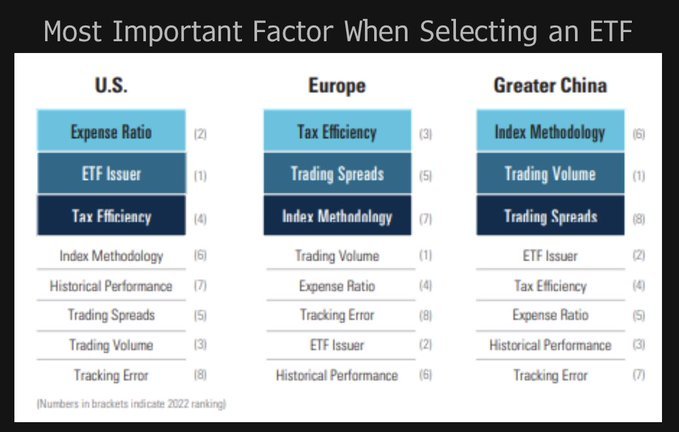
Most Important Factor When Selecting ETF

There are three ETFs tracking the S&P 500 Index available for what seems like a bargain basement fee of just three basis points (0.03%), and they manage a combined $620 billion in assets. However, there are funds that are available for less but are below investors’ radar. 

The BNY US Large Cap ETF (BKLC B+) has no expense ratio because the fee is 0.00%. Despite this, the large-cap ETF has just $1.8 billion in assets. While trading volume matters less to investors than it did in the past, the fund also trades more than 360,000 shares per day. While not as high as S&P 500 Index-based funds, this is sufficiently liquid for advisors and end clients, even before we discuss the liquidity of its holdings Apple, Microsoft, and Amazon. BNY manages just under $4 billion in assets, including $450 million in the BNY International Equity ETF (BKIE ), which provides developed markets exposure for a miniscule 0.04% fee. 

The JPMorgan BetaBuilders US Equity ETF (BBUS A-) charges a 0.02% expense ratio and has $1.5 billion in assets. The ETF trades over 100,000 shares per day, and it too holds Apple, Microsoft, and Amazon. While JPMorgan’s largest ETFs are actively managed, they have used their scale as an advantage in the broad market space.  

Meanwhile, the SoFi Select 500 ETF (SFY B) matches BKLC with an expense ratio of zero, and yet it has $455 million in assets. Like BBUS, it trades just over 100,000 shares. Looking inside SFY, investors will find hefty stakes in Apple, Microsoft, and Amazon as well. 

These three low- or no-cost U.S. core equity ETFs have meaningful histories to compare with one another — and the more well-known S&P 500 Index-based products — since BBUS and SFY launched in 2019 and BKLC launched in 2020. Yet, we think many advisors are not aware that these products exist and can be considered when building asset allocation strategies for new and existing clients.  

If expense ratio matters as much as people claim, then they really should do the homework to understand the cheapest funds available. 

For more news, information, and analysis, visit the Financial Literacy Channel.


Content continues below advertisement

Loading Articles...

Advertisement

Is Your Portfolio Positioned With Enough Global Exposure?

ETF Education Channel

How to Allocate Commodities in Portfolios

Tom LydonApr 26, 2022
2022-04-26

A long-running debate in asset allocation circles is how much of a portfolio an investor should...

Core Strategies Channel

Why ETFs Experience Limit Up/Down Protections

Karrie GordonMay 13, 2022
2022-05-13

In a digital age where information moves in milliseconds and millions of participants can transact...

}
X
