
ETFdb Logo
  • ETF Database
  • Content Hubs
    • Themes
      • Active ETF
      • Alternatives
      • Artificial Intelligence
      • China Insights
      • Core Strategies
      • Crypto
      • Disruptive Technology
      • Energy Infrastructure
      • ETF Building Blocks
      • ETF Investing
      • ETF Strategist
      • Financial Literacy
      • Fixed Income
      • Free Cash Flow
      • Future ETFs
      • Innovative ETFs
      • Institutional Income Strategies
      • Leveraged & Inverse
      • Market Insights
      • Market Outlooks
      • Modern Alpha
      • Nuclear Energy
      • Portfolio Strategies
      • Sector Investing
      • Tax Efficient Income
      • Thematic Investing
    • Asset Class
      • Equity
        • U.S. Equity
        • Int'l Developed
        • Emerging Market Equities
      • Alternatives
        • Gold/Silver/Critical Materials
        • Cryptocurrency
        • Currency
        • Volatility
      • Fixed Income
        • Investment Grade Corporates
        • US Treasuries & TIPS
        • High Yield Corporates
        • Int'l Fixed Income
    • ETF Ecosystem
    • ETFs in Canada
    • Market Outlook
    • Crypto ETF Hub
  • Tools
    • ETF Screener
    • ETF Country Exposure Tool
    • ETF Database Categories
    • Indexes
    • Scenario Analysis
    • Watchlists
    • Head-To-Head ETF Comparison Tool
    • Mutual Fund To ETF Converter
    • ETF Stock Exposure Tool
    • ETF Issuer Fund Flows
  • Research
    • ETF Education
    • Equity Investing
    • Dividend ETFs
    • Leveraged ETFs
    • Inverse ETFs
    • Index Education
    • Index Insights
    • Top ETF Sectors
    • Top ETF Issuers
    • Top ETF Industries
  • Webcasts
  • Sectors
    • Sector Investing Content Hub
    • XLK
    • XLI
    • XLU
    • XLY
    • XLP
    • XLRE
    • Sector Power Rankings
    • XLE
    • XLC
    • XLF
    • XLV
    • XLB
  • Multimedia
    • ETF 360 Video Series
    • ETF of the Week Podcast
    • Gaining Perspective Podcast
    • ETF Prime Podcast
    • Video
  • Company
    • About VettaFi
  • PRO
    • Pro Content
    • Pro Tools
    • Advanced
    • FAQ
    • Free sign up
    • Login
  1. Financial Literacy Content Hub
  2. Magnificent Seven Stocks Are in Different Sectors
Financial Literacy Content Hub
Share

Magnificent Seven Stocks Are in Different Sectors

Todd RosenbluthFeb 20, 2024
2024-02-20

Even if you have not heard of the Magnificent Seven stocks as a group, you likely know the companies.  

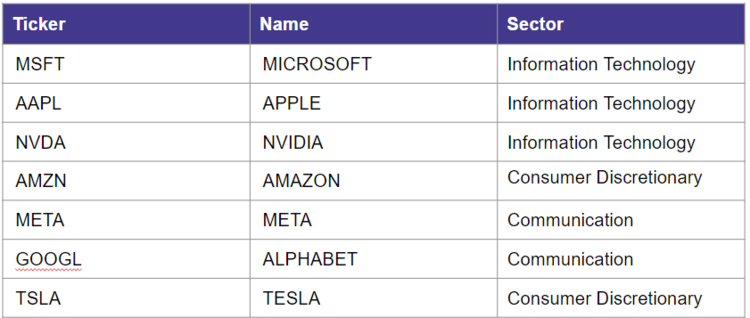
The Magnificent Seven comprises Apple (AAPL), Microsoft (MSFT), Amazon.com (AMZN), Nvidia (NVDA), Meta Platforms (META), Tesla (TSLA), and Alphabet (GOOG) (GOOGL).  

I asked my 13-year-old son to help me take a deeper dive into what some of these companies provide. Apple makes iPhones, iPods, iPads, and Mac computers. Tesla makes electric vehicles that benefit the environment. Alphabet owns YouTube and Google, a search engine platform. Microsoft owns Xbox, Minecraft, Skype, LinkedIn, and the creator of Call of Duty.   

Magnificent Seven Stocks Are in Different Sectors

As my colleague Roxanna Islam wrote, “it makes sense that investors like big tech. They can get exposure to innovation and technological advances while staying relatively safe due to these companies’ scale.”  

However, there is a catch.  


Content continues below advertisement

These Stocks Aren't All Found in ETFs With Tech in Their Name 

The largest information technology ETF is the Vanguard Information Technology ETF (VGT A). The $64 billion VGT’s largest holdings include AAPL, MSFT, and NVDIA out of the Magnificent Seven, but the next largest positions are Adobe, Advanced Micro Devices, Broadcom, and salesforce.com.  

The Technology Select Sector SPDR ETF (XLK A) is not far behind, with $62 billion in assets. XLK has the same top seven holdings as VGT. Software is the largest industry representing 39% of the portfolio, followed by semiconductors & semiconductor equipment (28%), and technology, hardware, storage and peripherals (21%). 

Where Is Alphabet or Amazon? 
Magnificent Seven Stocks Are in Different Sectors

Alphabet is in the communication services sector, according to index providers S&P Dow Jones Indices and MSCI. The largest communications services sector ETF is the Communications Services Select Sector SPDR (XLC A). The $18 billion sector ETF owns a combined 21% stake in GOOG and GOOGL. The top position in the ETF is META at 29%. Other positions include Electronic Arts, Netflix, Walt Disney and Verizon Communications. 

Interactive Media & Services companies make up more than half of XLC assets (52%). This is followed by entertainment (21%), media (15%) and diversified telecommunications services (8%). 

Amazon Is in the Consumer Discretionary Sector

The Consumer Discretionary Select Sector SPDR (XLY A) has a 26% stake in Amazon. Tesla is the next largest position at 14%. Other top-10 holdings in the $20 billion ETF include Chipotle Mexican Grill, McDonalds, Nike, and Starbucks. 

Broadline retail is the largest industry with 26% of assets followed by hotels, restaurants & leisure (24%). Specialty retail and automobiles are also well represented. 

What’s the Takeaway? 

Companies that are highly profitable due to technological advancements are not necessarily in the same sector ETF. You must look at an ETF’s holdings to understand what you own.  

Eli Rosenbluth contributed to this article. 

For more news, information, and analysis, visit the Financial Literacy Channel.

Loading Articles...

Advertisement

Is Your Portfolio Positioned With Enough Global Exposure?

ETF Education Channel

How to Allocate Commodities in Portfolios

Tom LydonApr 26, 2022
2022-04-26

A long-running debate in asset allocation circles is how much of a portfolio an investor should...

Core Strategies Channel

Why ETFs Experience Limit Up/Down Protections

Karrie GordonMay 13, 2022
2022-05-13

In a digital age where information moves in milliseconds and millions of participants can transact...

}
X
