

ETFdb Logo
  • ETF Database
  • Content Hubs
    • Themes
      • Active ETF
      • Alternatives
      • Artificial Intelligence
      • China Insights
      • Core Strategies
      • Crypto
      • Disruptive Technology
      • Energy Infrastructure
      • ETF Building Blocks
      • ETF Investing
      • ETF Strategist
      • Financial Literacy
      • Fixed Income
      • Free Cash Flow
      • Future ETFs
      • Innovative ETFs
      • Institutional Income Strategies
      • Leveraged & Inverse
      • Market Insights
      • Market Outlooks
      • Modern Alpha
      • Nuclear Energy
      • Portfolio Strategies
      • Sector Investing
      • Tax Efficient Income
      • Thematic Investing
    • Asset Class
      • Equity
        • U.S. Equity
        • Int'l Developed
        • Emerging Market Equities
      • Alternatives
        • Gold/Silver/Critical Materials
        • Cryptocurrency
        • Currency
        • Volatility
      • Fixed Income
        • Investment Grade Corporates
        • US Treasuries & TIPS
        • High Yield Corporates
        • Int'l Fixed Income
    • ETF Ecosystem
    • ETFs in Canada
    • Market Outlook
    • Crypto ETF Hub
  • Tools
    • ETF Screener
    • ETF Country Exposure Tool
    • ETF Database Categories
    • Indexes
    • Scenario Analysis
    • Watchlists
    • Head-To-Head ETF Comparison Tool
    • Mutual Fund To ETF Converter
    • ETF Stock Exposure Tool
    • ETF Issuer Fund Flows
  • Research
    • ETF Education
    • Equity Investing
    • Dividend ETFs
    • Leveraged ETFs
    • Inverse ETFs
    • Index Education
    • Index Insights
    • Top ETF Sectors
    • Top ETF Issuers
    • Top ETF Industries
  • Webcasts
  • Sectors
    • Sector Investing Content Hub
    • XLK
    • XLI
    • XLU
    • XLY
    • XLP
    • XLRE
    • Sector Power Rankings
    • XLE
    • XLC
    • XLF
    • XLV
    • XLB
  • Multimedia
    • ETF 360 Video Series
    • ETF of the Week Podcast
    • Gaining Perspective Podcast
    • ETF Prime Podcast
    • Video
  • Company
    • About VettaFi
  • PRO
    • Pro Content
    • Pro Tools
    • Advanced
    • FAQ
    • Free sign up
    • Login
  1. Fixed Income Content Hub
  2. Chart of the Week: Advisors Looking at Municipal Bonds Choices
Fixed Income Content Hub
Share

Chart of the Week: Advisors Looking at Municipal Bonds Choices

Todd RosenbluthFeb 29, 2024
2024-02-29

Investors continue to turn to low-cost core taxable bond ETFs in 2024. The Vanguard Total Bond Market ETF (BND A-) and the iShares Core Aggregate Bond ETF (AGG A-) gathered $2.5 billion and $2.1 billion, respectively, as of late February. However, on a total return basis, the pair were outperformed by their tax-free cousins. 

AGG and BND were down 1.8% to start the year. They incurred wider initial losses than the 0.4% for the iShares National Muni Bond ETF (MUB A+) and the 0.6% for the Vanguard Tax Exempt Bond ETF (VTEB ). Many fixed-income-minded advisors recently told VettaFi they planned to add muni bond exposure. 

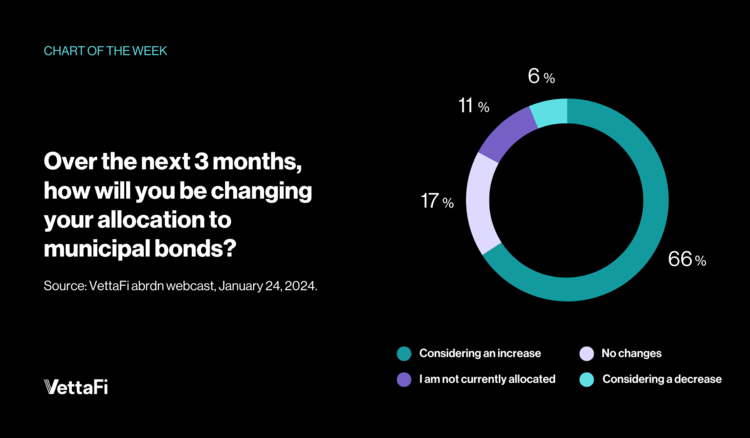
During a VettaFi webcast with abrdn in late January, we asked advisors, “Over the next 3 months, how will you be changing your allocation to municipal bonds?” Nearly two-thirds (66%) said they were considering an increase, significantly more than the 6% that were considering a decrease. 
Benefits of Municipal Bond ETFs

Benefits of Municipal Bond ETFs

While advisors often own municipal bonds directly or through a mutual fund, we think municipal bond ETFs are gaining further attention. MUB and VTEB own thousands of investment-grade bonds from issuers around the country, and charge miniscule 0.05% net expense ratios. MUB has more exposure to AAA- and a lower stake in A-rated bonds than VTEB. This helps explain the slight performance difference between the pair. Both funds have an average duration of approximately six years and can support the core of a portfolio. 

There are some popular funds for advisors seeking less interest-rate sensitivity given the uncertainty of monetary policy. The iShares Short-Term National Muni Bond ETF (SUB A-) and the SPDR Nuveen Bloomberg Short Term Municipal Bond ETF (SHM A-) manage $9 billion and $4 billion, respectively. However, we think SUB (1.8 years) and SHM (2.6 years) will not benefit as much if the Federal Reserve aggressively cuts interest rates in 2024.  


Content continues below advertisement

Active Municipal Bonds ETFs 

Many advisors have long turned to municipal bond mutual funds to gain exposure to professional management. However, there are some strong actively managed ETFs to consider. 

For example, the PIMCO Intermediate Municipal Bond Active ETF (MUNI B+) rose 5.5% in the 12-month period ended February 23. This return was stronger than MUB’s 5.1%, even as MUNI charged a higher 0.35% fee. Relative to its index-based peer, actively managed MUNI took on some additional credit risk and invested in nonrated bonds.  

Meanwhile, the AB Tax-Aware Short Duration Municipal Bond ETF (TAFI ) had a one-year total return of 4.0%, ahead of the 3.4% for SUB. TAFI was relatively diversified at the state level. At the end of January, California (8.2% of assets), New Jersey (7.7%), and New York (7.4%) were the largest. However, unlike index peers, no state represented more than 10% of fund assets. TAFI charges a 0.27% fee.  

VettaFi will be talking to muni bond experts from AB during an upcoming March webcast for advisors.  

For more news, information, and analysis, visit the Fixed Income Channel.

Loading Articles...

Advertisement

Is Your Portfolio Positioned With Enough Global Exposure?

ETF Education Channel

How to Allocate Commodities in Portfolios

Tom LydonApr 26, 2022
2022-04-26

A long-running debate in asset allocation circles is how much of a portfolio an investor should...

Core Strategies Channel

Why ETFs Experience Limit Up/Down Protections

Karrie GordonMay 13, 2022
2022-05-13

In a digital age where information moves in milliseconds and millions of participants can transact...

}
X
