


Airline stocks screened into the VictoryShares Free Cash Flow ETF (VFLO ) during the ETF’s March 2025 rebalance/reconstitution and remain following the most recent one in June 2025.
VFLO’s indexed approach seeks to provide exposure to high quality companies, trading at a discount with favorable growth prospects. VFLO’s Index holds companies with strong free cash flow (FCF), a powerful measure of the quality of a company. FCF is the remaining cash a company has after covering all expenses. It can be used to invest in growing the business, pay dividends, or pay down debt.
The ETF tracks the Victory U.S. Large Cap Free Cash Flow Index (the Index), which targets companies that generate strong FCF by first applying a profitability screen to a universe of U.S. large-cap stocks. The Index then selects companies with the highest FCF yields that exhibit higher growth potential based on a combination of trailing and forward-looking metrics.
See more: How Popular FCF ETF ‘VFLO’ May Help to Avoid Value Traps
Airline Stocks Remain Strong Free Cash Flow Generators
Delta Air Lines (DAL) and United Airlines Holding (UAL) were added to VFLO during the ETF’s March rebalance. More recently, the two airline stocks comprised 3.5% of the ETF by weight as of June 20, 2025, following June’s quarterly rebalance.
United Airlines serves as a case study: while the company generates strong free cash flow, it was a price decline that drove up its FCF yield — ultimately causing it to screen into the Index, according to Michael Mack, client portfolio manager at Victory Capital, in an interview with VettaFi.
United Airlines approached COVID-level lows this year. After UAL was added to VFLO, the market soon corrected itself and United Airlines stock rose 30% off its lows. According to Mack, a cyclical stock that’s down 50% has likely already priced in a recession.
While as of June 27, 2025, United Airlines still appears down from its high at $110, it was added to VFLO when shares were in the $70 range. When FCF remains stable despite falling share prices, the resulting increase in FCF yield may help a stock screen into the Index — especially when future free cash flow and growth expectations appear constructive.
“You have free cash flow over enterprise value,” Mack explained. “The [FCF] fundamentals did not deteriorate as much as the price did, so that’s what pushed up the FCF yield, and allowed United Airlines to screen in to the Index.”
Importantly, the Index methodology underpinning VFLO considers future growth potential as it is based on both trailing and forward-looking metrics. The forward-look analysis for United Airlines did not show any deterioration, underscoring why it was added to VFLO.
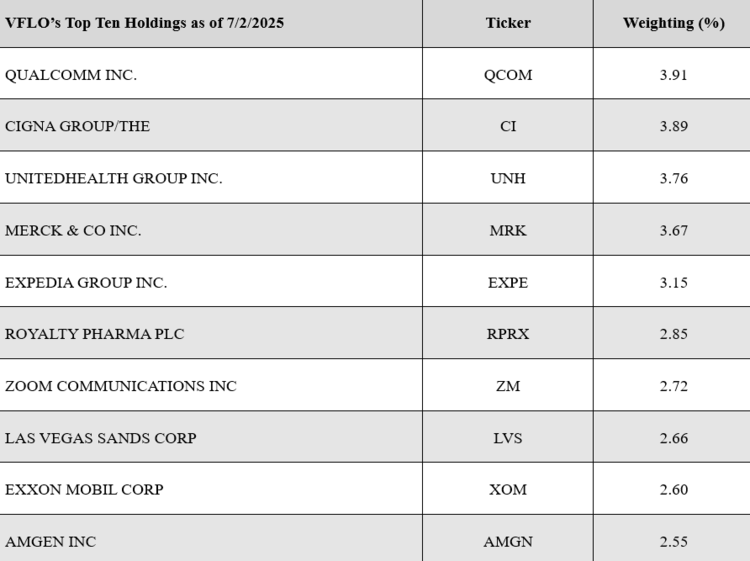
As of 7/2/2025 the ETF held a 1.84% in DAL and a 1.77% position in UAL.
For more news, information, and analysis, visit the Free Cash Flow Content Hub
Carefully consider a fund’s investment objectives, risks, charges, and expenses before investing. To obtain a prospectus or summary prospectus containing this and other important information, visit http://www.vcm.com/prospectus. Read it carefully before investing.
All investing involves risk, including the potential loss of principal. The Fund has the same risks as the underlying securities traded on the exchange throughout the day. ETFs may trade at a premium or discount to their net asset value. Index Funds invest in securities included in, or representative of securities included in, the Index, regardless of their investment merits. The performance of the Fund may diverge from that of the Index. Investing in companies with high free cash flows could lead to underperformance when such investments are unpopular or during periods of industry disruptions. The fund could also be affected by company-specific factors that could jeopardize the generation of free cash flow. The value of your investment is also subject to geopolitical risks such as wars, terrorism, trade disputes, environmental disasters, and public health crises; the risk of technology malfunctions or disruptions; and the responses to such events by governments and/or individual companies.
The Victory U.S. Large Cap Free Cash Flow Index aims to select high quality companies from its starting universe by applying profitability screens. It then selects companies with the strongest free cash flow yield that exhibit higher growth. The Index is rebalanced and reconstituted quarterly. This Index calculates free cash flow yield by dividing expected free cash flow by enterprise value. Expected free cash flow is the average of trailing 12-month FCF and next 12-month forward free cash flow. Enterprise value (EV) measures a company’s total value, often used as a more comprehensive alternative to equity market capitalization.
VictoryShares ETFs distributed by Victory Capital Services, Inc. (VCS). VCS is not affiliated with VettaFi.
20250707-4621684
VettaFi LLC (“VettaFi”) is the index provider for VFLO, for which it receives an index licensing fee. However, VFLO is not issued, sponsored, endorsed, or sold by VettaFi. VettaFi has no obligation or liability in connection with the issuance, administration, marketing, or trading of VFLO.

