

ETFdb Logo
  • ETF Database
  • Content Hubs
    • Themes
      • Active ETF
      • Alternatives
      • Artificial Intelligence
      • China Insights
      • Core Strategies
      • Crypto
      • Disruptive Technology
      • Energy Infrastructure
      • ETF Building Blocks
      • ETF Investing
      • ETF Strategist
      • Financial Literacy
      • Fixed Income
      • Free Cash Flow
      • Future ETFs
      • Innovative ETFs
      • Institutional Income Strategies
      • Leveraged & Inverse
      • Market Insights
      • Market Outlooks
      • Modern Alpha
      • Nuclear Energy
      • Portfolio Strategies
      • Sector Investing
      • Tax Efficient Income
      • Thematic Investing
    • Asset Class
      • Equity
        • U.S. Equity
        • Int'l Developed
        • Emerging Market Equities
      • Alternatives
        • Gold/Silver/Critical Materials
        • Cryptocurrency
        • Currency
        • Volatility
      • Fixed Income
        • Investment Grade Corporates
        • US Treasuries & TIPS
        • High Yield Corporates
        • Int'l Fixed Income
    • ETF Ecosystem
    • ETFs in Canada
    • Crypto ETF Hub
  • Tools
    • ETF Screener
    • ETF Country Exposure Tool
    • ETF Database Categories
    • Indexes
    • Scenario Analysis
    • Watchlists
    • Head-To-Head ETF Comparison Tool
    • Mutual Fund To ETF Converter
    • ETF Stock Exposure Tool
    • ETF Issuer Fund Flows
  • Research
    • ETF Education
    • Equity Investing
    • Dividend ETFs
    • Leveraged ETFs
    • Inverse ETFs
    • Index Education
    • Index Insights
    • Top ETF Sectors
    • Top ETF Issuers
    • Top ETF Industries
  • Webcasts
  • Sectors
    • Sector Investing Content Hub
    • XLK
    • XLI
    • XLU
    • XLY
    • XLP
    • XLRE
    • Sector Power Rankings
    • XLE
    • XLC
    • XLF
    • XLV
    • XLB
  • Multimedia
    • ETF 360 Video Series
    • ETF of the Week Podcast
    • Gaining Perspective Podcast
    • ETF Prime Podcast
    • Video
  • Company
    • About VettaFi
  • PRO
    • Pro Content
    • Pro Tools
    • Advanced
    • FAQ
    • Free sign up
    • Login
  1. Free Cash Flow Content Hub
  2. Divvy up Volatility With Victory’s CFA ETF
Free Cash Flow Content Hub
Share

Divvy up Volatility With Victory's CFA ETF

Tom LydonJun 15, 2020
2020-06-15

Some broad market benchmarks may not be as diverse as investors are led to believe. Take the case of the S&P 500 where six stocks – Apple (NASDAQ: AAPL), Microsoft (NASDAQ: MSFT), Amazon (NASDAQ: AMZN), Facebook (NASDAQ: FB) and two share classes of Alphabet (NASDAQ: GOOG) combine for over 21% of the index’s weight.

That may not be the level of diversity investors are looking for, and can sometimes introduce them to more volatility than is desired. The VictoryShares US 500 Volatility Wtd ETF (CFA B) is an exchange traded fund that aims to rectify this scenario.

The $706 million CFA, which turns seven years old on July 1, follows the Nasdaq Victory US Large Cap 500 Volatility Weighted Index. That index not only makes it a point to only include companies with four straight quarters of positive earnings, it weights components by volatility. Less volatile names receive larger weights while the more volatile names in the benchmark garner lower allocations.

CFA could be a credible idea for investors looking for strategies that are truly diverse at the holdings level, not just dominated by a smaller number of companies.

“Remember, in recent years domestic market leadership has been dominated by just a handful of mega-cap stocks. As of the end of the first quarter, the top 10 stocks in the S&P 500® Index represented 27.4% of the Index,” writes Victory Capital’s Scott Kefer. “That type of overweight position was fine when the proverbial FAANG + M stocks—Facebook, Apple, Amazon, Netflix, Google (i.e. Alphabet) and Microsoft—were providing a nice tailwind and powering returns in the S&P 500.”

None of CFA’s holdings exceed a weight of 0.40%.
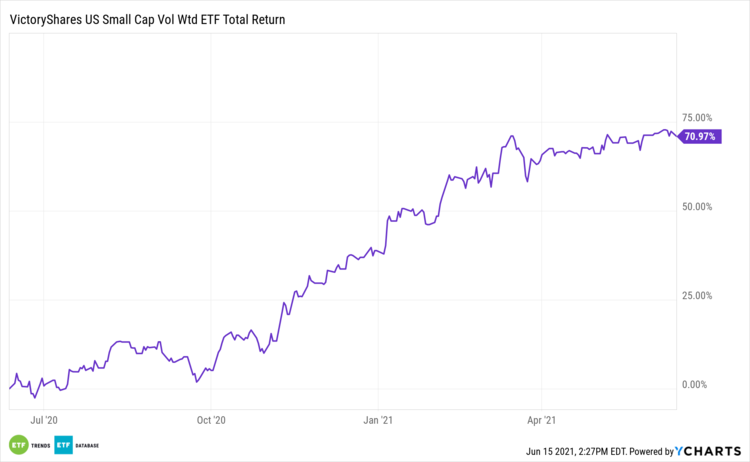
victoryshares us small cap

CFA Refreshes Broad Market Exposure

For investors that want truly diverse large cap exposure without concentration risk, CFA is one practical option. Additionally, the fund’s volatility-weighted methodology is suitable for risk-averse investors seek core exposure.

“For example, a volatility-weighting methodology allocates to stocks based on volatility, so each stock in the portfolio has an equal contribution to overall risk,” adds Kefer. “Not only is that a more diversified approach, but it could insulate investors against the possible underperformance of mega-cap stocks versus the broad market, while also providing greater exposure to cyclical stocks and sectors.”

CFA has another benefit: by weighting stocks by volatility, the fund is overweight some value sectors – namely financial services and industrials. Those groups combine for over 34% of CFA’s roster, as compared to less than 21% of the S&P 500.

Those differences are meaningful because CFA is slightly outpacing the S&P 500 this year while trouncing the MSCI USA Minimum Volatility Index.

For more news, information, and analysis, visit the Free Cash Flow Channel


Content continues below advertisement

Loading Articles...

Advertisement

Is Your Portfolio Positioned With Enough Global Exposure?

ETF Education Channel

How to Allocate Commodities in Portfolios

Tom LydonApr 26, 2022
2022-04-26

A long-running debate in asset allocation circles is how much of a portfolio an investor should...

Core Strategies Channel

Why ETFs Experience Limit Up/Down Protections

Karrie GordonMay 13, 2022
2022-05-13

In a digital age where information moves in milliseconds and millions of participants can transact...

}
X
