


Victory Capital’s large cap free cash flow (FCF) ETF has a unique weighting methodology that may enhance returns.
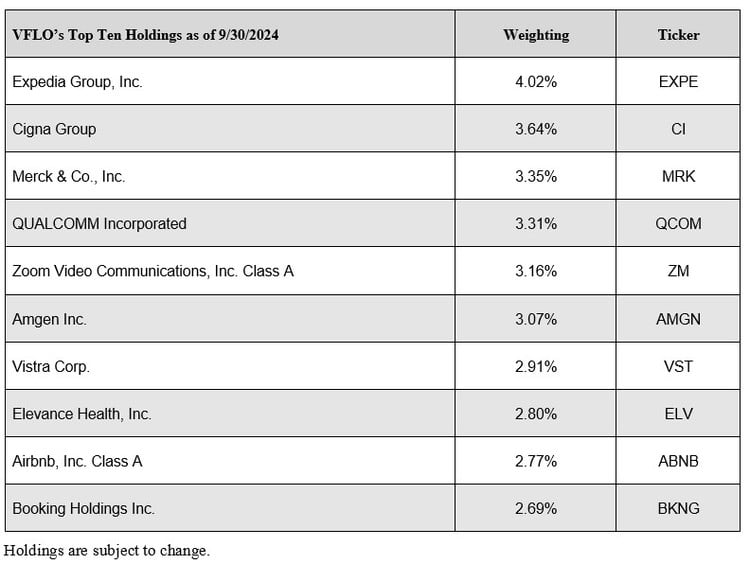
The VictoryShares Free Cash Flow ETF (VFLO) gives weights to securities in the portfolio based on the company’s FCF yield. This can potentially enhance returns, as has been the case with the ETF’s largest-weighted holding, Expedia (EXPE).
See More: VFLO’s Q3 Rebalance Brings Profitability Into Focus
VFLO tracks the Victory U.S. Large Cap Free Cash Flow Index (the Index), which targets companies that generate strong FCF by first applying a profitability screen to a universe of U.S. large-cap stocks. The Index then selects companies with the highest FCF yields exhibiting higher growth potential. The growth potential is based on both trailing and forward-looking metrics.
VFLO focuses on companies with strong FCF, a powerful measure of the quality of a company. FCF is the remaining cash a company has after covering all expenses. It can be used to invest in growing the business, pay dividends, or pay down debt.
Expedia: A Case Study on Sizing Positions to Enhance Returns
Expedia is an excellent example of why VFLO’s underlying index sizes positions based on FCF yield. The company, which is among the top-performing securities in VFLO, is currently the largest holding, comprising 4.57% of the ETF by weight as of November 22, according to Victory Capital’s website.
“The reason it’s our best performer is because when it sells off, we increase our weight,” Michael Mack, associate portfolio manager for VictoryShares and Solutions, told VettaFi. “The yield goes up, and we give it a higher weighting.”
When a stock sells off, its share price falls. This effectively drives up FCF yield, which is a solvency ratio that compares a company’s FCF to the value of its assets. FCF yield is calculated by dividing FCF by enterprise value (EV).
See More: Make Sure Your Free Cash Flow ETF Uses Forward-Looking Metrics
In turn, when Expedia rallies, VFLO will sell and take profits because its FCF yield is lower than when VFLO first created a position. This process repeats as the security’s price and FCF yield fluctuate.
“[Expedia] sold off when it first became a big position [in VFLO]. The stock doubled, we cut the position in half,” Mack said. “It goes down again; becomes a big position again. Basically, [VFLO is] going to own more [shares] at $100 than we do at $200.”
To conclude, FCF yield is the metric used within the index methodology to optimally weight the portfolio, as it will indicate to buy more shares when the price is low and sell when the price appreciates significantly.
For more news, information, and analysis, visit the Free Cash Flow Channel
VettaFi LLC (“VettaFi”) is the index provider for VFLO, for which it receives an index licensing fee. However, VFLO is not issued, sponsored, endorsed, or sold by VettaFi, and VettaFi has no obligation or liability in connection with the issuance, administration, marketing, or trading of VFLO.
Disclosure Information
Carefully consider a fund’s investment objectives, risks, charges, and expenses before investing. To obtain a prospectus or summary prospectus containing this and other important information, visit "http://www.vcm.com/prospectus":https://www.vcm.com/products/victoryshares-etfs/victoryshares-etfs-list/victoryshares-free-cash-flow-etf. Read it carefully before investing. All investing involves risk, including the potential loss of principal.
All investing involves risk, including the potential loss of principal. Please note that the Fund is a new ETF with a limited history. The Fund has the same risks as the underlying securities traded on the exchange throughout the day. Redemptions are limited, and commissions are often charged on each trade. ETFs may trade at a premium or discount to their net asset value. The ETF invests in securities included in, or representative of securities included in, the Index, regardless of their investment merits.
The performance of the Fund may diverge from that of the Index. Investing in companies with high free cash flows could lead to underperformance when such investments are unpopular or during periods of industry disruptions The ETF could also be affected by company-specific factors that could jeopardize the generation of free cash flow. Investments concentrated in an industry or group of industries may face more risks and exhibit higher volatility than investments that are more broadly diversified over industries or sectors. Derivatives may not work as intended and may result in losses.
Additional Information
If a seed investor redeems its shares, it could negatively impact the Funds’ NAV, market price and brokerage costs. The ETF has the same risks as the underlying securities traded on the exchange throughout the day. Redemptions are limited, and commissions are often charged on each trade. ETFs may trade at a premium or discount to their net asset value. The ETF invests in securities included in, or representative of securities included in, the Index, regardless of their investment merits.
Large shareholders, including other funds advised by the Adviser, may own a substantial amount of the Fund’s shares. The actions of large shareholders, including large inflows or outflows, may adversely affect other shareholders, including potentially increasing capital gains. The value of your investment is also subject to geopolitical risks such as wars, terrorism, environmental disasters, and public health crises; the risk of technology malfunctions or disruptions; and the responses to such events by governments and/or individual companies.
The Victory U.S. Large Cap Free Cash Flow Index aims to select high quality companies from its starting universe by applying profitability screens. It then selects companies with the strongest free cash flow yield that exhibit higher growth. The Index is rebalanced and reconstituted quarterly. This Index calculates free cash flow yield by dividing expected free cash flow by enterprise value. Expected free cash flow is the average of trailing 12-month FCF and next 12-month forward free cash flow. Enterprise value (EV) measures a company’s total value, often used as a more comprehensive alternative to equity market capitalization.
VictoryShares ETFs distributed by Victory Capital Services, Inc. (VCS). VCS is not affiliated with VettaFi.
20241231-4124539

