


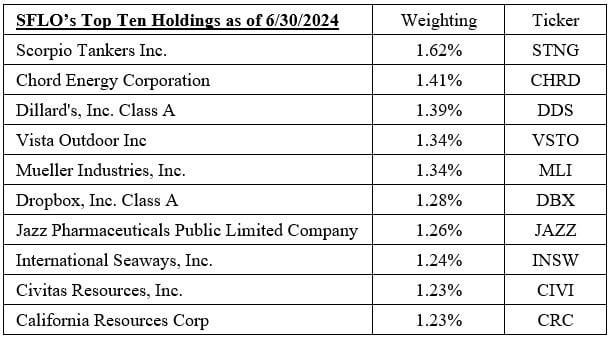
Oil tankers benefitted from heightened geopolitical turmoil and tension in the first half of the year. The VictoryShares Small Cap Free Cash Flow ETF (SFLO ) currently carries several oil tanker companies after the ETF’s second-quarter rebalance in June 2024.
SFLO seeks to track the Victory U.S. Small Cap Free Cash Flow Index (the Index), before fees and expenses, which provides exposure to small-cap companies with high free cash flow yields.
Free cash flow (FCF) is the remaining cash a company has after covering all expenses. It can be used to invest in growing the business, pay dividends, or pay down debt. FCF can be a good indicator of a company’s overall health.
The constituents captured within the Index methodology are small-cap companies that demonstrate high-quality and favorable growth potential. The Index includes companies with high FCF yields and the highest expected growth rates. The holistic approach to FCF identifies not just favorable companies now, but those positioned favorably looking ahead by factoring in forward-looking FCF estimates, not just trailing.
First Half Tailwinds for Oil Tankers
Ongoing geopolitical turmoil led to shipping disruptions and longer charters during 2024’s first half, reported Reuters. For oil tankers, the rising charter rates and increasingly constrained supply may be two key reasons for higher revenues and elevated stock prices.
Scorpio Tankers Inc. is one of the top holdings within SFLO as of the second quarter rebalance. The company is carried at 1.62% weight as of 6/30/2024. The tanker company reported $214 million in net income for the first quarter in its press release. It’s a notable increase from $193 million during the year prior in Q1 2023.
In its first quarter earnings, the company also announced an unscheduled reduction in its debt. Between January 1 to May 8, 2024, the company paid down $277.8 million in debt and lease repayments.
The company also announced a lower cash breakeven point of $3,500 daily.
“Reducing our debt and lowering our cash break-even rate increases cash flow in any rate environment. This allows the company to act opportunistically to further increase shareholder returns,” Emanuele A. Lauro, Chairman and CEO of Scorpio Tankers, said in the press release.
The inclusion of Scorpio Tankers within the portfolio is an illustrative example of the potential benefits a forward-looking approach like SFLO’s has in taking a holistic assessment of FCF with a focus on quality and growth potential.
SFLO carries a net expense ratio of 0.49% (gross expense ratio of 0.76%).
Net expense ratios reflect the contractual waiver and or reimbursement of management fees through at least December 31, 2024.
VettaFi LLC (“VettaFi”) is the index provider for SFLO, for which it receives an index licensing fee. However, SFLO is not issued, sponsored, endorsed, or sold by VettaFi, and VettaFi has no obligation or liability in connection with the issuance, administration, marketing, or trading of SFLO.
For more news, information, and analysis, visit the Free Cash Flow Channel
Disclosure Information
Carefully consider a fund’s investment objectives, risks, charges, and expenses before investing. To obtain a prospectus or summary prospectus containing this and other important information, visit http://www.vcm.com/prospectus. Read it carefully before investing. All investing involves risk, including the potential loss of principal.
All investing involves risk, including the potential loss of principal. Please note that the Fund is a new ETF with a limited history. The Fund has the same risks as the underlying securities traded on the exchange throughout the day. Redemptions are limited, and commissions are often charged on each trade. ETFs may trade at a premium or discount to their net asset value. The Fund invests in securities included in, or representative of securities included in, the Index, regardless of their investment merits. The performance of the Fund may diverge from that of the Index. Investments in smaller companies typically exhibit higher volatility. Investing in companies with high free cash flows could lead to underperformance when such investments are unpopular or during periods of industry disruptions.
The fund could also be affected by company-specific factors that could jeopardize the generation of free cash flow. Derivatives may not work as intended and may result in losses. Large shareholders, including other funds advised by the Adviser, may own a substantial amount of the Fund’s shares. The actions of large shareholders, including large inflows or outflows, may adversely affect other shareholders, including potentially increasing capital gains. Investments in mid-cap companies typically exhibit higher volatility. The value of your investment is also subject to geopolitical risks such as wars, terrorism, environmental disasters, and public health crises; the risk of technology malfunctions or disruptions; and the responses to such events by governments and/or individual companies.
Additional Information
Investments in small-capitalization companies involve greater risks than those associated with larger, more established companies. Free Cash Flow Risk—Investing in companies with high free cash flows could lead to underperformance during periods when such investments are unpopular, and fluctuations in market conditions, industry disruptions, or company-specific factors may jeopardize the generation of free cash flow. Fund holdings and sector allocations are subject to change, may differ from the Index, and should not be considered investment advice.
The Victory U.S. Small Cap Free Cash Flow Index aims to select high quality companies from its starting universe by applying profitability screens. It then selects companies with the strongest free cash flow yield that exhibit higher growth. The Index is rebalanced and reconstituted quarterly. This Index calculates free cash flow yield by dividing expected free cash flow by enterprise value. Expected free cash flow is the average of trailing 12-month FCF and next 12-month forward free cash flow. Enterprise value (EV) measures a company’s total value, often used as a more comprehensive alternative to equity market capitalization.
Distributed by Foreside Fund Services, LLC (Foreside). Foreside is not affiliated with Victory Capital Management Inc., the Fund’s investment adviser.

