

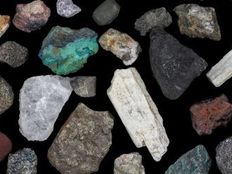
Moves from both the federal government and private sector could empower more investment opportunities in the critical materials sector.
What U.S. Equity Stakes Mean for the Mining Industry
Steven Schoffstall, director, ETF product management at Sprott Asset Management, recently discussed this during an episode of Metals in Motion. In the episode, host Thalia Hayden noted that the U.S. government has taken a number of different equity stakes in different mining companies in order to reduce reliance on foreign countries. Turning to Schoffstall, she asked him what impact these stakes are having on the mining industry as a whole.
As Schoffstall explained, these equity stakes mark a crucial step for a number of reasons. For one, they represent rhetoric moving into discernible action, with new capital moving into the mining space. Furthermore, Schoffstall noted that these investments help bolster a stronger domestic supply chain. As such, this investment contributes to generating capital, as well as providing support and clarity.
How the Private Sector is Meeting the Moment
The public sector isn’t the only area that’s supporting the mining and critical materials industries. Schoffstall and Hayden also discussed J.P. Morgan’s $1.5 trillion investment initiative to bolster U.S. economic security.
Crucially, this initiative focuses, in part, on the processing and mining of critical materials, along with nuclear energy. Schoffstall asserted that this initiative represents the largest investment from the private sector. Furthermore, this initiative, along with the actions from the federal government, is leading to significant inflows from interested investors.
“The main takeaway from all these announcements is that it’s not just rare earths, uranium or copper, where we’re seeing investment come in,” Schoffstall added. “It is indeed across the entire spectrum of critical materials.”
Sprott’s suite of ETFs can help provide distinct access to the critical materials and mining sector. For instance, the Sprott Critical Materials ETF (SETM ) offers pure-play access to a wide variety of different critical materials and miners. This includes uranium, lithium, silver, cobalt, rare earths, and more.
Alternatively, the Sprott Active Metals & Miners ETF (METL ) could offer appeal for its actively managed approach. METL takes advantage of Sprott’s decades of experience in navigating the markets of metals and mining to seek out the investments with long-term potential. Despite not directly focusing on critical materials, the fund does have a sizable exposure towards the critical materials sector.
For more news, information, and analysis, visit the Gold/Silver/Critical Minerals Content Hub.
An investor should consider the investment objectives, risks, charges, and expenses carefully before investing. To obtain a Prospectus, which contains this and other information, contact your financial professional or call 888.622.1813. Read the Prospectus carefully before investing, which can also be found by clicking one of the links below.
Past performance is no guarantee of future results. One cannot invest directly in an index.
Funds that emphasize investments in small/mid-cap companies will generally experience greater price volatility. Diversification does not eliminate the risk of investment losses. ETFs are considered to have continuous liquidity because they allow an individual to trade throughout the day. A higher portfolio turnover rate may indicate higher transaction costs and may result in higher taxes when Fund shares are held in a taxable account. These costs, which are not reflected in annual fund operating expenses, affect the Fund’s performance.
Sprott Asset Management USA, Inc. is the Investment Adviser to the ETFs. ALPS Distributors, Inc. is the Distributor for the ETFs and is a registered broker-dealer and FINRA Member. ALPS Distributors, Inc. is not affiliated with Sprott Asset Management USA, Inc. or VettaFi.
Exchange Traded Funds (ETFs): SETM, LITP, URNM, URN, COPP, COPJ, NIKL, SGDM, SGDJ, SLVR, GBUG, METL
Physical Bullion Funds: PHYS, PSLV, CEF, and SPPP.
Gold and precious metals are referred to with terms of art like store of value, safe haven and safe asset. These terms should not be construed to guarantee any form of investment safety. While “safe” assets like gold, Treasuries, money market funds and cash generally do not carry a high risk of loss relative to other asset classes, any asset may lose value, which may involve the complete loss of invested principal.

