


The largest U.S. high yield bond ETFs have seen sizable net outflows thus far in 2023, but in mid- March, there are positive signs. According to VettaFi’s investment sentiment analysis, high yield bond ETFs represented a higher percentage of the corporate bond fund traffic on VettaFi platforms in mid-March relative to a month earlier. In addition, the iShares iBoxx $High Yield Corporate Bond ETF (HYG ) gathered approximately $550 million of new money in the seven-day period ended March 21 to push its asset base to $13 billion, the SPDR Bloomberg High Yield Bond ETF (JNK ) added nearly $200 million to hit $6.6 billion, and the iShares Broad USD High Yield Corporate Bond ETF (USHY ) pulled in $31 million to push it to $8.7 billion. Yet many advisors are not inclined to make changes to their high yield credit exposure over the next six months.
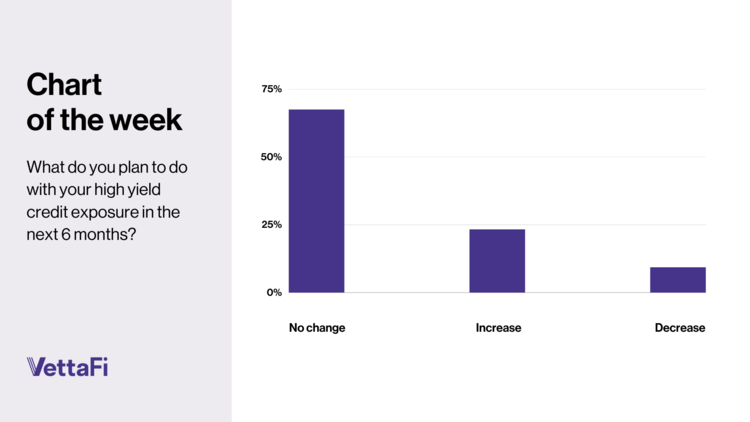
During a VettaFi webcast in mid-March, 67% of advisor respondents told us they have no plans to make an intermediate-term change to their high yield exposure, with just 23% planning to increase and 9.3% planning to decrease the stake. We thought this was a good opportunity to highlight the credit exposure typically found within a high yield bond ETF and how advisors can reduce their clients’ risk profiles using alternative funds.
According to S&P Global, bonds rated BBB — the lowest category of investment-grade — are from issuers with “adequate capacity to meet financial commitments, but more subject to adverse economic conditions.” Bonds rated BB — the highest category of speculative-grade — are from issuers “less vulnerable in the near term but faces major ongoing uncertainties to adverse business, financial and economic conditions.” Meanwhile, bonds rated CCC are “currently vulnerable and dependent on favorable business, financial, and economic conditions to meet financial commitments.” The lower the credit rating, the greater the likelihood of default.
HYG and USHY have 50% and 47% of assets, respectively, in bonds rated BB, 38% and 39% in bonds rated B, and 10% and 11% in bonds rated CCC or below; the remainder is mostly in cash and equivalents.
To compensate for this risk, USHY and HYG sport 30-day SEC yields of 8.8% and 8.3%, respectively. For advisors willing to trade some of the income generation for more exposure to higher-quality BB-rated bonds, there are some interesting ETFs.
Two of them invest in bonds that previously had an investment-grade rating but were downgraded. These bonds are known as fallen angels because the bonds often get oversold, as many investors can no longer hold them.
The iShares Fallen Angels USD Bond ETF (FALN ) and the VanEck Fallen Angel High Yield Bond ETF (ANGL ) each had 81% of assets in bonds rated BB. FALN has the lower expense ratio (0.25% vs. 0.35%) and a higher yield (7.8% vs 7.1%). But ANGL has more assets ($2.6 billion vs. $1.5 billion) and has a higher average daily volume (2.2 million shares to 1.0 million).
The BondBloxx BB Rated USD High Yield Corporate Bond ETF (XBB ), a newer, smaller ETF, provides an alternative with 99% of assets invested in BB-rated bond issues. The fund, which has $45 million in assets after launching in mid 2022, has a 30-day SEC yield of 6.8%.
Advisors might be concerned about concentration risk from investing in just bonds with one credit rating, but these ETFs are well diversified. XBB holds nearly 800 securities from more than 350 issuers, while ANGL and FALN have more than 200 holdings. For those seeking to maintain or add exposure to high yield, these modestly lower-risk ETFs might be worthy of consideration.
For more news, information, and analysis, visit the Institutional Income Strategies Channel.

