


Markets continued their bounce from Wednesday’s July consumer price index report that inflation rose just 8.5% year-over-year, coming in under analyst expectations of 8.7%, with the follow-up producer price index report on Thursday for July dropping 0.5% month-over-month. It’s the first time PPI has dropped in over two years and has investors hopeful that inflation has peaked.
Core inflation for July remained flat month-over-month, which takes out food and energy — often volatile contributors — and is a closer gauge of what the Federal Reserve will be looking at when they meet again in September.
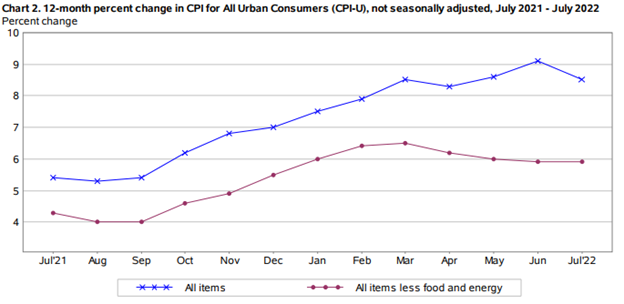
While gas prices have dropped (the gasoline index was down 7.7% in July), food prices have risen substantially, with the food-at-home index (a gauge of grocery store price changes) gaining 1.3% in July for a 10.9% year-over-year increase, the biggest 12-month rise. since 1979.
Shelter, one of the major contributors to CPI and core inflation, increased again in July, rising 0.5% after a 0.6% gain in June. Housing prices have finally begun to come down from their soaring highs, but as rental prices and the owner’s equivalent rent (OER is used to calculate how much a homeowner would pay to rent their home) typically lag by several months, shelter is expected to create inflationary pressure well into next year.
The core personal consumption expenditures price index (PCE) which measures what consumers are paying for goods and services, is one of the primary gauges that the Fed uses when it determines interest rate increases, alongside CPI. PCE for July will be released on August 26.
Investing for Any Market with Managed Futures
Markets may be back to risk-on as investor sentiment improves from hopeful inflation reports and a stronger than expected earnings season, but the Fed has indicated that it will need to see strong, consecutive signals that inflation is falling before it will be willing to back off from interest rate increases. Volatility is expected to continue as the labor market remains strong while growth drops off.
Investors looking for a fund that has performed well during volatility, as well as trend-followers who are considering funds performing above their moving day averages, should consider the iMGP DBi Managed Futures Strategy ETF (DBMF ).
DBMF is a managed futures fund designed to capture performance no matter how equity markets are moving. The fund seeks long-term capital appreciation by investing in some of the most liquid U.S.-based futures contracts in a strategy utilized by hedge funds.
DBMF allows for the diversification of portfolios across asset classes that are uncorrelated to traditional equities or bonds. It is an actively managed fund that uses long and short positions within derivatives, mostly futures contracts, and forward contracts. These contracts span domestic equities, fixed income, currencies, and commodities (via its Cayman Islands subsidiary).
The position that the fund takes within domestic managed futures and forward contracts is determined by the Dynamic Beta Engine. This proprietary, quantitative model attempts to ascertain how the largest commodity-trading advisor hedge funds have their allocations. It does so by analyzing the trailing 60-day performance of CTA hedge funds and then determining a portfolio of liquid contracts that would mimic the hedge funds’ performance (not the positions).
DBMF takes long positions in derivatives with exposures to asset classes, sectors, or markets that are anticipated to grow in value and takes short positions in derivatives with exposures expected to fall in value. Under normal market conditions, the fund seeks to maintain volatility between 8%–10% annually.
DBMF has a management fee of 0.85% and an additional 10 bps for other expenses listed in the prospectus.
For more news, information, and strategy, visit the Managed Futures Channel.

