


As a species, we are hard-wired to respond to danger, panic, and stress with a dump of adrenaline that often short-circuits higher-reasoning functions. This allows us to take in and process more information at greater speeds. But what happens when crisis strikes and more information only increases uncertainty, particularly within investing?
That’s the challenge advisors and investors continue to face this year. The market crash — that followed on the heels of massive U.S. tariffs across all imports — was pronounced last week. Announcement of changes to U.S. tariff policy less than 12 hours later sent markets surging. The historic rally fizzled, however, on yet more tariff announcements. Investors fled from U.S. stocks and bonds alike. They sought refuge in safe havens such as gold, as market panic reached an intensity not seen since the onset of the COVID-19 pandemic.
Rapidly changing and uncertain U.S. economic and trade policy continues to wreak havoc in markets. With so much changing day-to-day, crafting any sort of outlook remains incredibly difficult, if not impossible. Jeff Blazek, CFA, co-CIO, multi-asset strategies at Neuberger Berman, and Erik Knutzen, CFA, CAIA, co-CIO, multi-asset strategies at Neuberger Berman, discussed these challenges in a recent CIO Weekly Perspectives. They noted that “as the extreme and sudden changes to U.S. trade tariffs on April 2 and April 9 vividly demonstrated, the dispersion of potential outcomes is arguably wider and assigning probabilities to them is harder.”
Taking Investing Back to Basics
In an environment that remains so difficult to model, reverting to investment basics may prove beneficial. That means, first and foremost, focusing on individual investment objectives and not market movement. It’s certainly a tall order when markets crash. However, keeping an eye to investing timelines and risk tolerances could help investors hold the line.
Investors should also ensure they rebalance portfolios as markets change to keep alignment with desired objectives and exposures. Sharp price swings in asset classes as well as the development of new trends could result in overexposures in some categories and underexposures in others. The duo recommended setting a limit to the amount you’re willing to deviate from your desired allocations and reevaluating when the limits are reached.
Finally, balancing portfolio exposures with a multi-asset approach, when applicable, could enhance diversification. In stocks, this may mean including a variety of style, size, and factor strategies relevant to an investor’s objectives. In bonds, it might mean including a range of duration exposures within investment-grade corporate bonds, government securities, or high yield.
Noncorrelated asset classes also bring added diversification in a difficult investing environment for stocks and bonds. Often, “assets that are intended to be uncorrelated with stocks and bonds can provide optionality when markets go into crisis,” Blazek and Knutzen explained. “Options-based strategies can play this role, as can global macro and other trading-oriented hedged strategies. Consider diversifying these, too, as not all of them will be uncorrelated in every environment.”
Add Diversified Return Potential With NBOS
For advisors and investors seeking the potential benefits an option-based strategy can provide, the Neuberger Berman Option Strategy ETF (NBOS ) is worth consideration. The fund seeks to underwrite equity risk in markets, generating yield from option premiums and underlying collateral holdings. The ETF brings added diversification within the category as it writes put options on the S&P 500 and other indexes within the family of S&P 500 indexes, and on ETFs. Put options protect the buyer from loss should the underlying asset’s price fall below the strike price of the put.
As a put writer, the fund benefits when the put option expires with the underlying price above or at the strike price. When it expires below and the put is exercised, the fund still benefits from the premiums earned.
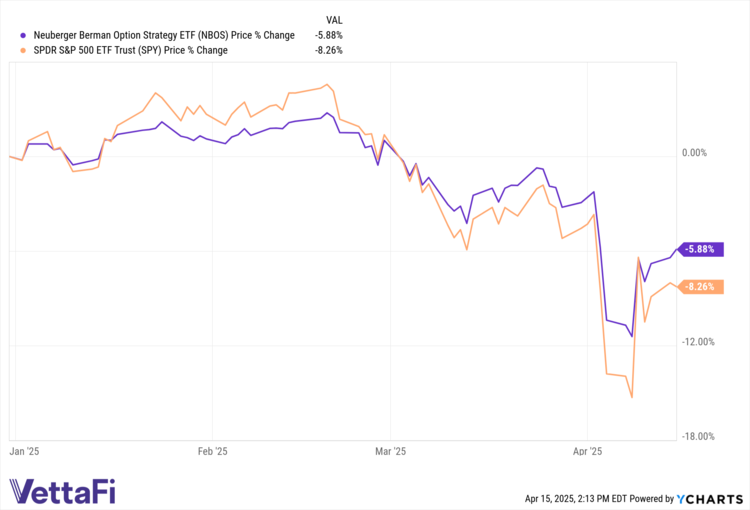
Alongside options, NBOS also invests in short-term Treasuries as a source of income. This allows investors to harness two sources of returns through a single strategy. They can do so without increasing their equity beta or credit exposures, or taking on additional interest rate risk.
The ETF managers consider overall market volatility, underlying valuations, and risks when writing put options. It’s expected to outperform in flat or declining markets, while lagging but still capturing some upside in rising markets. The strategy also seeks to increase income potential through options premiums, which benefit from market volatility.
In addition to purchasing put options, the fund may invest in or write call options. NBOS carries a net expense ratio of 0.56%.
For more news, information, and analysis, visit the Invest Beyond Cash Channel.

