


Advisors and investors found themselves navigating tumultuous markets as U.S. tariffs took effect in April. Frequent changes to tariffs only fueled the fire of greater uncertainty and worry, leading many investors to seek refuge in short duration bonds.
The new trade regime emerging under the current U.S. administration continues to send shocks through global markets. With U.S. stability called into question, investors fled from a wide array of asset classes. Long duration bonds took a particularly significant hit, with yields rising while equities plummeted mid-April (bond prices and yields move inversely).
Neuberger Berman recently released their second quarter fixed income investing outlook that highlighted the uncertainty and rising risks in the current environment. They discussed the potential impacts of tariffs, both near- and long-term, including to central bank policy and growth.
“More broadly, we should recognize that the president’s tariff regime likely ushers in an era of increased trade barriers for the U.S. Over time, this could mean fewer capital inflows and a higher equilibrium cost of capital,” Neuberger Berman cautioned. “We could see higher-than-expected interest rates, a steeper yield curve and weaker dollar, along with an increased risk premium in credit markets.”
Environments of elevated risk and uncertainty tend to favor risk-off asset classes. These include traditional safe havens such as gold, defensive stocks, and bonds. However, investors looking to bonds amidst the recent route would do well to consider short duration exposures at best while economic policy remains in flux.
“In terms of duration positioning, we see some potential value at the short end of the U.S. yield curve, but are cautious on longer maturities due to upward pressure on the term premium,” noted Neuberger Berman.
NBSD Combines Benefits of Short Duration and Active Management
The actively managed Neuberger Berman Short Duration Income ETF (NBSD ) seeks to generate reliable income while providing an investment-grade, short duration profile for portfolios. Short-term bonds often prove appealing for their reduced rate risk in challenging environments. In addition, investment-grade bonds generally carry a low credit risk. Combining the two creates reliable income potential for portfolios when market volatility and uncertainty rise.
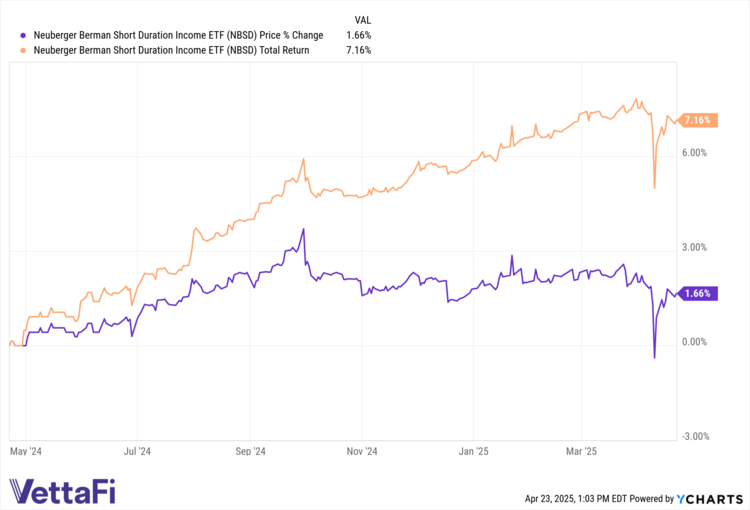
NBSD invests across a variety of sectors and bond types, including fixed- and floating-rate investment-grade bonds, both foreign and domestic. These can include asset- and mortgage-backed securities, collateralized debt obligations (including CLOs), and credit risk transfer securities.
The management team considers qualitative as well as quantitative factors when selecting securities. They search for underpriced bonds, both on a sector level as well as within peer groups. While 80% of the fund comprises investment-grade bonds, up to 20% may be below investment-grade. When investing in these junk bonds, the fund managers seek issuers in relatively strong financial health and whose credit scores may increase.
NBSD carries an expense ratio of 0.35%.
For more news, information, and analysis, visit the Invest Beyond Cash Channel.

