

ETFdb Logo
  • ETF Database
  • Content Hubs
    • Themes
      • Active ETF
      • Alternatives
      • Artificial Intelligence
      • China Insights
      • Core Strategies
      • Crypto
      • Disruptive Technology
      • Energy Infrastructure
      • ETF Building Blocks
      • ETF Investing
      • ETF Strategist
      • Financial Literacy
      • Fixed Income
      • Free Cash Flow
      • Future ETFs
      • Innovative ETFs
      • Institutional Income Strategies
      • Leveraged & Inverse
      • Market Insights
      • Market Outlooks
      • Modern Alpha
      • Nuclear Energy
      • Portfolio Strategies
      • Sector Investing
      • Tax Efficient Income
      • Thematic Investing
    • Asset Class
      • Equity
        • U.S. Equity
        • Int'l Developed
        • Emerging Market Equities
      • Alternatives
        • Gold/Silver/Critical Materials
        • Cryptocurrency
        • Currency
        • Volatility
      • Fixed Income
        • Investment Grade Corporates
        • US Treasuries & TIPS
        • High Yield Corporates
        • Int'l Fixed Income
    • ETF Ecosystem
    • ETFs in Canada
    • Market Outlook
    • Crypto ETF Hub
  • Tools
    • ETF Screener
    • ETF Country Exposure Tool
    • ETF Database Categories
    • Indexes
    • Scenario Analysis
    • Watchlists
    • Head-To-Head ETF Comparison Tool
    • Mutual Fund To ETF Converter
    • ETF Stock Exposure Tool
    • ETF Issuer Fund Flows
  • Research
    • ETF Education
    • Equity Investing
    • Dividend ETFs
    • Leveraged ETFs
    • Inverse ETFs
    • Index Education
    • Index Insights
    • Top ETF Sectors
    • Top ETF Issuers
    • Top ETF Industries
  • Webcasts
  • Sectors
    • Sector Investing Content Hub
    • XLK
    • XLI
    • XLU
    • XLY
    • XLP
    • XLRE
    • Sector Power Rankings
    • XLE
    • XLC
    • XLF
    • XLV
    • XLB
  • Multimedia
    • ETF 360 Video Series
    • ETF of the Week Podcast
    • Gaining Perspective Podcast
    • ETF Prime Podcast
    • Video
  • Company
    • About VettaFi
    • Get VettaFi’ed
  • PRO
    • Pro Content
    • Pro Tools
    • Advanced
    • FAQ
    • Free sign up
    • Login
  1. Invest Beyond Cash Content Hub
  2. Minding the Leverage Gap in Small-Caps
Invest Beyond Cash Content Hub
Share

Minding the Leverage Gap in Small-Caps

Karrie GordonMar 25, 2025
2025-03-25

The potential for interest rate cuts traditionally drives renewed investor interest in small-cap companies. However, the added risks of recession, inflationary impacts of tariffs, and more create a complex narrative this year. Targeted, actively managed exposure to an asset class with high degrees of leverage could prove a boon in such an uncertain market environment.

Major small-cap indexes offer exposure to a wide swathe of companies with varying levels of profitability. Within small-caps, leverage becomes a key consideration when it comes to balance sheets. For the majority of small- and midcap companies, long-term fixed credit isn’t an available option. This means that these companies feel the effects of rising or high interest rates first, and hardest. They’re often reliant on capital markets for financing, and generally must borrow more than large-cap peers. That leverage creates added risk for portfolios.

“Leverage is something that makes a bad mistake a terrible mistake,” Brett Reiner, managing director, portfolio manager on Neuberger Berman’s small-cap team, told VettaFi. “Leverage could hurt you quite a bit if you’re wrong about the fundamentals or the outlook in any way.”

See also: Neuberger Berman’s Reiner on Big Teams in Small-Caps

NBSM's Lower Leverage Helps Mitigate Drawdowns

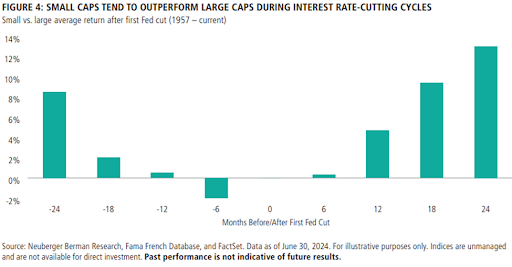
Investors traditionally look to small-caps when interest rate cuts decline. Their higher sensitivity to interest rates generally means they rebound first and outperform their large-cap peers — often by a fair bit. However, given the layers of complexity and uncertainty this year around tariffs, inflation, and interest rates, and recession risk, investors may want to consider targeted exposure to this highly leveraged asset class.

Content continues below advertisement

Image source: Neuberger Berman

The Neuberger Berman Small-Mid Cap ETF (NBSM ) is actively managed and invests in small- and midcap companies with elevated, sustainable growth potential. The fund managers use bottom-up analysis when evaluating companies. The strategy focuses on quality companies that generate reliable free cash flow and elevated profitability. The companies also have conservative balance sheets and business models that set them apart from peers.

“When the benchmarks go down, historically, one of the reasons we go down less is that we have significantly less leverage,” Reiner explained.

The overall approach to SMIDcap investing results in a diversified portfolio compared to benchmarks. he strategy also seeks to mitigate the elevated volatility inherent to small- and midcap investing while reducing downside risk. “We like to say that we have smaller midcap-like returns at large-cap-like volatility,” said Reiner.

NBSM carries an expense ratio of 0.74%.

For more news, information, and analysis, visit the Invest Beyond Cash Channel.

Loading Articles...

Advertisement

Is Your Portfolio Positioned With Enough Global Exposure?

ETF Education Channel

How to Allocate Commodities in Portfolios

Tom LydonApr 26, 2022
2022-04-26

A long-running debate in asset allocation circles is how much of a portfolio an investor should...

Core Strategies Channel

Why ETFs Experience Limit Up/Down Protections

Karrie GordonMay 13, 2022
2022-05-13

In a digital age where information moves in milliseconds and millions of participants can transact...

}
X
