


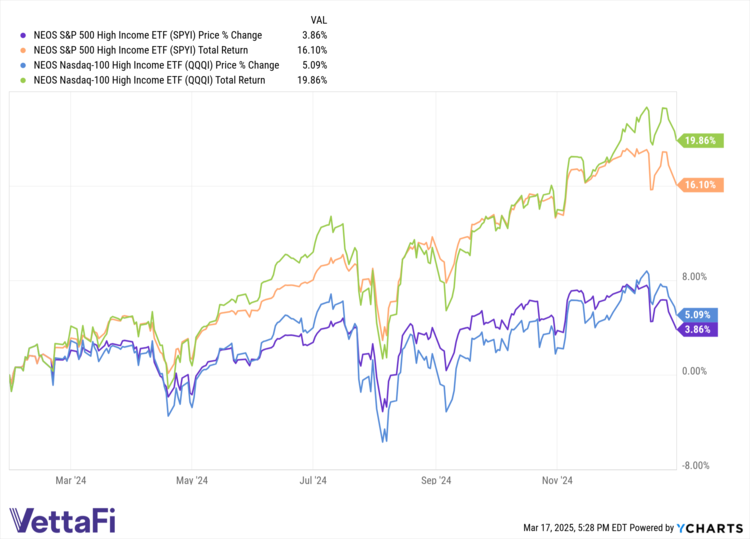
2025 could bring even greater adoption of options-based strategies as investors look to navigate heightened and ongoing market volatility. Call-writing strategies appear well-positioned this year for their ability to earn higher premiums and income when volatility spikes. That makes funds like the NEOS Nasdaq 100 High Income ETF (QQQI ) and the NEOS S&P 500 High Income ETF (SPYI ) worth consideration for their enhanced tax-efficiency and income potential.
Both funds generated notable total returns in 2024 without sacrificing underlying value. Both SPYI and QQQI offer a measure of their distributions as return-of-capital (RoC). RoCs occur when an investor receives some of their original investment back as a distribution. These receive special tax treatment, as taxes on RoC distributions are deferred as long as the investors holds the shares. This allows for a reduction of the cost basis each year an investors holds the shares, creating greater capital gain potential.
“For us here at NEOS, we’re really thinking about how do we make sure that as much of that gross return and yield that we can generate for an investor is taken home after taxes,” explained Garrett Paolella, co-founder and PM at NEOS in the most recent NEOS Monthly Income Podcast.
In the case of SPYI and QQQI, RoC distributions come from the premiums earned by the strategies. This means that the NAV of the fund doesn’t erode over time due to the RoC distributions. In 2024, 93.91% of SPYI’s distribution qualified as RoC while 95.8% of QQQI’s qualified as RoC.
Under the Hood of SPYI and QQQI's Tax-Efficient Income Strategy
Covered calls entail buying an asset while also writing a call on the underlying asset. This generates a premium, but also caps the upside potential should the underlying asset appreciate. SPYI and QQQI also use a call spread to achieve their income goals. This spread allows for more of the underlying to potentially participate in upside market movements when they occur, compared to indexed covered call option strategies.
SPYI offers a distribution rate of 14.21% as of February 28, 2025, while QQQI’s distribution rate sat at 12.18% over the same period. Distribution rate annualizes the most recent distribution and divides by the fund’s NAV. It’s a more forward-looking measurement of returns for investors, making QQQI an enticing addition to portfolios.
In addition to potential upside capture, the funds offer layers of tax efficiency for income-oriented investors. SPYI and QQQI use index options, which receive favorable tax treatment as Section 1256 Contracts under IRS rules. Options held at year’s end are treated as if sold at fair market value on the last market day. Any capital gains or losses are taxed as 60% long-term and 40% short-term, no matter how long investors hold them. This can offer noteworthy tax advantages. SPYI uses SPX index options while QQQI uses NDX options.
Options strategies use a range of option types when investing. These include single-stock options, equity-linked notes, ETF options, and more. However, the tax benefits of using these types of options are often minimal. “Any P&L that comes off of those option trades is traded as 100% short-term capital gains, so very different than how the index options are looked at,” explained Troy Cates, co-founder and PM at NEOS.
Should equities rise or fall, NEOS can actively manage the call options to capture gains in the underlying assets or minimize losses. In addition, the fund’s managers also engage in tax-loss harvesting opportunities throughout the year on the call options, equity holdings, or both.
Both funds have an expense ratio of 0.68%.
For more news, information, and analysis, visit the Tax-Efficient Income Channel.

