


June’s CPI print revealed heating inflation in a number of tariff-sensitive sectors. While consumers remain surprisingly resilient, uncertainty lingers as to the path of tariff-driven inflation in the months to come. Those investors seeking income while hedging for risk would do well to consider the NEOS Enhanced Income 1-3 Month T-Bill ETF (CSHI ).
Headline inflation gained in June, rising 2.7% compared to May’s 2.4% increase in the biggest jump since January, reported the WSJ. Meanwhile, core inflation (excludes energy and food) was 2.9% for the month. Although the numbers aligned largely with expectations, gains in goods with sensitivity to tariffs could prove the harbinger of inflation impacts to come.
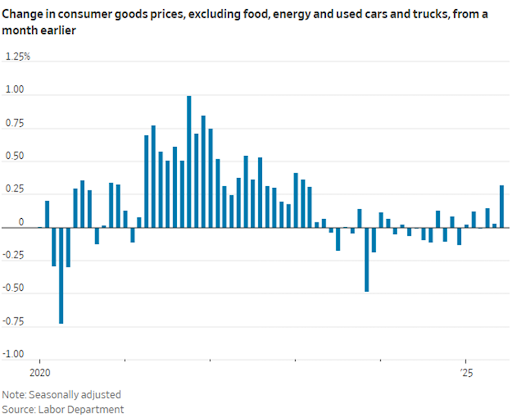
Notable price gains in furniture, clothes, toys and other goods were offset by declines in car prices. Sarah House, senior economist at Wells Fargo, attributed the decline to consumers potentially front running tariffs in previous months by pushing their purchases up earlier in the year. Additionally, companies stocked up on inventories ahead of tariffs going into effect, cushioning tariff impacts for a period of time.
Consumers spent significantly less on travel related expenses in June, which could reflect weakening. However, headline PPI declined in June, rising 2.3% versus May’s 2.7%. Core PPI gained the least amount since July 2024, rising 2.6% in June, reported CNBC.
In the inflation readings, pundits for either side of the tariff and inflation narrative will find data to support their outlooks. It reflects the ongoing uncertainty as to what impact tariffs will have on U.S. consumers, growth, and the economy. Add in the nebulous nature of U.S. tariff rates this year, with frequent and unexpected changes, and it creates an environment of elevated risk and volatility.
Invest Defensively While Earning Monthly Income
Investors looking to hedge defensively would do well to look to ultra short-term bonds. These bonds generally offer a lower risk profile than their longer duration peers, providing hedges against rate and credit risk.
The NEOS Enhanced Income 1-3 Month T-Bill ETF (CSHI ) is actively managed and seeks to generate high monthly income with its options-based strategy. The ETF seeks to deliver 100-150 basis points above what 1-3 month Treasuries are yielding. It is long on three-month Treasuries and sells out-of-the-money SPX Index put spreads. These roll weekly to account for market changes and volatility.
The put options that the fund uses are not ETF options but instead are S&P 500 index options. These options receive favorable tax treatment as Section 1256 Contracts under IRS rules. This means the options held at the end of the year are treated as if sold on the last market day of the year at fair market value.
Any capital gains or losses are taxed as 60% long-term and 40% short-term. Notably, this tax treatment applies regardless of how long the options were held, which can offer noteworthy tax advantages.
A portion of CSHI’s distributions also qualify as return of capital. These distributions are a return of some (or all) of the original investment made into an asset. In some cases, it is a return on premium earned by an investment as opposed to principal.
The fund’s managers also may engage in tax-loss harvesting opportunities throughout the year on the put options. CSHI has an expense ratio of 0.38%.
For more news, information, and analysis, visit the Tax-Efficient Income Content Hub.

