


The outlook for U.S. bonds and the dollar remains a challenged one heading into the second half. With elevated trade tensions and a restructuring of global trade driven by U.S. tariff policy, confidence in U.S. debt and currency already appears shaken. The passage of the tax and spending bill currently in Congress could further diminish that confidence while creating opportunity in low correlation asset classes such as gold and bitcoin.
Should the major budget bill pass through legislation this month, it could have serious repercussions for U.S. bonds and the dollar. The version approved by the Senate increases the U.S. deficit by $3.4 trillion in the next 10 years according to the nonpartisan Congressional Budget Office.
Concerns were already on the rise this year around the ballooning U.S. deficit. The passage of the bill —specifically in regards to the deficit — could have a significant impact to the dollar and U.S. bond market. Runaway government debt never bodes well for stability, and erodes confidence in existing as well as future debt issuance. It could prove a catalyst for further divestment in U.S. bonds, particularly as the U.S. dollar weakens. It may also create opportunity in alternatives like bitcoin.
Bitcoin may prove increasingly attractive in an environment of continued U.S. dollar weakening. The decentralized nature of the cryptocurrency may prove attractive for some in an environment of declining confidence in sovereign debt. Amongst cryptocurrencies, bitcoin stands out as a store of value, with scarcity due to its limited supply.
For those investors with the risk appetite for bitcoin investing, the NEOS Bitcoin High Income ETF (BTCI ) is worth consideration. The fund offers a diversified approach to bitcoin through its focus on harnessing volatility inherent to the asset class for income. What’s more, the fund currently boasts a 28.08% distribution rate as of June 30, 2025. A forward-looking metric, distribution rate annualizes the most recent distribution and then divides it by NAV at time of distribution. It’s what investors would earn should distributions remain the same over the next year.
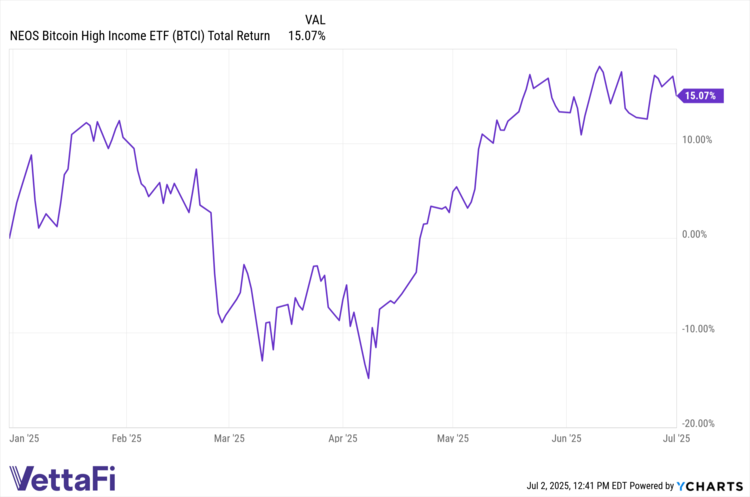
The fund invests in bitcoin futures ETFs and options contracts that use BTC futures ETFs for their reference asset. This creates synthetic exposure to BTC through BTC futures, while also writing covered call options on BTC futures ETFs to generate high monthly income. The strategy uses a rules-based, systematic, proprietary model to determine its options positions.
Covered call options entail buying an asset while also writing a call on the underlying asset. This generates a premium, but also caps the upside potential, should the underlying asset appreciate. Options strategies like BTCI often benefit from volatility, earning higher premiums on call writing (and thereby income) when volatility spikes. Given bitcoin’s enhanced volatility, it could prove an attractive source of additional income for BTC investors.
The fund’s managers may also engage in tax-loss harvesting to capture losses in order to offset gains made.
BTCI has an expense ratio of 0.98%.
For more news, information, and analysis, visit the Tax-Efficient Income Channel.

