


While the market outlook for interest rate cuts becomes increasingly more optimistic, several economic and macro risk factors loom in the second half. Advisors and investors should consider the tax treatment of their distribution streams when working to optimize their portfolio’s performance in a challenging environment.
The distributions investors receive fall into three main tax buckets: ordinary income, capital gains, or tax-advantaged. Depending on how much an individual or married couple makes for annual income determines which ordinary tax bracket they fall into. The highest earners are taxed at a 37% tax rate while the lowest are taxed at 10%.
Ordinary income includes interest earned on income, unqualified dividends, and short-term capital gains for assets owned for less than a year. Distributions that qualify as ordinary income are generally subject to state and federal taxes.
Capital Gains and Tax-Advantaged Distributions
Meanwhile, long-term capital gains (for assets held more than a year) generate notable tax savings for portfolios. Long-term capital gains are taxed at either 0%, 15%, or 20% as a maximum. It’s important to keep in mind that they are still generally taxed at the state and federal levels. Qualified dividends fall under this tax umbrella as well.
It’s also worth noting that high earners generally pay an additional net investment income tax of 3.8%. This goes for both short- and long-term capital gains distributions.
Tax-advantaged distributions are generated from assets that qualify as tax-exempt either at the federal or state level. This income comes from a wide range of investments, such as annuities, 401(k)s, Roth IRAs, municipal bonds, and more. Distributions that qualify for tax deferment or tax benefits are also considered tax-advantaged income.
Advisors and investors should understand the individual tax implications of their income streams. Some income generated from an investment, such as a municipal bond, qualify as tax-exempt. Meanwhile, other income types may instead receive tax deferment, such as from a 401(k).
A lesser-known type of tax-advantaged distribution is a Return of Capital. This occurs when some — or all — of an initial investment into an asset is returned. Some strategies also generate RoC as a return on the premium earned instead of returning principal. Many strategies that utilize options may offer RoC as part of their distributions. Such distributions generally aren’t taxed in the same year they’re earned but instead are delayed to a later tax year. This may create greater flexibility for investors at tax time.
Enhance Your Distribution Tax Efficiency With NEOS
The NEOS suite of ETFs offers tax-efficient income for investors across core allocations. These include the NEOS S&P 500 High Income ETF (SPYI ), the NEOS Nasdaq 100 High Income ETF (QQQI ), and the newly launched NEOS Russell 2000 High Income ETF (IWMI ) within equities.
The firm also offers the NEOS Enhanced Income Aggregate Bond ETF (BNDI ) and the NEOS Enhanced Income Cash Alternative ETF (CSHI ). The ETF suite is actively managed by NEOS who brings a long history of options-based investing to bear when managing the funds.
See also: Troy Cates Talks Growth of Options-Based Strategies
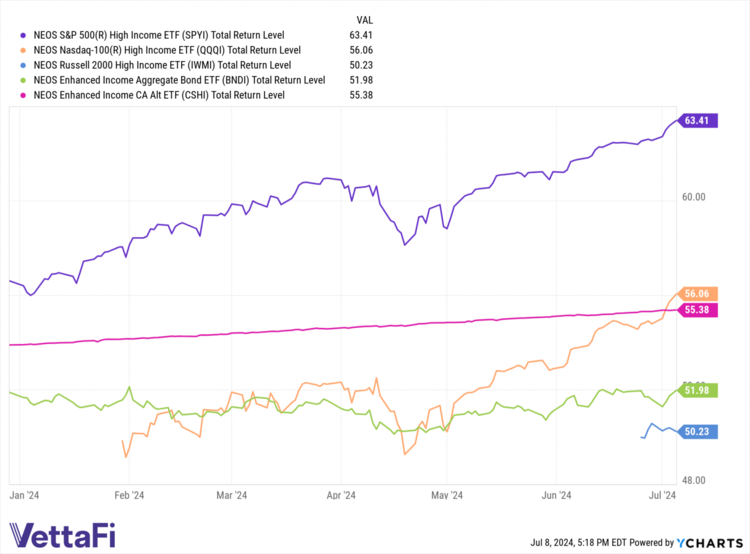
The tax-advantaged ETF suite utilizes several layers of tax efficiency. This includes the use of options that qualify as Section 1256 Contracts. All capital gains or losses receive a tax treatment of 60% long-term and 40% short-term. This occurs regardless of how long the strategy holds the options.
The fund managers also engage in tax-loss harvesting opportunities throughout the year on all three funds. In addition, part of the distributions are Return of Capital but do not come from the principal. This prevents the NAV from eroding over time.
For more news, information, and analysis, visit the Tax Efficient Income Channel.

