


In a sea of options-based strategies, standing out may prove challenging for some firms. However, that’s not the case for NEOS Investments, a firm that brings a long history of options-based experience to bear in its expanding high income ETF lineup.
Troy Cates and Garrett Paolella, both co-founders, managing partners, and PMs at NEOS Investments, discussed the growth of options-based strategies and the benefits of tax-efficiency within the space. The pair joined Todd Rosenbluth, Head of Research at VettaFi, in a recent webcast hosted on the VettaFi platform.
NEOS, a global asset manager, is home to the pioneers of options-based ETFs, first launched in 2013 under a different firm. Paolella, Cates, and the NEOS team bring decades of options-based investing to bear with their suite of income-oriented options ETFs. The NEOS ETFs rely on a data-driven, quantitative, rules-based methodology to invest in securities within the various portfolios.
“You might hear us talk about active management throughout, but we’re doing that through a very quantitative lens that’s looking at historical data, quantitative trends,” and more, Paolella explained.
Bringing Income and Tax-Efficiency to Core Exposures
Options-based strategies offer investors several benefits, including reduced correlations to a number of risk factors. Some strategies seek income generation while others provide a downside hedge in declining markets. Other options-based strategies provide enhanced tax-efficiency.
NEOS focuses primarily on the tax-efficiency potential. “When and where we can, we really want to take the ability to utilize the underlying investments — that being what types of options we use but also our investment process — to derive as much tax-efficiency as possible for your end client,” said Paolella.
When possible, the firm uses index options within its strategies that offer unique tax benefits. These index options are taxed favorably as Section 1256 Contracts under IRS rules. Options held at year’s end are treated as if sold at fair market value on the last market day. Any capital gains or losses are taxed as 60% long-term and 40% short-term, no matter how long investors hold them. These options also don’t carry counterparty risk while offering favorable liquidity.
NEOS also layers in tax-loss harvesting that may allow some distributions to qualify as Return of Capital. “We’re not looking to return principal,” Cates clarified. Instead, “we’re looking for that IRS designation of ‘Return of Capital’ so your taxes are deferred to a later date.”
Enhance Your Income With the NEOS ETF Suite
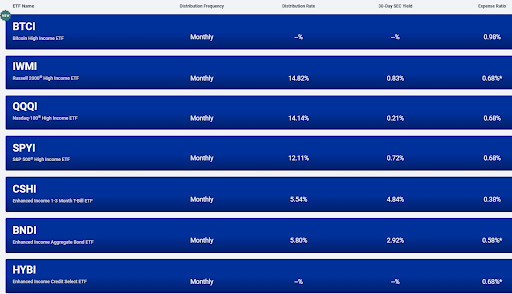
The use of index options, when applicable, helps to set the NEOS ETF suite apart in a growing sea of options-based strategies. The firm launched its original 3 ETFs in 2022 and has since grown the suite to seven funds. These include the NEOS S&P 500 High Income ETF (SPYI ), the NEOS Nasdaq 100 High Income ETF (QQQI ), the NEOS Enhanced Income Aggregate Bond ETF (BNDI ), and the NEOS Enhanced Income 1-3 Month T-Bill ETF (CSHI ).
More recently, the firm launched the NEOS Russell 2000 High Income ETF (IWMI ), the NEOS Bitcoin High Income ETF (BTCI ), and NEOS Enhanced Income Credit Select ETF (HYBI ), a mutual fund conversion.
See also: Options Income ETF SPYI Soars Past $2 Billion in AUM
“All of our strategies are rules-based and systematic, where they’re looking at a number of factors,” noted Cates. “Most importantly, they’re really looking at the volatility of the underlying index.” It leaves the funds well-positioned for an environment of ongoing market volatility.
The suite combines core portfolio exposures with options overlays to enhance income, tax-efficiency, or both, when applicable. The funds remain consistent outperformers within their peer groups, offering notable distribution rates. Distribution rate annualizes the most recent distribution and then divides it by the fund’s NAV.
SPYI generated a distribution rate of 12.11%, IWMI 14.82%, and QQQI 14.14% as of Sept. 30, 2024. BNDI yielded a distribution rate of 5.54% and BNDI a rate of 5.80% over the same period. HYBI and BTCI both launched too recently to qualify for a distribution rate yet.
For more news, information, and analysis, visit the Tax Efficient Income Channel.

