
ETFdb Logo
  • ETF Database
  • Content Hubs
    • Themes
      • Active ETF
      • Alternatives
      • Artificial Intelligence
      • China Insights
      • Core Strategies
      • Crypto
      • Disruptive Technology
      • Energy Infrastructure
      • ETF Building Blocks
      • ETF Investing
      • ETF Strategist
      • Financial Literacy
      • Fixed Income
      • Free Cash Flow
      • Future ETFs
      • Innovative ETFs
      • Institutional Income Strategies
      • Leveraged & Inverse
      • Market Insights
      • Market Outlooks
      • Modern Alpha
      • Nuclear Energy
      • Portfolio Strategies
      • Sector Investing
      • Tax Efficient Income
      • Thematic Investing
    • Asset Class
      • Equity
        • U.S. Equity
        • Int'l Developed
        • Emerging Market Equities
      • Alternatives
        • Gold/Silver/Critical Materials
        • Cryptocurrency
        • Currency
        • Volatility
      • Fixed Income
        • Investment Grade Corporates
        • US Treasuries & TIPS
        • High Yield Corporates
        • Int'l Fixed Income
    • ETF Ecosystem
    • ETFs in Canada
    • Market Outlook
    • Crypto ETF Hub
  • Tools
    • ETF Screener
    • ETF Country Exposure Tool
    • ETF Database Categories
    • Indexes
    • Scenario Analysis
    • Watchlists
    • Head-To-Head ETF Comparison Tool
    • Mutual Fund To ETF Converter
    • ETF Stock Exposure Tool
    • ETF Issuer Fund Flows
  • Research
    • ETF Education
    • Equity Investing
    • Dividend ETFs
    • Leveraged ETFs
    • Inverse ETFs
    • Index Education
    • Index Insights
    • Top ETF Sectors
    • Top ETF Issuers
    • Top ETF Industries
  • Webcasts
  • Sectors
    • Sector Investing Content Hub
    • XLK
    • XLI
    • XLU
    • XLY
    • XLP
    • XLRE
    • Sector Power Rankings
    • XLE
    • XLC
    • XLF
    • XLV
    • XLB
  • Multimedia
    • ETF 360 Video Series
    • ETF of the Week Podcast
    • Gaining Perspective Podcast
    • ETF Prime Podcast
    • Video
  • Company
    • About VettaFi
  • PRO
    • Pro Content
    • Pro Tools
    • Advanced
    • FAQ
    • Free sign up
    • Login
  1. Tax Efficient Income Content Hub
  2. Investors Buying Back Into Bonds Shouldn’t Overlook BNDI
Tax Efficient Income Content Hub
Share

Investors Buying Back Into Bonds Shouldn’t Overlook BNDI

Karrie GordonNov 16, 2023
2023-11-16

Hopes of a conclusion to Federal Reserve interest rate hikes sent bond prices soaring this week. Investors continue to increase their bond allocations in November, capturing yield opportunities as Fed rate risk falls. The NEOS Enhanced Income Aggregate Bond ETF (BNDI ) is a fund to consider for investors buying back into bonds, given BNDI’s income focus.

Flows are moving consistently back into bonds this month after a year of plummeting prices and soaring yields. Since the beginning of the month, the iShares Core U.S. Aggregate Bond ETF (AGG A-) is up $1.34 billion in net flows. Meanwhile, the Vanguard Total Bond Market ETF (BND A-) is up $1.1 billion month-to-date as of November 14, according to FactSet data.

October’s cooler-than-expected inflation print buoyed markets and sent yields tumbling in Treasuries (bond prices and yields move inversely). A conclusion to Fed rate hikes would be a major boon for bond stability. Investors and advisors looking to expand their bond allocations should consider the NEOS Enhanced Income Aggregate Bond ETF (BNDI ). The fund seeks high monthly income while offering exposure to the broad bond market.

BNDI had a distribution yield of 5.57% as of 10/31/2023. The fund also generated a 30-day SEC yield of 2.64% (excludes income from options) over the same period.

See also: Income Opportunities in Bonds and Beyond
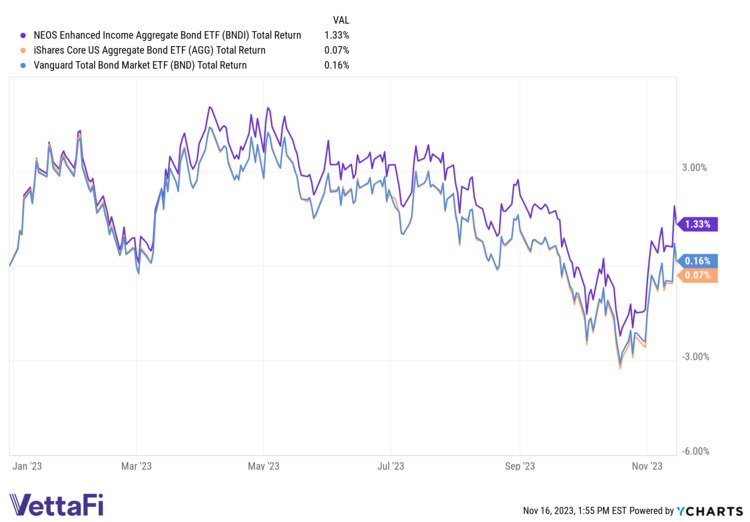
The fund invests in BND

The fund invests in BND and the AGG and generated better total returns YTD than both funds. However, the income and capital gains BNDI receives from its bond exposures are enhanced by adding monthly income from the fund’s put-option strategy on the S&P 500. The strategy includes selling short puts and buying long puts to protect against volatility.

The strategy may offer positive returns in both flat and rising equity markets. It may also generate positive returns in moderately declining equity markets. This is possible if the premium earned from the puts is greater than the cost to close out the positions. BNDI may also offer a lower correlation to certain risk factors such as duration, credit, and inflation risk.

BNDI’s put options aren’t ETF options but S&P 500 index options. These options are taxed favorably as Section 1256 Contracts under IRS rules. The IRS treats options held at the end of the year as if the investor had sold on the last market day of the year at fair market value. Most importantly, the IRS taxes any capital gains as 60% long-term and 40% short-term, no matter how long the fund held them.

This treatment can offer noteworthy tax advantages. In addition, the fund’s managers also may engage in tax-loss harvesting opportunities throughout the year on the put options.

BNDI currently has an expense ratio of 0.58%.

For more news, information, and analysis, visit the Tax Efficient Income Channel.


Content continues below advertisement

Loading Articles...

Advertisement

Is Your Portfolio Positioned With Enough Global Exposure?

ETF Education Channel

How to Allocate Commodities in Portfolios

Tom LydonApr 26, 2022
2022-04-26

A long-running debate in asset allocation circles is how much of a portfolio an investor should...

Core Strategies Channel

Why ETFs Experience Limit Up/Down Protections

Karrie GordonMay 13, 2022
2022-05-13

In a digital age where information moves in milliseconds and millions of participants can transact...

}
X
