


Small-cap stocks remain a closely watched asset class this year as changing market trends could benefit small businesses in the U.S. The NEOS Russell 2000 High Income ETF (IWMI ) is worth consideration, given its outperformance compared to the benchmark year-to-date.
A decade of sluggish performance compared to large-cap peers has left small-caps in an attractive position. In an environment of high large-cap concentration, they prove an attractive diversifier that could benefit significantly, should interest rates decline. With significantly lower valuations, they have more runway to perform, should economic conditions improve.
Small businesses generally have greater room for growth compared to large-cap peers. This outperformance potential makes them particularly appealing when the macro environment turns more favorable. Whether it’s rebounding from recessions or depressed economic growth, or if its due to federal interest rate cuts, small-caps have much to potentially offer portfolios.
New economic and deregulation policies by the current administration could prove beneficial to U.S. small businesses, according to some analysts. However, rapid changes in supply chains and price increases remain a notable risk for small-caps.
Don’t miss NEOS Investments in tomorrow’s Alternatives Symposium, hosted on the VettaFi platform.
Harness Small-Cap Potential & High Monthly Income
Investors looking to add equity diversification, benefit from the bargain prices of small-caps this year, or wanting to capture performance potential looking ahead should consider IWMI. The fund continues to draw investor attention, up nearly $100 million in net flows YTD as of July 20, 2025, according to FactSet data.
IWMI currently generates a distribution rate of 14.90%, as of June 30, 2025. Distribution rate annualizes the most recent distribution before dividing by the fund’s NAV at the time of distribution. It seeks to combine high monthly income within small-cap stocks with tax efficiency. It also outperforms the benchmark Russell 2000 Index YTD.
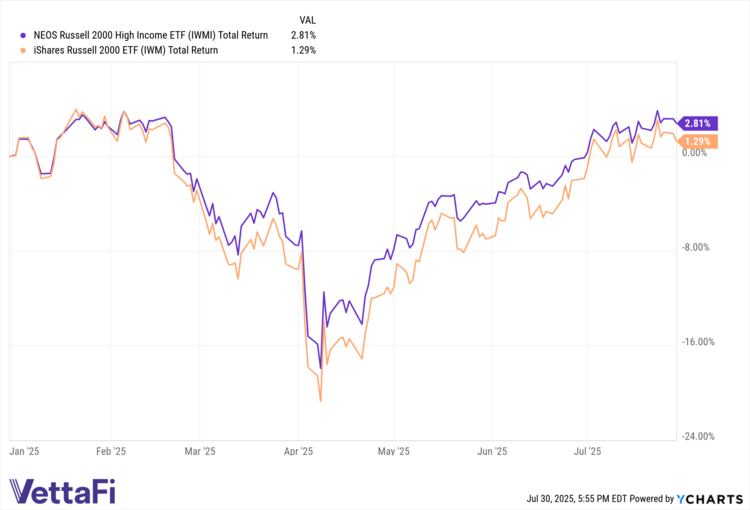
The actively managed IWMI provides exposure to the Russell 2000 Index alongside an options strategy designed to generate high-income potential. The fund uses call spreads to achieve its income goals. These spreads allow for more of the underlying to potentially participate in upside market movements when they occur, compared to indexed covered call option strategies.
In addition to potential upside capture, the fund offers layers of tax efficiency for investors seeking income. The options that IWMI uses are call options on the Russell 2000 Index (RUT) and qualify as Section 1256 contracts. These receive favorable tax treatment under IRS rules. The options held at year’s end are treated as if sold at fair market value on the last market day. Any capital gains or losses are taxed at 60% long-term and 40% short-term, no matter how long they were held.
NEOS also actively manages the call options to capture gains in the underlying assets or minimize losses. In addition, the fund’s managers also engage in tax-loss harvesting opportunities throughout the year on the call options, equity holdings, or both.
IWMI has a net expense ratio of 0.68% on a contract that lasts through September 28, 2025.
For more news, information, and analysis, visit the Tax-Efficient Income Content Hub.

