


NEOS Investments launched its first trio of options income ETFs August 30, 2022. Three years later, the NEOS S&P 500 High Income ETF (SPYI ), the NEOS Enhanced Income 1-3 Month T-Bill ETF (CSHI ), and the NEOS Enhanced Income Aggregate Bond ETF (BNDI ) boast a collective AUM of $5.7 billion. The funds continue to draw inflows as advisors and investors look to enhance core portfolio income.
Flagship NEOS Funds Offer Innovation, Income & Tax Efficiency
The firm is home to some of the pioneers of options-based ETFs, who continue to innovate within the space. Indeed, NEOS stands for “Next Evolution Option Strategies.” The launch of SPYI, CSHI, and BNDI brought a new iteration and next step in options-based strategies through a focus on high income and tax efficiency. In the three years since the launch of the flagship funds, NEOS has accumulated over $10 billion in assets.
“As we celebrate NEOS Investments’ three-year anniversary, we’re proud to reflect on how far we’ve come. In just a short time, we’ve built an award-winning firm with an innovative suite of options-based ETFs designed to seek high monthly income and tax efficiency across core portfolio exposures,” Troy Cates, co-founder and PM at NEOS, told VettaFi. “This milestone is a testament not only to our team’s vision and expertise, but also to the trust and partnership of the advisors and investors who have joined us on this journey.”
The funds offer core exposure to the S&P 500, one- to three-month Treasury Bills, and the broad bond market through AGG and BND, respectively. Notably, they also offer high income through their option-writing strategy. All three funds write options on the S&P 500 Index, which qualify as Section 1256 Contracts under IRS rules. The IRS treats options held at the end of the year as if the investor had sold on the last market day of the year at fair market value. Most importantly, the IRS taxes any capital gains as 60% long term and 40% short term. This taxation applies no matter how long the fund holds the options.
Under the Options Income Hood
SPYI writes call options, while both BNDI and CSHI write puts. For BNDI and CSHI, equity option exposure adds a layer of diversification within fixed income portfolios. A portion of distributions for all three ETFs also qualify as return of capital. These distributions are a return of some (or all) of the original investment made into an asset. In certain cases, the return is on premiums earned by the investments as opposed to principal.
SPYI remains an investor favorite, accumulating over $2.25 billion in net flows so far this year, as of August 30, 2030 according to FactSet data. What’s more, it’s been a consistent performer among the largest income-oriented peers. With total returns since inception of 45.91% as of July 31, 2025, the fund demonstrates the capabilities of innovations in active management that allow for greater upside capture according to NEOS data.
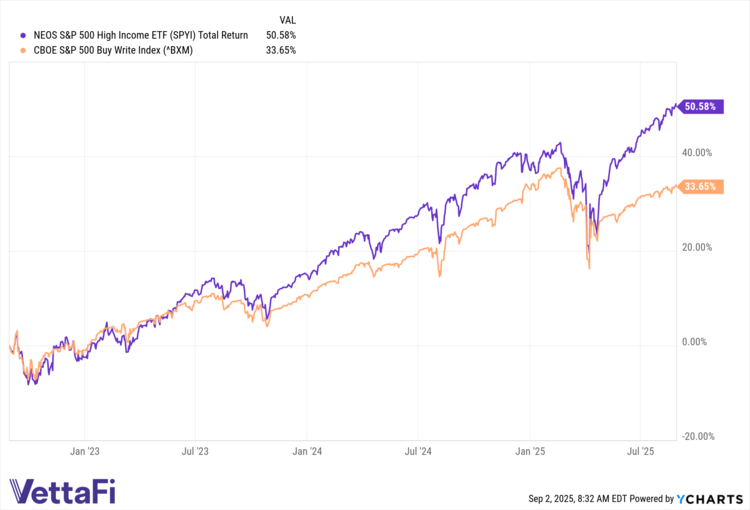
From a distribution rate perspective, SPYI consistently outperforms peers. The fund generated a distribution rate of 12.05%, as of the end of July. Distribution rate annualizes the most recent distribution and divides by the fund’s NAV. It’s a forward-looking measurement of what an investor would earn should distributions remain the same over the next 12 months.
Tax-Efficiency and Reliable Performance in Treasuries and Bonds
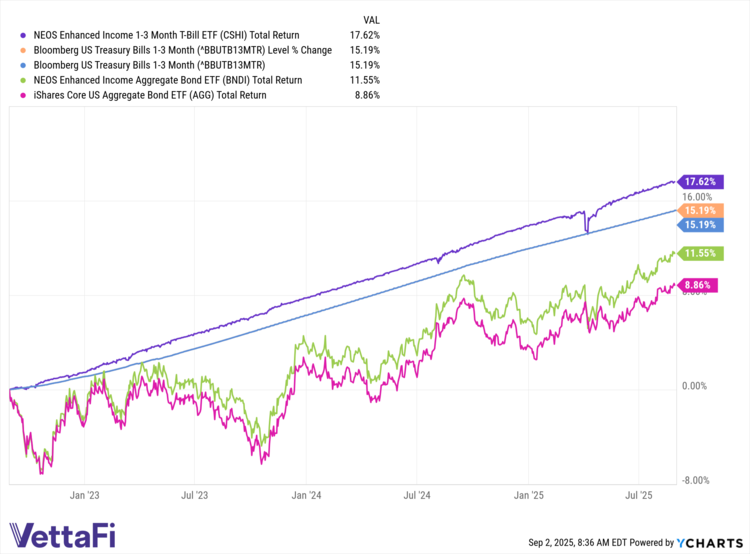
Since inception, BNDI offers better total returns and a higher distribution rate than its peers as well as underlying benchmarks as of the end of July. CSHI performs similarly, hedging out the largest funds within its category on a total return and distribution rate basis since inception.
In the last three years, NEOS expanded its ETF lineup to include high-income offerings in alternatives and hedged equity income ETFs. It also added more core portfolio high-income exposures. The award-winning NEOS Nasdaq 100 High Income ETF (QQQI ), launched January 2024, has accumulated over $3.4 billion in AUM this year.
The funds’ managers also engage in tax-loss harvesting opportunities throughout the year on the options, underlying holdings, or both. SPYI and QQQI carry an expense ratio of 0.68%, while CSHI maintains an expense ratio of 0.38%.
For more news, information, and analysis, visit the Tax-Efficient Income Content Hub.

