

ETFdb Logo
  • ETF Database
  • Content Hubs
    • Themes
      • Active ETF
      • Alternatives
      • Artificial Intelligence
      • China Insights
      • Core Strategies
      • Crypto
      • Disruptive Technology
      • Energy Infrastructure
      • ETF Building Blocks
      • ETF Investing
      • ETF Strategist
      • Financial Literacy
      • Fixed Income
      • Free Cash Flow
      • Future ETFs
      • Innovative ETFs
      • Institutional Income Strategies
      • Leveraged & Inverse
      • Market Insights
      • Market Outlooks
      • Modern Alpha
      • Nuclear Energy
      • Portfolio Strategies
      • Sector Investing
      • Tax Efficient Income
      • Thematic Investing
    • Asset Class
      • Equity
        • U.S. Equity
        • Int'l Developed
        • Emerging Market Equities
      • Alternatives
        • Gold/Silver/Critical Materials
        • Cryptocurrency
        • Currency
        • Volatility
      • Fixed Income
        • Investment Grade Corporates
        • US Treasuries & TIPS
        • High Yield Corporates
        • Int'l Fixed Income
    • ETF Ecosystem
    • ETFs in Canada
    • Market Outlook
    • Crypto ETF Hub
  • Tools
    • ETF Screener
    • ETF Country Exposure Tool
    • ETF Database Categories
    • Indexes
    • Scenario Analysis
    • Watchlists
    • Head-To-Head ETF Comparison Tool
    • Mutual Fund To ETF Converter
    • ETF Stock Exposure Tool
    • ETF Issuer Fund Flows
  • Research
    • ETF Education
    • Equity Investing
    • Dividend ETFs
    • Leveraged ETFs
    • Inverse ETFs
    • Index Education
    • Index Insights
    • Top ETF Sectors
    • Top ETF Issuers
    • Top ETF Industries
  • Webcasts
  • Sectors
    • Sector Investing Content Hub
    • XLK
    • XLI
    • XLU
    • XLY
    • XLP
    • XLRE
    • Sector Power Rankings
    • XLE
    • XLC
    • XLF
    • XLV
    • XLB
  • Multimedia
    • ETF 360 Video Series
    • ETF of the Week Podcast
    • Gaining Perspective Podcast
    • ETF Prime Podcast
    • Video
  • Company
    • About VettaFi
  • PRO
    • Pro Content
    • Pro Tools
    • Advanced
    • FAQ
    • Free sign up
    • Login
  1. Tax Efficient Income Content Hub
  2. Turn Tech Volatility Into Income With QQQI
Tax Efficient Income Content Hub
Share

Turn Tech Volatility Into Income With QQQI

Karrie GordonJun 04, 2024
2024-06-04

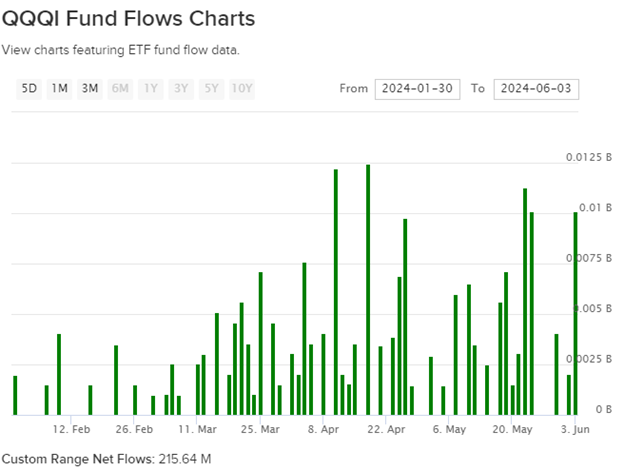
Market volatility persists heading into the summer months as investors weigh the impact of a slowing economy. Investors looking to increase income in their tech exposures and benefit from volatility continue buying into the NEOS Nasdaq 100 High Income ETF (QQQI A) since its launch in late January.

While NVIDIA celebrated another strong quarter for earnings in May, growing concerns of economic resilience increasingly weigh on growth stocks heading into the summer months. News of the U.S. manufacturing contraction sent equity indexes lower this week.

While markets have largely recovered, further indicators of economic slowing could lead to increased volatility. For growth stocks that rely on forward-earnings estimates for a portion of their valuations, economic slowing spells potential trouble.

In an environment of ongoing risks and prolonged uncertainty, income-generating ETFs continue to prove popular with investors, particularly covered-call ETFs. These funds benefit from increasing volatility that raises premium prices. These premiums generate additional income for the funds and prove beneficial across various market environments.

See also: Looking for an Equity Alternative? Consider Covered Call ETFs

QQQI a Popular Choice With Income, Tech Investors

With distribution yields of 14.56%, it’s no wonder investors continue to flock to the NEOS Nasdaq 100 High Income ETF (QQQI A). Distribution yield is calculated by annualizing the last distribution and dividing it by the fund’s most recent NAV at the time of distribution.

QQQI employs an options strategy using covered calls to generate a premium. The premiums earned by the fund help provide a potential buffer should stocks decline and enhance monthly income. Premiums also benefit from increased volatility.

The fund offers layers of tax efficiency for investors seeking income, an added boon in a challenging market environment. The options that QQQI uses are call options on the NDX and qualify as section 1256 contracts. These receive favorable tax treatment under IRS rules. The options held at year’s end are treated as if sold at fair market value on the last market day. Any capital gains or losses are taxed at 60% long-term and 40% short-term, no matter how long they were held.

Should equities rise or fall, NEOS can actively manage the call options to capture gains in the underlying assets or minimize losses. In addition, the fund’s managers also engage in tax-loss harvesting opportunities throughout the year on the call options, equity holdings, or both.

Content continues below advertisement

Turn Tech Volatility Into Income With QQQI
Image source: ETF Database

QQQI currently has $216 million in AUM as of 06/03/2024 and continues growing at a steady pace. It follows similar growth to the NEOS S&P 500 High Income ETF (SPYI A), launched 08/30/2022 and with nearly $1.4 billion in AUM currently.

QQQI has an expense ratio of 0.68%.

For more news, information, and analysis, visit the Tax-Efficient Income Channel.

Loading Articles...

Advertisement

Is Your Portfolio Positioned With Enough Global Exposure?

ETF Education Channel

How to Allocate Commodities in Portfolios

Tom LydonApr 26, 2022
2022-04-26

A long-running debate in asset allocation circles is how much of a portfolio an investor should...

Core Strategies Channel

Why ETFs Experience Limit Up/Down Protections

Karrie GordonMay 13, 2022
2022-05-13

In a digital age where information moves in milliseconds and millions of participants can transact...

}
X
