
ETFdb Logo
  • ETF Database
  • Content Hubs
    • Themes
      • Active ETF
      • Alternatives
      • Artificial Intelligence
      • China Insights
      • Core Strategies
      • Crypto
      • Disruptive Technology
      • Energy Infrastructure
      • ETF Building Blocks
      • ETF Investing
      • ETF Strategist
      • Financial Literacy
      • Fixed Income
      • Free Cash Flow
      • Future ETFs
      • Innovative ETFs
      • Institutional Income Strategies
      • Leveraged & Inverse
      • Market Insights
      • Market Outlooks
      • Modern Alpha
      • Nuclear Energy
      • Portfolio Strategies
      • Sector Investing
      • Tax Efficient Income
      • Thematic Investing
    • Asset Class
      • Equity
        • U.S. Equity
        • Int'l Developed
        • Emerging Market Equities
      • Alternatives
        • Gold/Silver/Critical Materials
        • Cryptocurrency
        • Currency
        • Volatility
      • Fixed Income
        • Investment Grade Corporates
        • US Treasuries & TIPS
        • High Yield Corporates
        • Int'l Fixed Income
    • ETF Ecosystem
    • ETFs in Canada
    • Market Outlook
    • Crypto ETF Hub
  • Tools
    • ETF Screener
    • ETF Country Exposure Tool
    • ETF Database Categories
    • Indexes
    • Scenario Analysis
    • Watchlists
    • Head-To-Head ETF Comparison Tool
    • Mutual Fund To ETF Converter
    • ETF Stock Exposure Tool
    • ETF Issuer Fund Flows
  • Research
    • ETF Education
    • Equity Investing
    • Dividend ETFs
    • Leveraged ETFs
    • Inverse ETFs
    • Index Education
    • Index Insights
    • Top ETF Sectors
    • Top ETF Issuers
    • Top ETF Industries
  • Webcasts
  • Sectors
    • Sector Investing Content Hub
    • XLK
    • XLI
    • XLU
    • XLY
    • XLP
    • XLRE
    • Sector Power Rankings
    • XLE
    • XLC
    • XLF
    • XLV
    • XLB
  • Multimedia
    • ETF 360 Video Series
    • ETF of the Week Podcast
    • Gaining Perspective Podcast
    • ETF Prime Podcast
    • Video
  • Company
    • About VettaFi
    • Get VettaFi’ed
  • PRO
    • Pro Content
    • Pro Tools
    • Advanced
    • FAQ
    • Free sign up
    • Login
  1. Multi-Asset Content Hub
  2. The Case for a Low Volatility ETF Like ‘QLV’
Multi-Asset Content Hub
Share

The Case for a Low Volatility ETF Like 'QLV'

Tom LydonMar 09, 2021
2021-03-09

Low volatility isn’t flashy, but it is still a beloved investment factor. How funds like the FlexShares US Quality Low Volatility Index Fund (QLV ) capture it in practice is important to investors.

QLV follows the Northern Trust US Quality Low Volatility Index. The ETF’s benchmark employs a quality screen to provide exposure to high-quality companies with lower absolute risk, thereby limiting potential future volatility. The quality screen analyzes a broad universe of equities based on key indicators such as profitability, management efficiency, and cash flow, and then excludes the bottom 20% of stocks with the lowest quality score. The index is then subject to the regional, sector, and risk-factor constraints, in order to manage unintended style factor exposures, significant sector concentration, and high turnover.

“In a higher volatility market environment, it’s important to keep in mind that downside and upside volatility don’t have an equal impact on returns,” according to FlexShares research. “For example, if a portfolio returns -20% in one month and rises 20% the following month, the result isn’t a breakeven. Rather, due to compounding returns, the portfolio nets a 4% loss. It’s for this reason that more investors are turning to low volatility strategies for downside risk mitigation in the face of rising volatility.”
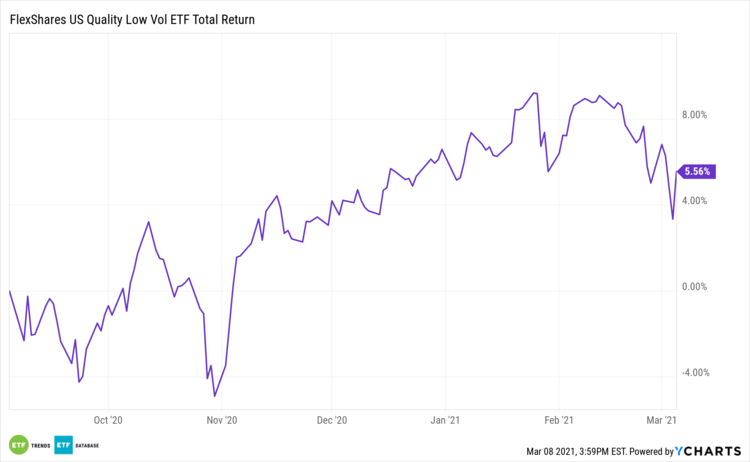
QLV 6 Month Total Return

QLV: Shooting for the Right Low Vol Structure

QLV integrates rigorous fundamental analysis through a quality screen of US-based companies that can be viewed as a means to mitigate future volatility. FlexShares believes this is different than other low volatility funds that may utilize only historical return and/or correlation data in hopes that the lower volatility will carry forward.

The ETF also offers a deeper approach to less volatility.

“We believe that a company’s financial health is important when constructing low volatility strategies. Metrics such as profitability and cash flow are key to assessing the quality of a company, and our research shows that the poorest quality companies also tended to be the most volatile. As such, incorporating the quality factor into volatility strategies to eliminate low quality companies can result in a more targeted low volatility experience,” notes FlexShares.

QLV has the potential to outshine standard low volatility strategies while providing investors with decent growth allocations and exposure to the value resurgence.

The fund is “designed to provide exposure to companies that possess lower overall absolute volatility characteristics, while also exhibiting financial strength and stability, or what we believe are quality characteristics,” adds FlexShares.


Content continues below advertisement

For more on multi-asset strategies, visit our Multi-Asset Channel.

Loading Articles...

Advertisement

Is Your Portfolio Positioned With Enough Global Exposure?

ETF Education Channel

How to Allocate Commodities in Portfolios

Tom LydonApr 26, 2022
2022-04-26

A long-running debate in asset allocation circles is how much of a portfolio an investor should...

Core Strategies Channel

Why ETFs Experience Limit Up/Down Protections

Karrie GordonMay 13, 2022
2022-05-13

In a digital age where information moves in milliseconds and millions of participants can transact...

}
X
