

ETFdb Logo
  • ETF Database
  • Content Hubs
    • Themes
      • Active ETF
      • Alternatives
      • Artificial Intelligence
      • China Insights
      • Core Strategies
      • Crypto
      • Disruptive Technology
      • Energy Infrastructure
      • ETF Building Blocks
      • ETF Investing
      • ETF Strategist
      • Financial Literacy
      • Fixed Income
      • Free Cash Flow
      • Future ETFs
      • Innovative ETFs
      • Institutional Income Strategies
      • Leveraged & Inverse
      • Market Insights
      • Market Outlooks
      • Modern Alpha
      • Nuclear Energy
      • Portfolio Strategies
      • Sector Investing
      • Tax Efficient Income
      • Thematic Investing
    • Asset Class
      • Equity
        • U.S. Equity
        • Int'l Developed
        • Emerging Market Equities
      • Alternatives
        • Gold/Silver/Critical Materials
        • Cryptocurrency
        • Currency
        • Volatility
      • Fixed Income
        • Investment Grade Corporates
        • US Treasuries & TIPS
        • High Yield Corporates
        • Int'l Fixed Income
    • ETF Ecosystem
    • ETFs in Canada
    • Market Outlook
    • Crypto ETF Hub
  • Tools
    • ETF Screener
    • ETF Country Exposure Tool
    • ETF Database Categories
    • Indexes
    • Scenario Analysis
    • Watchlists
    • Head-To-Head ETF Comparison Tool
    • Mutual Fund To ETF Converter
    • ETF Stock Exposure Tool
    • ETF Issuer Fund Flows
  • Research
    • ETF Education
    • Equity Investing
    • Dividend ETFs
    • Leveraged ETFs
    • Inverse ETFs
    • Index Education
    • Index Insights
    • Top ETF Sectors
    • Top ETF Issuers
    • Top ETF Industries
  • Webcasts
  • Sectors
    • Sector Investing Content Hub
    • XLK
    • XLI
    • XLU
    • XLY
    • XLP
    • XLRE
    • Sector Power Rankings
    • XLE
    • XLC
    • XLF
    • XLV
    • XLB
  • Multimedia
    • ETF 360 Video Series
    • ETF of the Week Podcast
    • Gaining Perspective Podcast
    • ETF Prime Podcast
    • Video
  • Company
    • About VettaFi
  • PRO
    • Pro Content
    • Pro Tools
    • Advanced
    • FAQ
    • Free sign up
    • Login
  1. Multi-Asset Content Hub
  2. Fight Inflation with High Yield Bond ETFs like HYGV
Multi-Asset Content Hub
Share

Fight Inflation with High Yield Bond ETFs like HYGV

Tom LydonFeb 01, 2021
2021-02-01

Inflation shouldn’t chase income investors from high yield corporate debt. That’s particularly true if they embrace quality strategies such as the FlexShares High Yield Value-Scored Bond Index Fund (HYGV A-).

HYGV’s index reflects the performance of a broad universe of U.S.-dollar denominated high yield corporate bonds that seeks a higher total return than the overall high yield corporate bond market, as represented by the Northern Trust High Yield US Corporate Bond IndexSM. The fund generally will invest under normal circumstances at least 80% of its total assets (exclusive of collateral held from securities lending) in the securities of its index.

Underscoring the utility of HYGV in an inflationary environment are data confirming junk bonds aren’t highly correlated to rising consumer prices.

“It may be useful to explore the past relationship between high-yield bonds and their correlation to inflation over both a 5-year and 10-year history, if for no other reasons than to help us give reason to manage expectations. So, what does history show?,” according to FlexShares research. “Going back to the beginning of 2010, high-yield bonds have had a correlation to the Consumer Price Index of just 0.43 and since 2015, they have had a correlation of 0.56. While a correlation of 0.43 is not a particularly strong one, the fact that it has increased over the 5-year time frame does imply some relationship.”

The HYGV ETF: An Inflation Fighter

With yields on U.S. government debt depressed and likely to remain that way for several years, advisors are looking to other corners of the bond market to source income. Predictability, some will embrace high yield corporate debt and the relevant exchange traded funds.

“High-yield bonds can be like equities, in that we believe they are often strongly linked to the businesses and corporations that they represent. In our opinion, this means that rising inflation rates and the potential for a corresponding increase in interest rates, won’t necessarily cause high-yield bonds to plunge, as there are other factors at play,” notes FlexShares.

With its unique scoring methodology, HYGV offers investors a potentially better mousetrap for junk bonds, especially for those seeking long-term, yield-bearing allocations.

HYGV focuses on value by pursuing the higher risk/return potential found by concentrating on a targeted credit beta; utilizing Northern Trust Credit Scoring methodology to eliminate the bottom 10% of issuers; performing liquidity assessment based on issuer’s debt outstanding, age, and remaining time to maturity with the purpose of eliminating the bottom 5% illiquid securities; and intending to match the duration of a market cap-weighted index (ICE BofAML US High Yield Index), while maintaining sector neutrality.

Content continues below advertisement

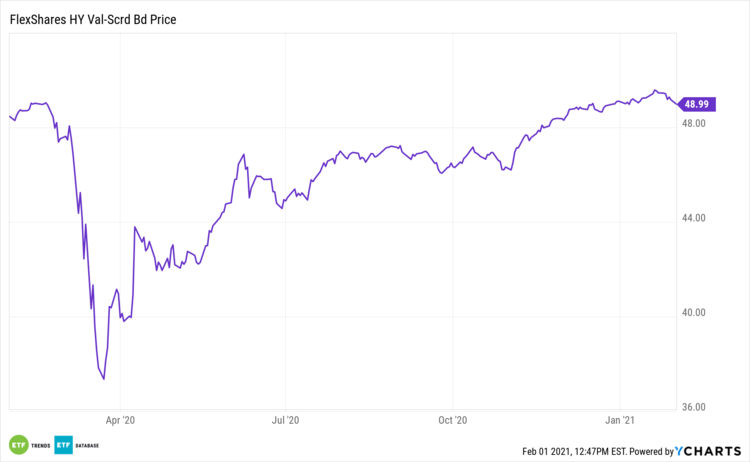
HYGV 1 Year Performance

For more on multi-asset strategies, visit our Multi-Asset Channel.

Loading Articles...

Advertisement

Is Your Portfolio Positioned With Enough Global Exposure?

ETF Education Channel

How to Allocate Commodities in Portfolios

Tom LydonApr 26, 2022
2022-04-26

A long-running debate in asset allocation circles is how much of a portfolio an investor should...

Core Strategies Channel

Why ETFs Experience Limit Up/Down Protections

Karrie GordonMay 13, 2022
2022-05-13

In a digital age where information moves in milliseconds and millions of participants can transact...

}
X
