


Corporate bonds are one of the largest segments of the already vast fixed income landscape. That expansive nature tends to highlight the advantages of index-based approaches such as the FlexShares Credit‐Scored US Corporate Bond Index Fund (SKOR ).
SKOR tracks the Northern Trust Credit-Scored US Corporate Bond Index, which focuses on issues from companies with quality characteristics such as strength in management efficiency, profitability, and solvency, according to FlexShares.
“Exchange-traded funds tracking indexes that are representative of the broad investment-grade corporate bond market are a solid option for exposure to this asset class,” writes Morningstar analyst Neal Kosciulek Portfolios that mimic the contours of this opportunity set and boast low fees have been difficult for active managers to beat. Over the 10 years through June 2020, just 40% of actively managed funds in the corporate bond Morningstar Category managed to survive and outperform the average of their passive peers.”
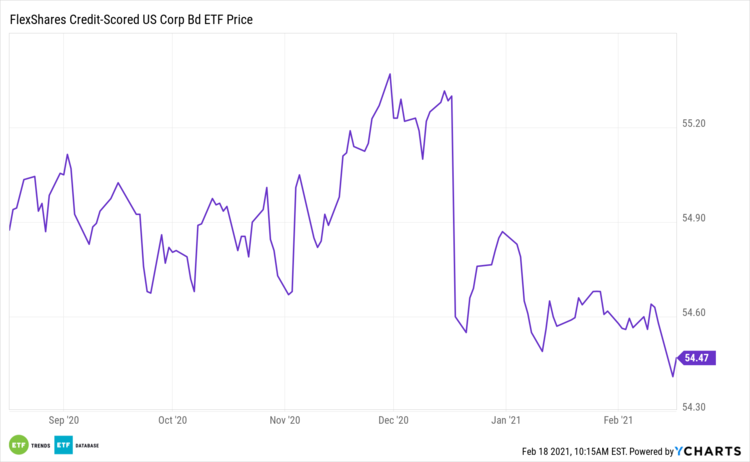
Why SKOR? Analyzing a Positive Methodology
SKOR’s scoring methodology indicates the fund is appropriate for a broad swath of investors, including those looking to reduce risk.
“The FlexShares Credit Scoring Model addresses the corporate bond liquidity challenge by optimizing a carefully selected subset of all credit issuers of which illiquid, orphaned and small lot names have been removed,” adds FlexShares. “The model also takes into account multiple factors to aid in developing improved corporate bond indexes, including the characteristics of issuers’ total debt structure, minimum exposure percentages, and odd-lot trade restrictions.”
There are other reasons why index funds make sense for investors in the corporate bond universe.
“Leveraging the wisdom of the crowd through indexing is a sensible approach to gain exposure to large and liquid markets that enjoy active price discovery. The process of buyers and sellers actively negotiating fair prices for assets allows markets to incorporate new information in real time,” according to Morningstar.
Bond funds hold a collection of debt with varying maturities, buying and selling debt securities to maintain their short-, intermediate-, or long-term strategies. When it comes to bond ETFs, investors should look at the duration, or a bond fund’s measure of sensitivity, to gauge their investment exposure to changes in interest rates. A higher duration means higher sensitivity to shifts in rates.
SKOR has some other benefits, including liquidity.
“An illiquid market can be fertile ground for mispricing. A market populated by mispriced securities can be target-rich for active managers. Why, then, have actively managed strategies struggled in the investment-grade corporate bond market?,” concludes Morningstar. “While there are many factors at play, one of them pertains to the technological advances that have made the bond market more fluid.”
For more on multi-asset strategies, visit our Multi-Asset Channel.

