

ETFdb Logo
  • ETF Database
  • Content Hubs
    • Themes
      • Active ETF
      • Alternatives
      • Artificial Intelligence
      • China Insights
      • Core Strategies
      • Crypto
      • Disruptive Technology
      • Energy Infrastructure
      • ETF Building Blocks
      • ETF Investing
      • ETF Strategist
      • Financial Literacy
      • Fixed Income
      • Free Cash Flow
      • Future ETFs
      • Innovative ETFs
      • Institutional Income Strategies
      • Leveraged & Inverse
      • Market Insights
      • Market Outlooks
      • Modern Alpha
      • Nuclear Energy
      • Portfolio Strategies
      • Sector Investing
      • Tax Efficient Income
      • Thematic Investing
    • Asset Class
      • Equity
        • U.S. Equity
        • Int'l Developed
        • Emerging Market Equities
      • Alternatives
        • Gold/Silver/Critical Materials
        • Cryptocurrency
        • Currency
        • Volatility
      • Fixed Income
        • Investment Grade Corporates
        • US Treasuries & TIPS
        • High Yield Corporates
        • Int'l Fixed Income
    • ETF Ecosystem
    • ETFs in Canada
    • Market Outlook
    • Crypto ETF Hub
  • Tools
    • ETF Screener
    • ETF Country Exposure Tool
    • ETF Database Categories
    • Indexes
    • Scenario Analysis
    • Watchlists
    • Head-To-Head ETF Comparison Tool
    • Mutual Fund To ETF Converter
    • ETF Stock Exposure Tool
    • ETF Issuer Fund Flows
  • Research
    • ETF Education
    • Equity Investing
    • Dividend ETFs
    • Leveraged ETFs
    • Inverse ETFs
    • Index Education
    • Index Insights
    • Top ETF Sectors
    • Top ETF Issuers
    • Top ETF Industries
  • Webcasts
  • Sectors
    • Sector Investing Content Hub
    • XLK
    • XLI
    • XLU
    • XLY
    • XLP
    • XLRE
    • Sector Power Rankings
    • XLE
    • XLC
    • XLF
    • XLV
    • XLB
  • Multimedia
    • ETF 360 Video Series
    • ETF of the Week Podcast
    • Gaining Perspective Podcast
    • ETF Prime Podcast
    • Video
  • Company
    • About VettaFi
    • Get VettaFi’ed
  • PRO
    • Pro Content
    • Pro Tools
    • Advanced
    • FAQ
    • Free sign up
    • Login
  1. Multi-Asset Content Hub
  2. Yield May Tempt, But Dividend Growth Always Matter
Multi-Asset Content Hub
Share

Yield May Tempt, But Dividend Growth Always Matter

Tom LydonMar 18, 2021
2021-03-18

High dividend yields are often eye-catching and that’s particularly true when interest rates are low, as is the case today. However, dividend growth should always be a priority for income investors, and they can latch onto that theme with the FlexShares Quality Dividend Index Fund (QDF A-).

QDF’s underlying benchmark targets management efficiency or quantitative evaluation of a firm’s deployment of capital and its financing decisions. By using a management efficiency screen, the index can screen out firms that aggressively pursue capital expenditures and additional financing, which typically lose flexibility in both advantageous and challenging partitions of the market cycle.

“Dividends are typically an indication that a business is established and financially healthy enough to return cash to shareholders,” writes Morningstar analyst Karen Wallace. “Dividends also force management to be focused on the long term and disciplined with their capital allocation decisions: After a company declares a dividend, it usually tries very hard to avoid cutting the payout, even during lean times. A dividend cut is a signal that a company’s earnings are weakening, which will lead many investors to dump the shares.”
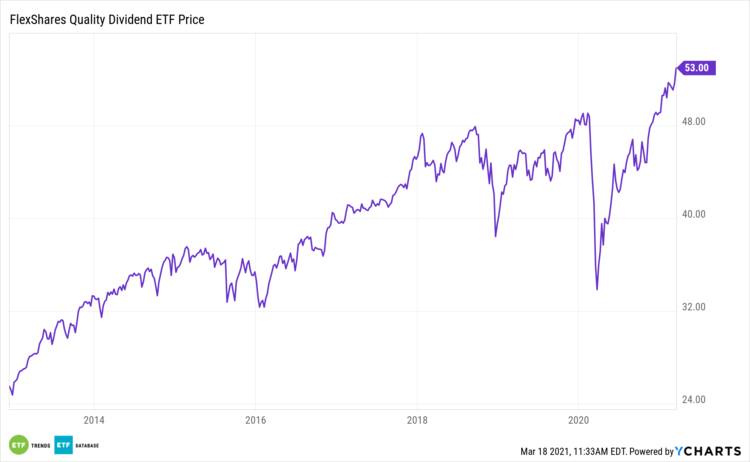
QDF All Time Performance

QDF for Long-Term Dividend Investors

QDF emphasizes the quality factor, of which a company’s ability to generate free cash and dividend growth and stability are integral tenants. Another element that has been critical to QDF’s success is the emphasis on management efficiency and a company’s ability to generate cash.

Company stocks that issue high dividend yields can be masking their distressed books or may not be sustainable. Consequently,  quality dividend ETFs try to limit the impact of these value traps by requiring a history of sustainable dividend growth.

“That’s not to say that investing in companies that pay higher dividends is a bad idea. (For purposes of this article, let’s define ‘dividend yielders’ as stocks with yields higher than 2%.),” notes Wallace. “But when investing in dividend yielders, your investment criteria should consider more than just the yield. In order to determine if a company can continue to pay out a high dividend yield, make sure you focus on stocks of companies that are financially healthy enough to sustain and even grow their dividend.”

QDF screens for management efficiency, profitability and cash flow. Each company has to show management efficiency, or firms that efficiently deploy capital and make smart financing decisions. Companies with wider profit margins are better positioned to grow and maintain dividends than those with slimmer margins. Additionally, firms that can meet debt obligations and day-to-day liquidity needs are better capable of maintaining dividends.


Content continues below advertisement

For more on multi-asset strategies, visit our Multi-Asset Channel.

Loading Articles...

Advertisement

Is Your Portfolio Positioned With Enough Global Exposure?

ETF Education Channel

How to Allocate Commodities in Portfolios

Tom LydonApr 26, 2022
2022-04-26

A long-running debate in asset allocation circles is how much of a portfolio an investor should...

Core Strategies Channel

Why ETFs Experience Limit Up/Down Protections

Karrie GordonMay 13, 2022
2022-05-13

In a digital age where information moves in milliseconds and millions of participants can transact...

}
X
