

ETFdb Logo
  • ETF Database
  • Content Hubs
    • Themes
      • Active ETF
      • Alternatives
      • Artificial Intelligence
      • China Insights
      • Core Strategies
      • Crypto
      • Disruptive Technology
      • Energy Infrastructure
      • ETF Building Blocks
      • ETF Investing
      • ETF Strategist
      • Financial Literacy
      • Fixed Income
      • Free Cash Flow
      • Future ETFs
      • Innovative ETFs
      • Institutional Income Strategies
      • Leveraged & Inverse
      • Market Insights
      • Market Outlooks
      • Modern Alpha
      • Nuclear Energy
      • Portfolio Strategies
      • Sector Investing
      • Tax Efficient Income
      • Thematic Investing
    • Asset Class
      • Equity
        • U.S. Equity
        • Int'l Developed
        • Emerging Market Equities
      • Alternatives
        • Gold/Silver/Critical Materials
        • Cryptocurrency
        • Currency
        • Volatility
      • Fixed Income
        • Investment Grade Corporates
        • US Treasuries & TIPS
        • High Yield Corporates
        • Int'l Fixed Income
    • ETF Ecosystem
    • ETFs in Canada
    • Market Outlook
    • Crypto ETF Hub
  • Tools
    • ETF Screener
    • ETF Country Exposure Tool
    • ETF Database Categories
    • Indexes
    • Scenario Analysis
    • Watchlists
    • Head-To-Head ETF Comparison Tool
    • Mutual Fund To ETF Converter
    • ETF Stock Exposure Tool
    • ETF Issuer Fund Flows
  • Research
    • ETF Education
    • Equity Investing
    • Dividend ETFs
    • Leveraged ETFs
    • Inverse ETFs
    • Index Education
    • Index Insights
    • Top ETF Sectors
    • Top ETF Issuers
    • Top ETF Industries
  • Webcasts
  • Sectors
    • Sector Investing Content Hub
    • XLK
    • XLI
    • XLU
    • XLY
    • XLP
    • XLRE
    • Sector Power Rankings
    • XLE
    • XLC
    • XLF
    • XLV
    • XLB
  • Multimedia
    • ETF 360 Video Series
    • ETF of the Week Podcast
    • Gaining Perspective Podcast
    • ETF Prime Podcast
    • Video
  • Company
    • About VettaFi
    • Get VettaFi’ed
  • PRO
    • Pro Content
    • Pro Tools
    • Advanced
    • FAQ
    • Free sign up
    • Login
  1. Multi-Asset Content Hub
  2. High-Yield Considerations for Near-Term
Multi-Asset Content Hub
Share

High-Yield Considerations for Near-Term

Tom LydonOct 14, 2020
2020-10-14

There could be post-election implications for high-yield corporate debt, potentially putting exchange traded funds, such as the FlexShares High Yield Value-Scored Bond Index Fund (HYGV A-), in the spotlight. Fortunately, HYGV is designed to weather storms.

HYGV’s index reflects the performance of a broad universe of U.S.-dollar denominated high yield corporate bonds that seeks a higher total return than the overall high yield corporate bond market, as represented by the Northern Trust High Yield US Corporate Bond IndexSM. The fund generally will invest under normal circumstances at least 80% of its total assets (exclusive of collateral held from securities lending) in the securities of its index.

“The eight elections for which ICE Indices LLC daily price returns are available are equally divided between Democratic candidate victories and Republican candidate victories,” writes Lehmann Livian Fridson Advisors LLC Chief Investment Officer Martin Fridson.

HYGV focuses on value by pursuing the higher risk/return potential found by concentrating on a targeted credit beta; utilizes Northern Trust Credit Scoring methodology to eliminate the bottom 10% of issuers; performs liquidity assessment based on issuer’s debt outstanding, age, and remaining time to maturity with the purpose of eliminating the bottom 5% illiquid securities; and intends to match the duration of a market cap-weighted index (ICE BofAML US High Yield Index), while maintaining sector neutrality.

Closing Out 2020: Near-Term Outlook

“Based on the admittedly small number of available observations, the probability of a pop is as great as the probability of a drop between Nov. 3 and Nov. 10, whether Donald Trump or Joe Biden wins. That is to say, returns in the immediate aftermath of next month’s election will most likely be determined by factors other than the election results, with a possible exception in the event of a contested outcome,” notes Fridson.

HYGV is significant at a time when many high-yield investors are still chastened by rampant credit downgrades. The weakness comes right after a record borrowing binge in recent years as many companies looked at the relatively low-rate environment as a cheap opportunity to borrow, with more investors willing to chase after speculative-grade debt for their more attractive yields.

Content continues below advertisement

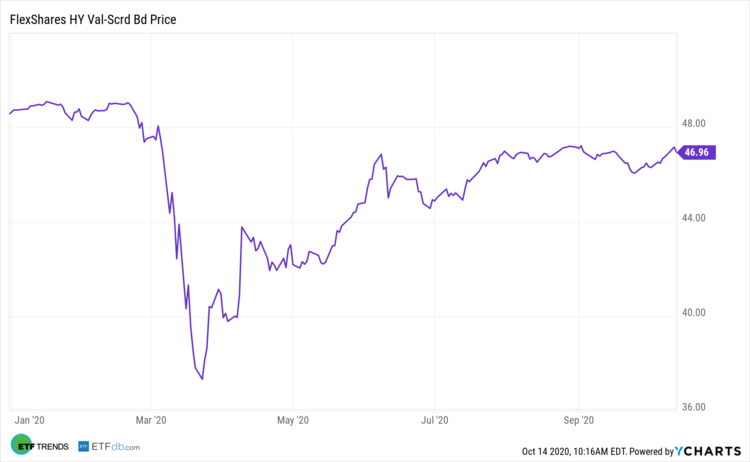
HYGV YTD Performance

Ultimately, HYGV could prove durable regardless of what happens on Election Day.

“Party-based model is inadequate for projecting high-yield return over the course of a presidential administration,” according to Fridson. “This is despite the fact that the mean annualized return during the Republican administrations was just 5.89%, versus 10.38% during the Democratic administrations. That difference, by the way, does not come close to being statistically significant, owing to the very small sample size.”


Loading Articles...

Advertisement

Is Your Portfolio Positioned With Enough Global Exposure?

ETF Education Channel

How to Allocate Commodities in Portfolios

Tom LydonApr 26, 2022
2022-04-26

A long-running debate in asset allocation circles is how much of a portfolio an investor should...

Core Strategies Channel

Why ETFs Experience Limit Up/Down Protections

Karrie GordonMay 13, 2022
2022-05-13

In a digital age where information moves in milliseconds and millions of participants can transact...

}
X