
ETFdb Logo
  • ETF Database
  • Content Hubs
    • Themes
      • Active ETF
      • Alternatives
      • Artificial Intelligence
      • China Insights
      • Core Strategies
      • Crypto
      • Disruptive Technology
      • Energy Infrastructure
      • ETF Building Blocks
      • ETF Investing
      • ETF Strategist
      • Financial Literacy
      • Fixed Income
      • Free Cash Flow
      • Future ETFs
      • Innovative ETFs
      • Institutional Income Strategies
      • Leveraged & Inverse
      • Market Insights
      • Market Outlooks
      • Modern Alpha
      • Nuclear Energy
      • Portfolio Strategies
      • Sector Investing
      • Tax Efficient Income
      • Thematic Investing
    • Asset Class
      • Equity
        • U.S. Equity
        • Int'l Developed
        • Emerging Market Equities
      • Alternatives
        • Gold/Silver/Critical Materials
        • Cryptocurrency
        • Currency
        • Volatility
      • Fixed Income
        • Investment Grade Corporates
        • US Treasuries & TIPS
        • High Yield Corporates
        • Int'l Fixed Income
    • ETF Ecosystem
    • ETFs in Canada
    • Market Outlook
    • Crypto ETF Hub
  • Tools
    • ETF Screener
    • ETF Country Exposure Tool
    • ETF Database Categories
    • Indexes
    • Scenario Analysis
    • Watchlists
    • Head-To-Head ETF Comparison Tool
    • Mutual Fund To ETF Converter
    • ETF Stock Exposure Tool
    • ETF Issuer Fund Flows
  • Research
    • ETF Education
    • Equity Investing
    • Dividend ETFs
    • Leveraged ETFs
    • Inverse ETFs
    • Index Education
    • Index Insights
    • Top ETF Sectors
    • Top ETF Issuers
    • Top ETF Industries
  • Webcasts
  • Sectors
    • Sector Investing Content Hub
    • XLK
    • XLI
    • XLU
    • XLY
    • XLP
    • XLRE
    • Sector Power Rankings
    • XLE
    • XLC
    • XLF
    • XLV
    • XLB
  • Multimedia
    • ETF 360 Video Series
    • ETF of the Week Podcast
    • Gaining Perspective Podcast
    • ETF Prime Podcast
    • Video
  • Company
    • About VettaFi
  • PRO
    • Pro Content
    • Pro Tools
    • Advanced
    • FAQ
    • Free sign up
    • Login
  1. Multi-Asset Content Hub
  2. Junk Bonds Looking Expensive? Check Out ‘HYGV’
Multi-Asset Content Hub
Share

Junk Bonds Looking Expensive? Check Out 'HYGV'

Tom LydonApr 08, 2021
2021-04-08

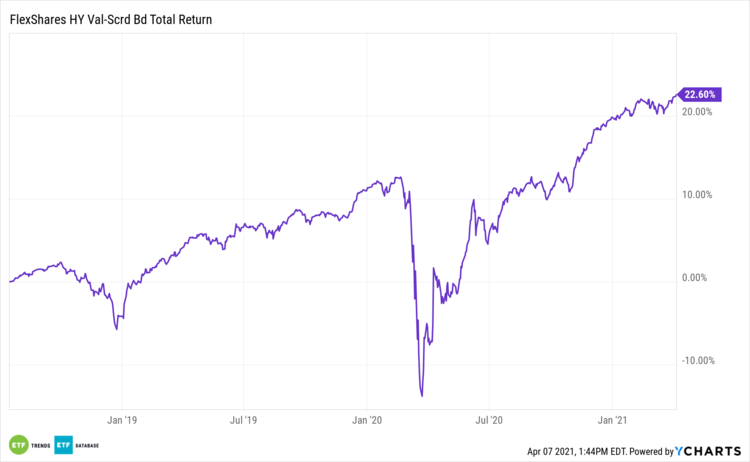
High-yield corporate bonds aren’t necessarily inexpensive these days, but in a low Treasury yield environment, junk bonds are useful for income investors. One noteworthy quality play the FlexShares High Yield Value-Scored Bond Index Fund (HYGV A-).

HYGV’s index reflects the performance of a broad universe of U.S.-dollar denominated high-yield corporate bonds that seeks a higher total return than the overall high yield corporate bond market, as represented by the Northern Trust High Yield US Corporate Bond IndexSM. The fund generally will invest under normal circumstances at least 80% of its total assets (exclusive of collateral held from securities lending) in the securities of its index.

HYGV’s 0.37% expense ratio is looking attractive in an increasingly expensive high-yield market.

Goldman Sachs “highlighted signs the high-yield market is looking pricey. First, the market’s rising tide is lifting all junk-rated boats: The gap between valuations on different bonds has narrowed, meaning there are fewer deals for professional bond pickers. For example, only about 10% of bonds in the high-yield market are trading with yields of more than 5 percentage points above Treasuries, compared with 25% in November,” reports Alexandra Scaggs for Barron’s.
HYGV 3 Year Total Return

With HYGV, Quality Is Always On the Menu

With its unique scoring methodology, HYGV offers investors a potentially better mousetrap for junk bonds, especially for those seeking long-term, yield-bearing allocations.

HYGV focuses on value by pursuing the higher risk/return potential found by concentrating on a targeted credit beta; utilizing Northern Trust Credit Scoring methodology to eliminate the bottom 10% of issuers; performing liquidity assessments based on issuer’s debt outstanding, age, and remaining time to maturity with the purpose of eliminating the bottom 5% illiquid securities; and intending to match the duration of a market cap-weighted index (ICE BofAML US High Yield Index), while maintaining sector neutrality.

“The relative scarcity of places to put cash creates a headwind for Goldman Sachs’ bullish view on the high-yield market, wrote strategist Michael Puempel,” adds Barron’s. “But while the scarcity of good bargains may be a sign that high-yield valuations are stretched, it doesn’t mean that junk bonds can’t continue to outperform higher-rated markets, such as Treasuries and investment-grade bonds. Treasuries have marked steep losses this year as their yields have climbed, and few on Wall Street expect yields to stop climbing until the 10-year yield reaches 2%”


Content continues below advertisement

For more on multi-asset strategies, visit our Multi-Asset Channel.

Loading Articles...

Advertisement

Is Your Portfolio Positioned With Enough Global Exposure?

ETF Education Channel

How to Allocate Commodities in Portfolios

Tom LydonApr 26, 2022
2022-04-26

A long-running debate in asset allocation circles is how much of a portfolio an investor should...

Core Strategies Channel

Why ETFs Experience Limit Up/Down Protections

Karrie GordonMay 13, 2022
2022-05-13

In a digital age where information moves in milliseconds and millions of participants can transact...

}
X
