

ETFdb Logo
  • ETF Database
  • Content Hubs
    • Themes
      • Active ETF
      • Alternatives
      • Artificial Intelligence
      • China Insights
      • Core Strategies
      • Crypto
      • Disruptive Technology
      • Energy Infrastructure
      • ETF Building Blocks
      • ETF Investing
      • ETF Strategist
      • Financial Literacy
      • Fixed Income
      • Free Cash Flow
      • Future ETFs
      • Innovative ETFs
      • Institutional Income Strategies
      • Leveraged & Inverse
      • Market Insights
      • Market Outlooks
      • Modern Alpha
      • Nuclear Energy
      • Portfolio Strategies
      • Sector Investing
      • Tax Efficient Income
      • Thematic Investing
    • Asset Class
      • Equity
        • U.S. Equity
        • Int'l Developed
        • Emerging Market Equities
      • Alternatives
        • Gold/Silver/Critical Materials
        • Cryptocurrency
        • Currency
        • Volatility
      • Fixed Income
        • Investment Grade Corporates
        • US Treasuries & TIPS
        • High Yield Corporates
        • Int'l Fixed Income
    • ETF Ecosystem
    • ETFs in Canada
    • Market Outlook
    • Crypto ETF Hub
  • Tools
    • ETF Screener
    • ETF Country Exposure Tool
    • ETF Database Categories
    • Indexes
    • Scenario Analysis
    • Watchlists
    • Head-To-Head ETF Comparison Tool
    • Mutual Fund To ETF Converter
    • ETF Stock Exposure Tool
    • ETF Issuer Fund Flows
  • Research
    • ETF Education
    • Equity Investing
    • Dividend ETFs
    • Leveraged ETFs
    • Inverse ETFs
    • Index Education
    • Index Insights
    • Top ETF Sectors
    • Top ETF Issuers
    • Top ETF Industries
  • Webcasts
  • Sectors
    • Sector Investing Content Hub
    • XLK
    • XLI
    • XLU
    • XLY
    • XLP
    • XLRE
    • Sector Power Rankings
    • XLE
    • XLC
    • XLF
    • XLV
    • XLB
  • Multimedia
    • ETF 360 Video Series
    • ETF of the Week Podcast
    • Gaining Perspective Podcast
    • ETF Prime Podcast
    • Video
  • Company
    • About VettaFi
  • PRO
    • Pro Content
    • Pro Tools
    • Advanced
    • FAQ
    • Free sign up
    • Login
  1. Nasdaq Portfolio Solutions Content Hub
  2. How Loan Loss Reserves Can Light Up Banking ETFs
Nasdaq Portfolio Solutions Content Hub
Share

How Loan Loss Reserves Can Light Up Banking ETFs

Tom LydonMar 17, 2021
2021-03-17

Already riding the wave of rising Treasury yields, ETFs holding bank stocks, including the Invesco KBW Bank ETF (KBWB B), have other upside catalysts.

KBWB tracks the widely followed KBW Nasdaq Bank Index.

“The Index is a modified-market capitalization-weighted index of companies primarily engaged in US banking activities. The Index is compiled, maintained and calculated by Keefe, Bruyette & Woods, Inc. and Nasdaq, Inc. and is composed of large national US money centers, regional banks and thrift institutions that are publicly traded in the US,” according to Invesco.

An important factor in the 2021 case for funds such as KBWB is the release of cash set aside last year to cover bad loans.

“In the coming months, banks are expected to free up tens of billions of dollars in reserves they set aside to cover soured loans—losses that still haven’t materialized a year into a pandemic that shut down swaths of the U.S. economy,” reports David Benoit for the Wall Street Journal. “In 2020, banks rushed to build up their stockpiles to cover losses on the assumption that consumers and businesses would default on their loans after government stimulus ran out. U.S. banks had $236.6 billion in total reserves in December, according to the Federal Deposit Insurance Corp., nearly double their level from before the coronavirus upended the economy and sent unemployment up sharply.”
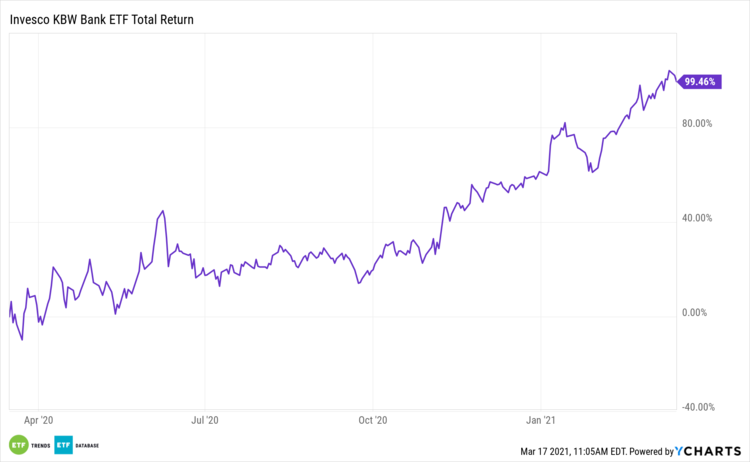
KBWB 1 Year Performance

A Big Influx of Cash Is Coming

Some analysts believe bank stock performance is about to take a turn for the better after falling behind on low interest rates and weak loan growth, along with credit concerns. Plus, there are some near-term catalysts for KBWB and friends, including solid credit quality.

The problem with banks setting aside large chunks of cash to cover bad loans is that the strategy weighs on earnings. Those reserves come directly out of profits, but if the economy improves, KBWB holdings may not need to cover as many bad loans as expected, meaning those reserves will eventually be turned into profits.

“Banks set their loan-loss expectations using broad economic gauges, particularly gross domestic product and unemployment rates. From that starting point, they factor in hundreds of other variables, with some leeway built in for how optimistic or pessimistic executives feel,” adds the Journal. “Since the start of the pandemic, bank executives have tended toward pessimism when setting aside loan-loss reserves. As a result, their internal models offer a more muted outlook than broader economic forecasts.”

For more news, information, and strategy, visit the Nasdaq Portfolio Solutions Channel.


Content continues below advertisement

Loading Articles...

Advertisement

Is Your Portfolio Positioned With Enough Global Exposure?

ETF Education Channel

How to Allocate Commodities in Portfolios

Tom LydonApr 26, 2022
2022-04-26

A long-running debate in asset allocation circles is how much of a portfolio an investor should...

Core Strategies Channel

Why ETFs Experience Limit Up/Down Protections

Karrie GordonMay 13, 2022
2022-05-13

In a digital age where information moves in milliseconds and millions of participants can transact...

}
X
