

The Nuclear Regulatory Commission’s (NRC) arduous licensing process remains the most frequently cited barrier to rapidly iterating and deploying nuclear energy in the United States. Traditional frameworks — built around large, light-water reactor designs — have required newer technologies to undergo lengthy reviews and seek extensive exemptions.
Clearing the Path to Commercialization
Now, recent regulatory actions under the Department of Energy (DOE) and the NRC are proving revolutionary in their ability to speed up the licensing process while maintaining rigorous safety standards. These changes directly address the backlog of construction applications expected over the next few years. They will also help clear the path to commercialization.
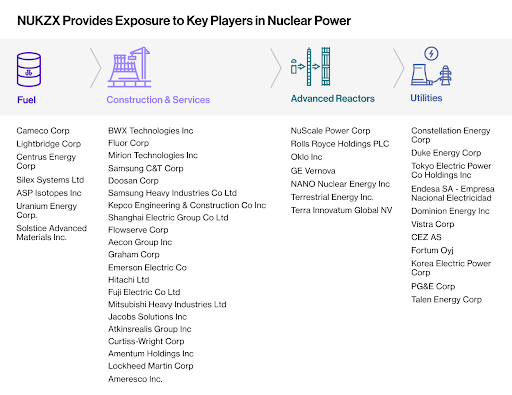
Improved licensing pathways represent a significant tailwind to the public and private companies developing new reactors. This also includes the firms that will play a supporting role by providing key components and services. The VettaFi Nuclear Renaissance Index (NUKZX) includes the nuclear equipment manufacturers, service providers, and construction firms that are expected to see higher demand for their offerings as new reactors are built. An improved regulatory landscape was a much-needed catalyst for new nuclear development.
DOE Pathways Deliver Early Wins
On April 6, 2026, Antares Nuclear (private) became the first company to receive DOE approval of its Documented Safety Analysis (DSA) for its Mark-0 microreactor, under the DOE’s Reactor Pilot Program (RPP). The approval validates the reactor’s final design and safety case. Antares is now preparing to turn its reactor on for the first time and attain criticality. Criticality refers to a sustained chain reaction of uranium atoms splitting inside the core.
DOE leadership has remarked that the approval of a DSA is equivalent to an NRC license. Considering Antares started its licensing process under the DOE only eight months ago, the fact that the company has already received approval to commence startup preparation is truly groundbreaking.
NRC Modernizes Rules to Clear the Path
The NRC finalized a new path for reactor licensing last month. This new pathway, Part 53, marks the first new reactor licensing framework in decades:
- Originally reactor license applicants had only one option, called Part 50. This path involves a two-step process where the reactor developer first gets permission to construct the reactor. After the reactor is built, the company applies for a license to turn on and operate the plant.
- Part 52 was eventually approved. It allowed the construction and operation permit reviews to be combined into one step for a more streamlined process.
- Because Part 50 and 52 tailor specifically to the large reactors produced by companies like Westinghouse, the industry required an additional path. Companies with more exotic designs have had to make endless exception requests, and perform multiple studies and safety evaluations that aren’t applicable to their reactors.
The new, risk-informed, technology-inclusive regulation creates an alternative pathway tailored for advanced reactors. This also includes non-light-water designs and small modular reactors (SMRs). Under Part 53, applicants gain greater flexibility to demonstrate safety through performance-based analyses rather than the prescriptive rules designed for older technologies. The new framework reduces unnecessary duplication in reviews, allows licensing in stages, and establishes clearer timelines.
The NRC has also been hard at work this year issuing multiple new rules. This includes streamlined environmental reviews, standardization of environmental studies, additional regulatory pathways for microreactors, and more structured and streamlined public hearing processes. The environmental regulation changes alone are projected to save as much as 6,500 man-hours of preparation and review per reactor license.
Benefits for Key Reactor Developers & Manufacturers
These regulatory advancements promise meaningful speed and cost advantages to several leading companies within NUKZX:
- Cameco (CCJ), through its ownership stake in Westinghouse, is anticipated to progress through licensing much faster with the AP1000 reactor.
- GE Vernova (GEV) stands to benefit significantly with its BWRX-300 SMR design.
- Advanced reactor developers such as Oklo (OKLO) are also well positioned. The ability to reference prior DOE test data and the technology-inclusive rules under Part 53 should substantially ease their path to commercialization.
- Heavy equipment manufacturers including BWX Technologies (BWXT) and Curtiss-Wright (CW) are providing equipment and fuel to companies including Antares.
- These also represent opportunities offering investors a unique means of accessing the potential success of private companies in the nuclear sector.
Licensing timelines that once stretched for years can now benefit from risk-informed frameworks, prior-authorization credits, and targeted microreactor pathways. The changes support both large-scale advanced reactor projects, SMRs, and factory-built microreactors suited for data centers, remote power, and industrial applications.
NUKZX includes companies across the nuclear value chain, from fuel to utilities. NUKZX is the underlying index for the Range Nuclear Renaissance Index ETF (NUKZ).
Related Research:
Companies Set to Win as States Vie to Host Nuclear Campuses
New Regulatory Approvals Power NUKZ Performance
Not All Nuclear Exposure Is Created Equally
The Future of Uranium Enrichment is Being Developed Today
Looking for nuclear insights in your inbox? Subscribe here to keep a pulse on nuclear investing through our weekly research.
For more news, information, and analysis, visit the Nuclear Energy Content Hub.
vettafi.com is owned by VettaFi LLC (“VettaFi”). VettaFi is the index provider for NUKZ, for which it receives an index licensing fee. However, NUKZ is not issued, sponsored, endorsed, or sold by VettaFi. VettaFi has no obligation or liability in connection with the issuance, administration, marketing, or trading of NUKZ.

