

ETFdb Logo
  • ETF Database
  • Content Hubs
    • Themes
      • Active ETF
      • Alternatives
      • Artificial Intelligence
      • China Insights
      • Core Strategies
      • Crypto
      • Disruptive Technology
      • Energy Infrastructure
      • ETF Building Blocks
      • ETF Investing
      • ETF Strategist
      • Financial Literacy
      • Fixed Income
      • Free Cash Flow
      • Future ETFs
      • Innovative ETFs
      • Institutional Income Strategies
      • Leveraged & Inverse
      • Market Insights
      • Market Outlooks
      • Modern Alpha
      • Nuclear Energy
      • Portfolio Strategies
      • Sector Investing
      • Tax Efficient Income
      • Thematic Investing
    • Asset Class
      • Equity
        • U.S. Equity
        • Int'l Developed
        • Emerging Market Equities
      • Alternatives
        • Gold/Silver/Critical Materials
        • Cryptocurrency
        • Currency
        • Volatility
      • Fixed Income
        • Investment Grade Corporates
        • US Treasuries & TIPS
        • High Yield Corporates
        • Int'l Fixed Income
    • ETF Ecosystem
    • ETFs in Canada
    • Market Outlook
    • Crypto ETF Hub
  • Tools
    • ETF Screener
    • ETF Country Exposure Tool
    • ETF Database Categories
    • Indexes
    • Scenario Analysis
    • Watchlists
    • Head-To-Head ETF Comparison Tool
    • Mutual Fund To ETF Converter
    • ETF Stock Exposure Tool
    • ETF Issuer Fund Flows
  • Research
    • ETF Education
    • Equity Investing
    • Dividend ETFs
    • Leveraged ETFs
    • Inverse ETFs
    • Index Education
    • Index Insights
    • Top ETF Sectors
    • Top ETF Issuers
    • Top ETF Industries
  • Webcasts
  • Sectors
    • Sector Investing Content Hub
    • XLK
    • XLI
    • XLU
    • XLY
    • XLP
    • XLRE
    • Sector Power Rankings
    • XLE
    • XLC
    • XLF
    • XLV
    • XLB
  • Multimedia
    • ETF 360 Video Series
    • ETF of the Week Podcast
    • Gaining Perspective Podcast
    • ETF Prime Podcast
    • Video
  • Company
    • About VettaFi
  • PRO
    • Pro Content
    • Pro Tools
    • Advanced
    • FAQ
    • Free sign up
    • Login
  1. Portfolio Strategies Content Hub
  2. Discover Equal Weight Benefits With RSP
Portfolio Strategies Content Hub
Share

Discover Equal Weight Benefits With RSP

Tom LydonOct 06, 2021
2021-10-06

In a fund universe dominated by products that are weighted by market capitalization, investors shouldn’t lose sight of alternative methodologies. Equal weighting is one of the premier non cap-weighted concepts.

The Invesco S&P 500® Equal Weight ETF (RSP B+) is a pioneer in this space. The $28.69 billion RSP follows the S&P 500 Equal Weight Index (EWI). As its name implies, the benchmark equally weights the 506 members of the S&P 500.

RSP is 18.5 years old, and the exchange traded fund offers out-performance potential over cap-weighted rivals. While it doesn’t repeat every year, RSP has frequently topped cap-weighted S&P 500 ETFs and index funds.

Evaluating RSP Methodology
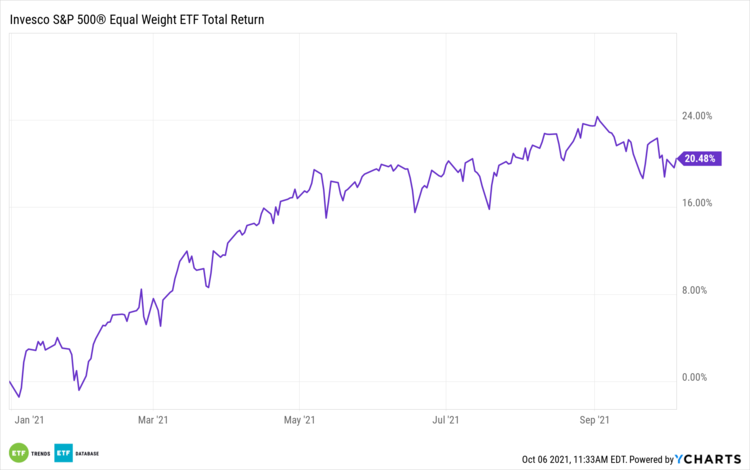
Invesco SP 500 Equal Weight ETF

Content continues below advertisement

Critics and even some proponents assert that out-performance delivered by RSP and other equal weight funds largely boils down to overweighting the size and value factors. Said another way, the traditional S&P 500 is heavy on large- and mega-cap stocks, but by eschewing cap weighting, the aforementioned EWI benefits from the size factor. However, EWI isn’t a dedicated factor index.

“The S&P 500 EWI is unique in that its methodology is defined not by factors like other alternatively weighted indices,” notes S&P Dow Jones Indices. “In an equal weighted index, the weight of each stock is one divided by the total number of components in the index—making the index factor indifferent. It randomizes factor mispricing, making the index an attractive option for proponents of the theory that the market is inefficient and at times misprices factors.”

While RSP allocates about 57% of its weight to mid-cap stocks and 37% to value equities — more than double the weight to growth — there’s more to the story with equal weighting than resulting factor exposures.

“In addition to being factor neutral, equal weighting captures another important stock price behavior, the mean-reversion, in a simple way. As an equal weight portfolio is often rebalanced periodically, it is in effect buying low and selling high, which benefits automatically from the short-term mean-reversion,” adds S&P.

Rather than getting bogged down in wonky factor debates, investors may want to focus on one of the primary benefits of equal weighting: It actually delivers the diversification investors think they’re getting with cap-weighted broad market funds. Think of it this way — a small number of stocks (Apple (AAPL), Microsoft (MSFT), Amazon (AMZN), and friends) are taking on larger and larger percentages of the cap-weighted S&P 500.

Alone, Apple commands almost 6% of that index. Conversely, RSP’s largest holding — Devon Energy (DVN) — garners a weight of just 0.28% in that fund.

For more news, information, and strategy, visit our Portfolio Strategies Channel.

Loading Articles...

Advertisement

Is Your Portfolio Positioned With Enough Global Exposure?

ETF Education Channel

How to Allocate Commodities in Portfolios

Tom LydonApr 26, 2022
2022-04-26

A long-running debate in asset allocation circles is how much of a portfolio an investor should...

Core Strategies Channel

Why ETFs Experience Limit Up/Down Protections

Karrie GordonMay 13, 2022
2022-05-13

In a digital age where information moves in milliseconds and millions of participants can transact...

}
X
