

ETFdb Logo
  • ETF Database
  • Content Hubs
    • Themes
      • Active ETF
      • Alternatives
      • Artificial Intelligence
      • China Insights
      • Core Strategies
      • Crypto
      • Disruptive Technology
      • Energy Infrastructure
      • ETF Building Blocks
      • ETF Investing
      • ETF Strategist
      • Financial Literacy
      • Fixed Income
      • Free Cash Flow
      • Future ETFs
      • Innovative ETFs
      • Institutional Income Strategies
      • Leveraged & Inverse
      • Market Insights
      • Market Outlooks
      • Modern Alpha
      • Nuclear Energy
      • Portfolio Strategies
      • Sector Investing
      • Tax Efficient Income
      • Thematic Investing
    • Asset Class
      • Equity
        • U.S. Equity
        • Int'l Developed
        • Emerging Market Equities
      • Alternatives
        • Gold/Silver/Critical Materials
        • Cryptocurrency
        • Currency
        • Volatility
      • Fixed Income
        • Investment Grade Corporates
        • US Treasuries & TIPS
        • High Yield Corporates
        • Int'l Fixed Income
    • ETF Ecosystem
    • ETFs in Canada
    • Market Outlook
    • Crypto ETF Hub
  • Tools
    • ETF Screener
    • ETF Country Exposure Tool
    • ETF Database Categories
    • Indexes
    • Scenario Analysis
    • Watchlists
    • Head-To-Head ETF Comparison Tool
    • Mutual Fund To ETF Converter
    • ETF Stock Exposure Tool
    • ETF Issuer Fund Flows
  • Research
    • ETF Education
    • Equity Investing
    • Dividend ETFs
    • Leveraged ETFs
    • Inverse ETFs
    • Index Education
    • Index Insights
    • Top ETF Sectors
    • Top ETF Issuers
    • Top ETF Industries
  • Webcasts
  • Sectors
    • Sector Investing Content Hub
    • XLK
    • XLI
    • XLU
    • XLY
    • XLP
    • XLRE
    • Sector Power Rankings
    • XLE
    • XLC
    • XLF
    • XLV
    • XLB
  • Multimedia
    • ETF 360 Video Series
    • ETF of the Week Podcast
    • Gaining Perspective Podcast
    • ETF Prime Podcast
    • Video
  • Company
    • About VettaFi
    • Get VettaFi’ed
  • PRO
    • Pro Content
    • Pro Tools
    • Advanced
    • FAQ
    • Free sign up
    • Login
  1. Portfolio Strategies Content Hub
  2. Equal Weight is Always Stylish, Often Durable
Portfolio Strategies Content Hub
Share

Equal Weight is Always Stylish, Often Durable

Tom LydonOct 28, 2021
2021-10-28

Investors frequently try to time investment styles and factors, such as growth and value. However, those looking for an alternative to weighting by market capitalization can find a durable solution with equal-weight funds.
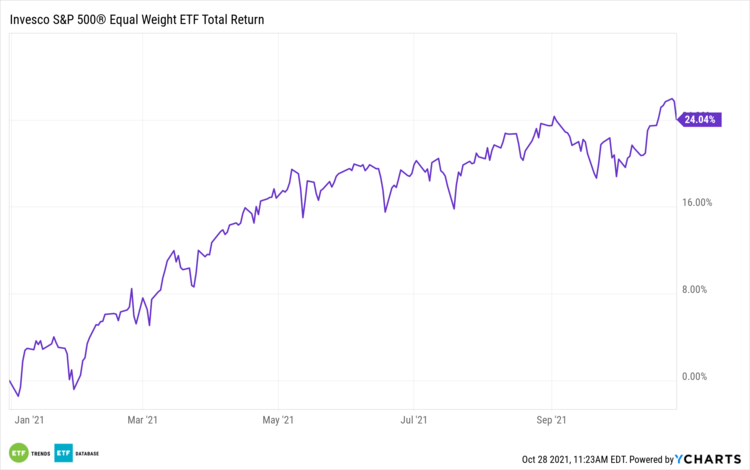
Invesco 500 Equal Weight

The Invesco S&P 500® Equal Weight ETF (RSP B+) is the king of that bunch, and while there are times when RSP beats cap-weighted rivals and years in which it lags those competitors, investors shouldn’t fiddle with timing when RSP will be in and out of fashion. Simply put, its track record is more than convincing enough against the cap-weighted S&P 500 to make it an attractive buy-and-hold investment.

Over the past year, RSP is beating the cap-weighted S&P 500 by 800 basis points, prompting equal-weight critics to rehash some old criticisms aimed at what supposedly explains equal-weight out-performance.

“Of course, the performance of cap-weighted indexes hew more closely to their large stock constituents while the returns of medium- and small-sized issues are more vividly depicted in equal-weighted funds, so it’s easy to say that RSP’s outperformance can be attributed simply to size alone, but is that really so?” reports WealthManagement.

Yes, an equal-weight broad market fund such as RSP will feature more exposure to smaller stocks. That’s simply the result of eschewing cap weighting. RSP’s 506 components have an average market value of $77.3 billion, according to Invesco data, meaning that this is far from a small-cap fund.

Even if the size factor explained all of RSP’s ability to beat its cap-weighted peers (which it doesn’t), that’s not necessarily a point to critique. Rather, it underscores the point that equal-weight works over long investing horizons because those extended time frames are conducive to smoothing out some of the volatility associated with investing in smaller stocks.

“The biggest difference between RSP and (cap-weighted S&P 500 ETFs) isn’t the names of the stocks they hold, but the proportion. Because a cap-weighted index allocates space on the basis of market capitalization,  overvalued companies are weighted more heavily while undervalued stocks have less heft. By contrast, an equal-weighted index reserves the same amount of real estate for each issue, regardless of market value,” according to WealthManagement.

Perhaps it can be inferred that some of RSP’s ability to beat cap-weighted competitors comes by way of a value tilt tied to equal-weighting. Indeed, that’s a point often mentioned in conversations about equal-weighting, but it’s somewhat flawed because prior to late last year, value spent the better part of a decade lagging growth while RSP performed well over that period. In fact, over the past three years, RSP is beating the S&P 500 Value Index by an astounding 1,840 basis points.

For more news, information, and strategy, visit our Portfolio Strategies Channel.

Loading Articles...

Advertisement

Is Your Portfolio Positioned With Enough Global Exposure?

ETF Education Channel

How to Allocate Commodities in Portfolios

Tom LydonApr 26, 2022
2022-04-26

A long-running debate in asset allocation circles is how much of a portfolio an investor should...

Core Strategies Channel

Why ETFs Experience Limit Up/Down Protections

Karrie GordonMay 13, 2022
2022-05-13

In a digital age where information moves in milliseconds and millions of participants can transact...

}
X
