


In an environment of ongoing market volatility, revisiting core portfolio allocations may prove beneficial. Fixed income investors looking to potentially enhance portfolio diversification or increase responsiveness to shifting market dynamics would do well to consider the Thornburg Multi Sector Bond ETF (TMB ).
The onset of blanket U.S. tariffs in the second quarter created an environment of elevated market volatility and uncertainty. The looming inflationary impact of tariffs, potential weakening of consumer demand, a slowing job market, and a ballooning U.S. government deficit only complicates second half forecasts. Advisors and investors may wish to reassess core portfolio allocations, given market regime changes underway.
In 2025’s challenging market environment, actively managed, dynamic, and diversifying strategies appear well-positioned. The Thornburg Multi Sector Bond ETF (TMB ) captures all three within a single fixed income ETF.
The actively managed TMB seeks long-term capital appreciation and income. The strategy offers opportunistic as well as defensive capabilities relative to the macro environment. TMB combines diversification and adaptability in one strategy for advisors and investors looking to augment or enhance income portfolios. Since its launch on February 4, 2025, the fund has offered notable performance compared to the benchmark Bloomberg U.S. Aggregate Bond Index, according to Y-Charts data.
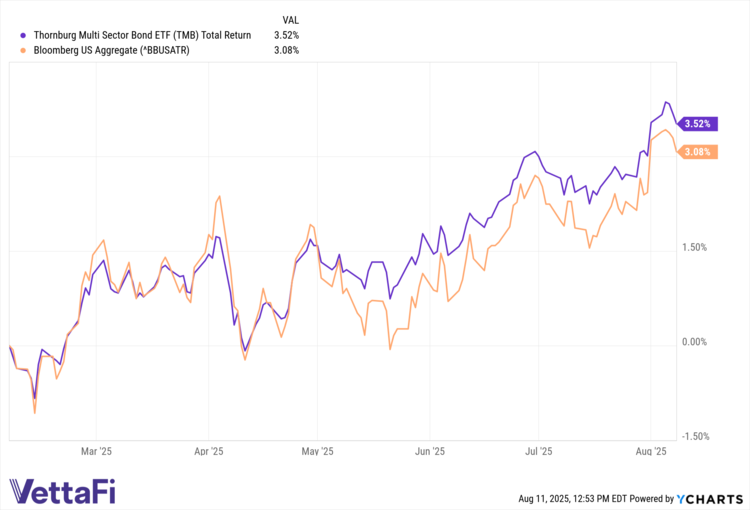
By investing across sectors and geographies, TMB seeks to provides a diversified fixed income portfolio. The strategy can include debt obligations of any quality, type, and maturity. When investing or selling, the fund managers seek exposure to those sectors or individual securities with favorable, relative outlooks. They take into account current and future economic expectations domestically as well as internationally. The managers also consider inflation, interest rates, supply and demand levels, and sector and individual security analysis.
The fund invests across a range of credit qualities and typically maintains roughly one-third (35%) of its portfolio in high yield “junk bonds”, or bonds rated below investment grade. As market outlooks evolve, the percentage of junk bonds can comprise less than 35% or grow to more than half of the fund’s portfolio.
TMB generally maintains a dollar-weighted, average effective duration of between one and five years. Though the fund can invest across a sizeable duration range, the managers consider interest rate expectations and the market environment when selecting securities. These expectations are included in the calculation for the fund’s effective duration.
TMB carries an expense ratio of 0.55%.
For more news, information, and analysis, visit our Portfolio Strategies Content Hub.
For current performance information, visit TMB.
Important Information
For investment professional use only.
Before investing, carefully consider the Fund’s investment goals, risks, charges, and expenses. For a prospectus or summary prospectus containing this and other information, contact your financial advisor or visit thornburg.com. Read them carefully before investing.
Exchange Traded Funds (ETF) are bought and sold through exchange trading at market prices (not NAV) and are not individually redeemed from a Fund. Shares may trade at a premium or discount to their NAV in the secondary market. Brokerage commissions will reduce returns.
Thornburg ETFs are actively managed and do not seek to replicate the performance of a specified index. To determine whether to buy or sell a security, the portfolio managers consider, among other things, various fund requirements and standards, along with economic conditions, alternative investments, interest rates and various credit metrics. If the portfolio manager considerations are inaccurate or misapplied, the fund’s performance may suffer.
Investments carry risks, including possible loss of principal.
Thornburg ETFs are distributed by ALPS Distributors, Inc.

