


Equity long/short strategies appeal to investors wanting to diversify their equity portfolios while seeking outperformance potential. However, the long-term trend of underperformance for single managers as well as a high bar of entry for hedge fund strategies proved a deterrent for many. Unlimited seeks to rectify these issues with the Unlimited HFEQ Equity Long/Short ETF (HFEQ ).
For investors, equity long/short strategies offer the potential to capitalize on stock gains as well as declines. These strategies often hold appeal in times of market uncertainty or distress for the performance they offer above long-only equity exposures.
“The primary driver of Equity Long/Short managers’ outperformance is their ability to play defense well,” Bob Elliott, co-founder and CEO of Unlimited, explained in a recent blog post. “The challenge for allocators investing in Equity Long/Short Hedge Funds is that managers typically run their strategies at bond-like risk to fulfill the mandates of institutional clients.”
Leveraging to Outperform the Equity Long/Short Category
Over long enough timelines, individual managers rarely outperform equity indexes on a risk-adjusted basis. Unlimited works to solve for this by replicating the equity long/short sector at large. This eliminates the risk of single managers while offering the cost savings of an ETF versus a hedge fund’s 2/20 fee model. These high fees often erode returns for hedge fund investors.
By combining these benefits with an approach that targets “twice the notional positions of the manager’s capital,” Unlimited offers a strategy that may generate alpha across market environments.
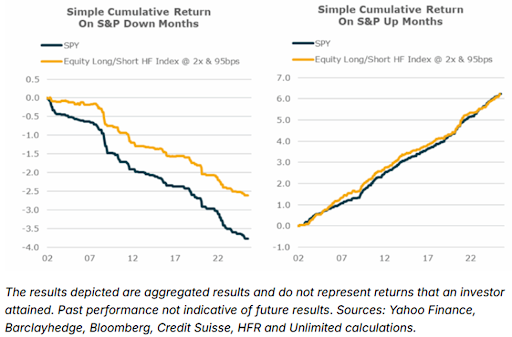
“Even during a prolonged period of upside returns like the last 15 years, holding a 2x Equity Long/Short Hedge Fund strategy at lower fees would have produced meaningful alpha relative to direct index investing,” said Elliott.
HFEQ seeks to generate a similar return profile as the equity long/short sector within the hedge fund industry. The strategy works to generate alpha compared to investing in the stock market broadly. It also aims for twice the volatility of the sector to generate potential outperformance.
By capturing the return potential of these hedge fund sectors through an ETF, investors can potentially retain more of their returns. High management fees (2 and 20 fee models) often eroded returns, while inaccessibility of many hedge fund strategies proved a barrier for most investors. The ETF wrapper helps to democratize these strategies, while replication works to ensure accurate capture of the return profile.
HFEQ carries an expense ratio of 1.00%.
For more news, information, and analysis, visit our Portfolio Strategies Content Hub.

